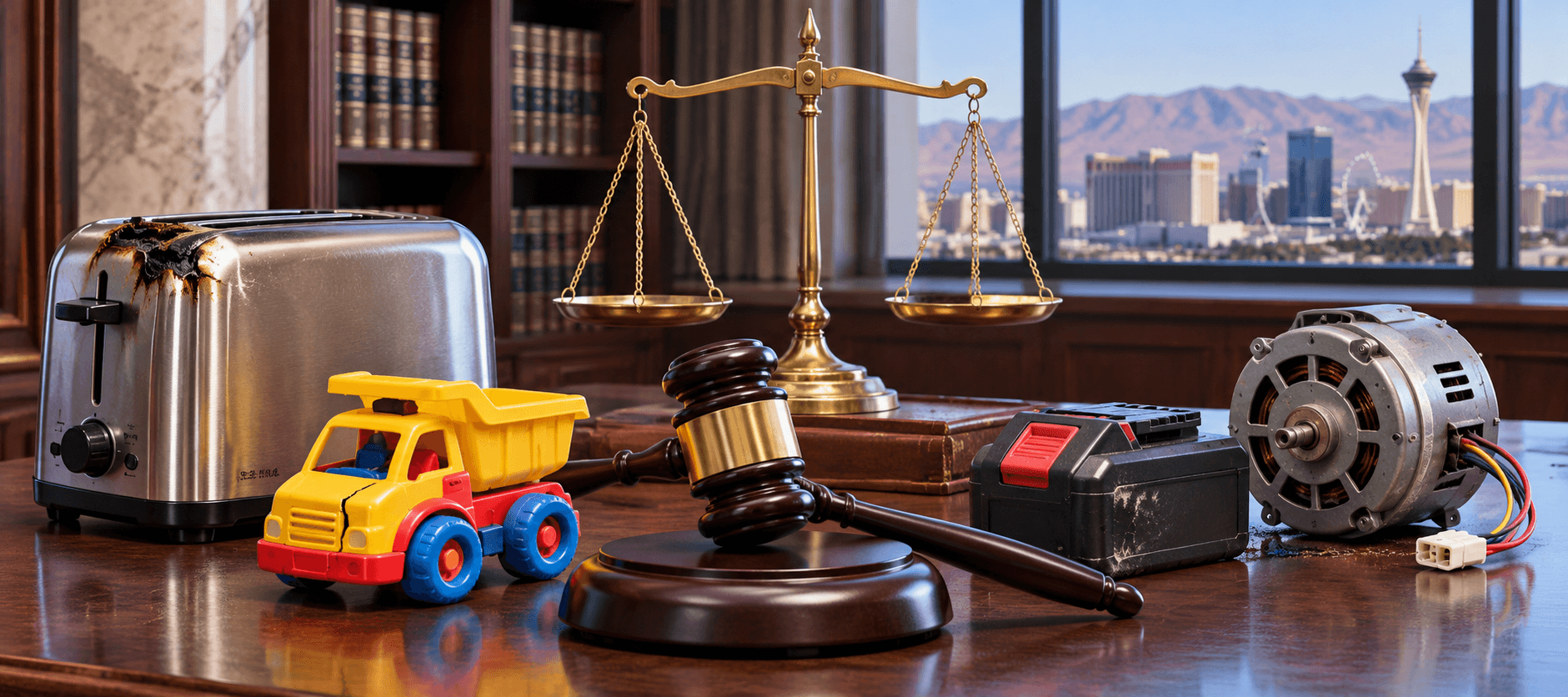
Nevada does not require a plaintiff to prove a safer alternative design in a strict liability design defect claim. In Ford Motor Co. v. Trejo, the Nevada Supreme Court kept the consumer-expectation test and declined to adopt the risk-utility test, reasoning that the latter would bring negligence concepts into strict liability.
Evidence of a safer design can still be useful. This guide explains what strict liability means in Nevada, what Trejo decided, and how these claims differ from negligence claims.
Key Takeaways
- Strict liability focuses on the product, not on how careful the company was.
- Trejo kept the consumer-expectation test for strict liability design defect claims.
- Proof of a safer alternative design is not required, but it can be used.
- A plaintiff must still prove a defect, its existence when the product left the defendant’s hands, and causation.
- Nevada has declined to apply comparative negligence to strict products liability.
What Is Strict Liability for Defective Products?
Strict liability means a company can be responsible for a defective product even if it used reasonable care. In Shoshone Coca-Cola Bottling Co. v. Dolinski, a 1966 decision, the Nevada Supreme Court recognized liability even though the seller exercised all reasonable care and the user had no contract with the seller.
It is not automatic. Shoshone states that the plaintiff must still establish that the injury was caused by a defect that existed when the product left the defendant’s hands.
What Did Ford Motor Co. v. Trejo Decide?
Ford Motor Co. v. Trejo, decided in 2017, involved the roof of an SUV in a rollover. The court addressed which test applies to a strict liability design defect claim:
- Consumer-expectation test. Nevada continues to use it. A product is defective if it fails to perform as reasonably expected in light of its nature and intended function, and is more dangerous than would be contemplated by the ordinary user with community knowledge of its characteristics.
- Risk-utility test. The court declined to adopt it.
- Safer alternative design. The court held that proof of an alternative design is not required.
Why Did Nevada Reject the Risk-Utility Test?
The court reasoned that the test brings negligence concepts into strict liability and shifts the focus from the product to the manufacturer’s conduct. It also said requiring proof of an alternative design would unfairly raise the plaintiff’s burden.
Can Alternative Design Evidence Still Be Used?
Yes. Trejo noted that evidence of an alternative design is often an effective way to show a product was unreasonably dangerous. Plaintiffs may present it, and defendants may argue an alternative was not commercially feasible. Other factors, such as cost, product longevity, warnings, and advertising, can remain relevant.
How Does Strict Liability Differ From Negligence?
| Issue | Strict liability | Negligence |
|---|---|---|
| Main focus | The product | The company’s conduct |
| Must show lack of care? | No | Yes |
| Must show a defect and causation? | Yes | Causation and breach of a duty |
| Comparative negligence | Not applied to strict products liability | Can apply under NRS 41.141 |
A lawsuit may include both theories. See the elements of negligence in Nevada.
What Defenses Apply in Strict Liability?
In Young’s Machine Co. v. Long, a 1984 decision, the Nevada Supreme Court refused to apply the comparative negligence statute to strict products liability. The court described assumption of the risk and misuse of the product as the defenses Nevada had recognized, and said ordinary contributory negligence was not to be considered. A company may still argue that the injured person’s conduct was the sole cause of the injury. A company can also argue that there was no defect or that something else caused the injury.
Does Strict Liability Apply to Warnings and Manufacturing Errors?
It can. Rivera v. Philip Morris, Inc. said a product may be found unreasonably dangerous and defective if the manufacturer failed to provide an adequate warning. In Stackiewicz v. Nissan Motor Corp., the court said proof of an unexpected, dangerous malfunction may suffice to establish a prima facie case of a product defect. See our Nevada defective products page.
What Is the Deadline to File?
Nevada generally allows 2 years to sue for personal injury under NRS 11.190(4)(e), and 3 years for injury to personal property under NRS 11.190(3)(c). Exceptions can apply, and a lawyer can explain which deadline fits your situation.
Talk With a Nevada Defective Product Lawyer
Vaksman Khalfin, PC handles Nevada defective product claims and has an office in Las Vegas. A lawyer can review your situation and explain the options that may be available. Contact us or visit our Nevada defective products page to learn more.
General information, not legal advice. This page is provided for general informational purposes only and is not medical advice. No attorney-client relationship is formed by reading this page or contacting the firm. Prior results do not guarantee a similar outcome.
Reviewed by Robert B. Vaksman, Partner, Vaksman Khalfin, PC (admitted in Nevada). Last reviewed: 11/05/2026
Frequently Asked Questions
No. In Ford Motor Co. v. Trejo, the Nevada Supreme Court held that proof of an alternative design is not required in a strict liability design defect claim. Such evidence can still be presented.
It asks whether a product failed to perform as reasonably expected in light of its nature and intended function, and was more dangerous than the ordinary user with community knowledge would contemplate.
Not for strict liability design defect claims. In Trejo, the Nevada Supreme Court declined to adopt it. Related factors, such as cost and feasibility, can still be argued.
No. You would still need to prove a defect, that it existed when the product left the defendant's hands, and that it caused your injury. The defendant can also raise defenses.