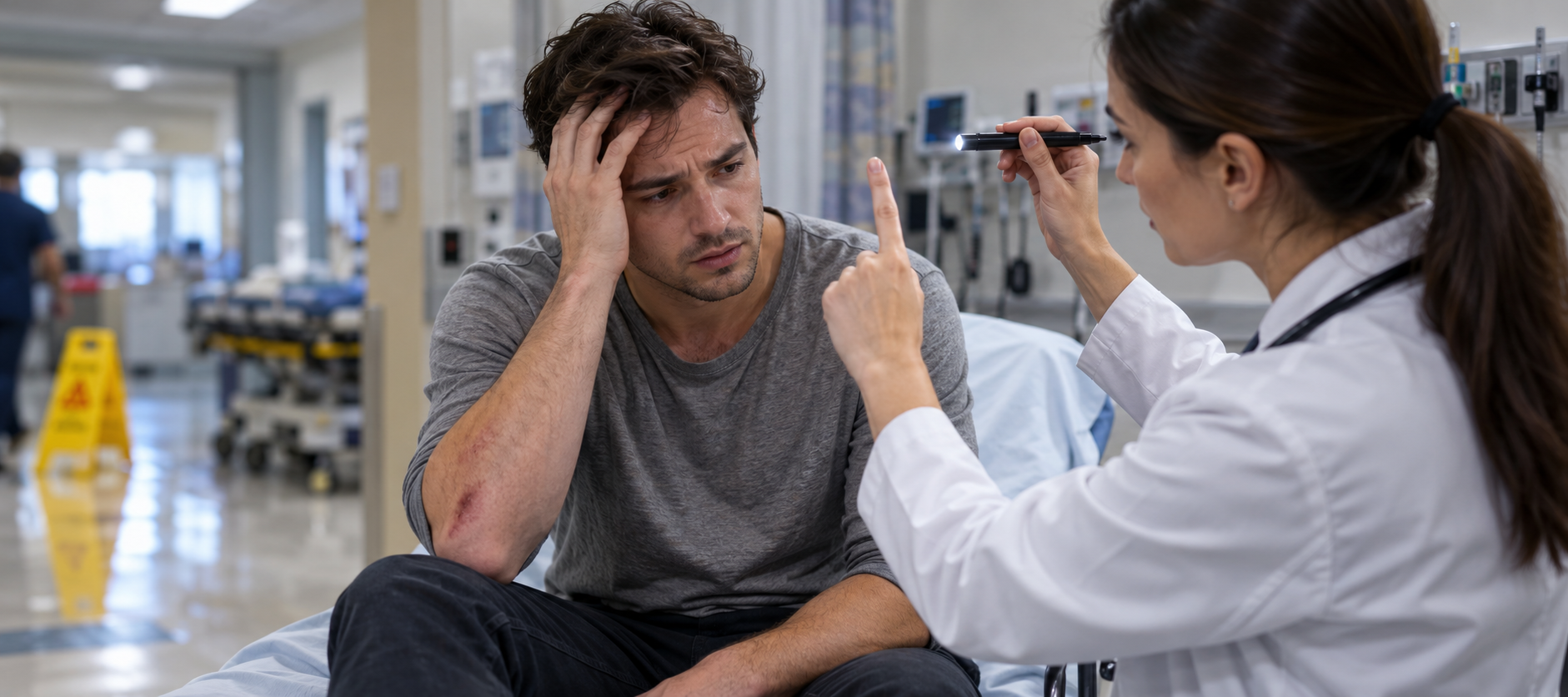
Anyone searching this question after a fall usually wants the medical answer, and the medical answer belongs to a clinician. What a law firm can usefully add is different: in a claim, a concussion is not only something a person has. It is something that has to be established, and what establishes it is a record created mostly in the first hours and days after the fall.
That record is built differently in a fall than in almost any other kind of injury case. There is no crash report. There is usually no police report. On private property the only contemporaneous documents are the one the property chooses to make and the one a clinician makes when the injured person first describes what happened.
This page is about that second document — how Nevada’s evidence statutes treat what a person tells a clinician, why the account of the fall itself matters as much as the description of the injury, and how any of it reaches a jury.
Key Takeaways
- A claim does not turn on the label applied to a head injury but on what the record establishes about it.
- A fall on private property generates no official report, so the medical record often carries the only contemporaneous account.
- Nevada admits statements made for medical diagnosis or treatment, including statements about symptoms, pain and sensations.
- That provision also reaches statements describing “the inception or general character of the cause or external source” of the injury.
- So what a person tells a clinician about how the fall happened can be admissible, not only what they say about how they feel.
- Medical records themselves reach a jury as records of a regularly conducted activity, on the testimony or affidavit of a custodian.
- A gap between the fall and the first record is an evidentiary problem, and it is one the other side will raise.
The Medical Question and the Legal One Are Different
The question “what is a concussion” has a clinical answer, and nothing on a law firm’s website should be read as supplying it. Diagnosis, treatment and what any particular person should do about their own health are matters for a qualified clinician, and this page does not address them.
The legal question is narrower and it is the one a claim turns on: can it be shown, from evidence a court will receive, that this person sustained this injury in this fall. The label matters far less than most people expect. What matters is whether there is a record, when it was made, what it says, who made it, and whether it will be admitted.
Those are evidentiary questions with statutory answers in Nevada, and they are answerable without anyone on the legal side venturing an opinion about medicine.
A Fall Produces No Report of Its Own
It is worth being clear about how unusual the position is.
A collision on a Nevada road produces paperwork by operation of law. A fall in a lobby, a stairwell, a parking structure or a supermarket aisle produces nothing automatically. If the property makes an incident report, it makes it for its own purposes, it holds it, and the injured person may never see it unless it is asked for. If nobody on the property is told at all, there may be no document anywhere recording that the fall happened.
Against that background the first clinical encounter does something a family rarely realises at the time. It creates a dated document, made by a professional with no stake in the claim, that records both the injury and — if the person describes it — how it occurred. In a fall case that document frequently carries more evidentiary weight than anything else generated in the first week.
What You Say to a Clinician Becomes Evidence
Nevada deals with this expressly. NRS 51.115 provides that “statements made for purposes of medical diagnosis or treatment and describing medical history, or past or present symptoms, pain or sensations, or the inception or general character of the cause or external source thereof are not inadmissible under the hearsay rule insofar as they were reasonably pertinent to diagnosis or treatment.”
Read the categories the section lists. Medical history. Past or present symptoms. Pain or sensations. Each of those is what a person says about themselves, and each of them is admissible where the statement was made for diagnosis or treatment and was reasonably pertinent to it.
The exception does not depend on the person being unavailable, and it does not depend on which clinician heard it. What it depends on is the purpose of the statement and its pertinence — which is why an account given in a clinical setting stands on different footing from the same words said to a friend.
Why the Cause Clause Matters After a Fall
The clause that does the most work in a premises case is the one most people skim past: statements describing “the inception or general character of the cause or external source” of the symptoms are within the exception too.
That reaches how the injury came about. A person who tells a clinician that they went down on a wet tile floor, struck the back of their head, and could not get up for a minute is not only describing symptoms. They are describing the external source, and to the extent that description was reasonably pertinent to diagnosis or treatment, the statute brings it within the exception.
In a case where the property controls the premises, controls any camera footage, and controls its own incident report, an early account of the mechanism of the fall — recorded by someone independent, on a date nobody disputes — can be the most durable thing the injured person has.
The limit in the section is real and worth stating. The statements must have been made for purposes of diagnosis or treatment and must be reasonably pertinent to it. A narrative given for some other purpose, or detail that has nothing to do with the care being provided, is a different question, and it is one a court decides on the facts.
How a Medical Record Reaches a Jury
A statement being within an exception is not the same as the document containing it being in evidence. The record itself has to get in.
NRS 51.135 covers that. A “memorandum, report, record or compilation of data, in any form, of acts, events, conditions, opinions or diagnoses, made at or near the time by, or from information transmitted by, a person with knowledge, all in the course of a regularly conducted activity, as shown by the testimony or affidavit of the custodian or other qualified person, is not inadmissible under the hearsay rule.”
Three features of that are worth noticing. It expressly covers “opinions or diagnoses,” not merely raw observations. It requires the record to have been made “at or near the time,” which is why a note written contemporaneously is treated differently from an account reconstructed later. And it can be established by affidavit rather than by calling the custodian, which is an ordinary and practical route.
The section closes with a condition: the record is admissible “unless the source of information or the method or circumstances of preparation indicate lack of trustworthiness.” That is the opening a defendant will look for, and it is the reason the circumstances in which a record was created can become a live issue in a case that otherwise looks straightforward.
A Gap in the Record Is an Evidentiary Problem
This is the point at which the legal and the medical questions pull apart most sharply, and it is worth separating them carefully.
Whether and when a person seeks care is a matter between them and a clinician, and this page says nothing about it. What can be said, as a matter of evidence, is that a period between the fall and the first record is a period with no contemporaneous documentation of either the injury or its cause — and that a defendant will use that gap, arguing that the injury arose from something else, or that it cannot be connected to the fall.
That is not a reason to treat such a claim as lost. Gaps are explained in cases all the time, by other evidence from the same period. But it does explain why the date on the first record tends to matter in a fall case out of proportion to anything else on it.
What Follows for a Head Injury After a Fall
Taken together, the two provisions describe how a head injury sustained in a fall is actually proved in Nevada: by a dated record, made by a professional in the course of their regular work, containing both what the person reported about themselves and what the professional concluded, with the person’s own account of the mechanism admissible to the extent it was pertinent to the care being given.
What this page does not do is tell anyone what their symptoms mean, whether they have an injury, or what care to seek. Those are questions for a clinician, and the firm’s Nevada slip and fall guide addresses the legal side of a premises claim in more general terms.
Speak to a Nevada Slip and Fall Attorney
The evidence that decides a fall case is created early and by other people — a property’s own report, a camera that may or may not be preserved, and a clinical record made before anyone is thinking about a claim. Working out what exists and securing it is the part of the work that cannot be done later.
Vaksman Khalfin, PC acts for injured people across Nevada from the firm’s Las Vegas office at 10161 Park Run Drive, Suite 150. The first consultation is free, and injury claims are handled on a contingency-fee basis: there is no upfront cost, attorney’s fees are owed only out of a recovery, and fees and case costs are separate items set out in the written agreement. Wider material sits in the Nevada personal injury guides.
Reviewed by Robert B. Vaksman, Partner, Vaksman Khalfin, PC (admitted in Nevada). Last reviewed: 10/30/2026
Frequently Asked Questions
The label is not what a claim turns on. What has to be established is the injury and its connection to the fall, which is done through the record and the evidence rules that govern it rather than through terminology.
Often, yes. NRS 51.115 admits statements made for purposes of medical diagnosis or treatment describing medical history, past or present symptoms, pain or sensations, insofar as they were reasonably pertinent to diagnosis or treatment.
The section extends to statements describing "the inception or general character of the cause or external source" of the symptoms, subject to the same requirement that the statement was reasonably pertinent to diagnosis or treatment.
Because a fall on private property generates no report by operation of law. Any incident report belongs to the property, and the first clinical record is often the only contemporaneous document made by someone independent of the claim.
Under NRS 51.135, as records of a regularly conducted activity, made at or near the time by or from a person with knowledge, shown by the testimony or affidavit of the custodian or another qualified person.
It can try. NRS 51.135 makes such a record admissible "unless the source of information or the method or circumstances of preparation indicate lack of trustworthiness," which is the ground on which such records are usually challenged.
The section refers to a record "of acts, events, conditions, opinions or diagnoses," so it is not limited to raw observations.
It creates a period without contemporaneous documentation, which a defendant will use to argue the injury is not attributable to the fall. It does not by itself defeat a claim, and such gaps are commonly addressed with other evidence from the same period.