
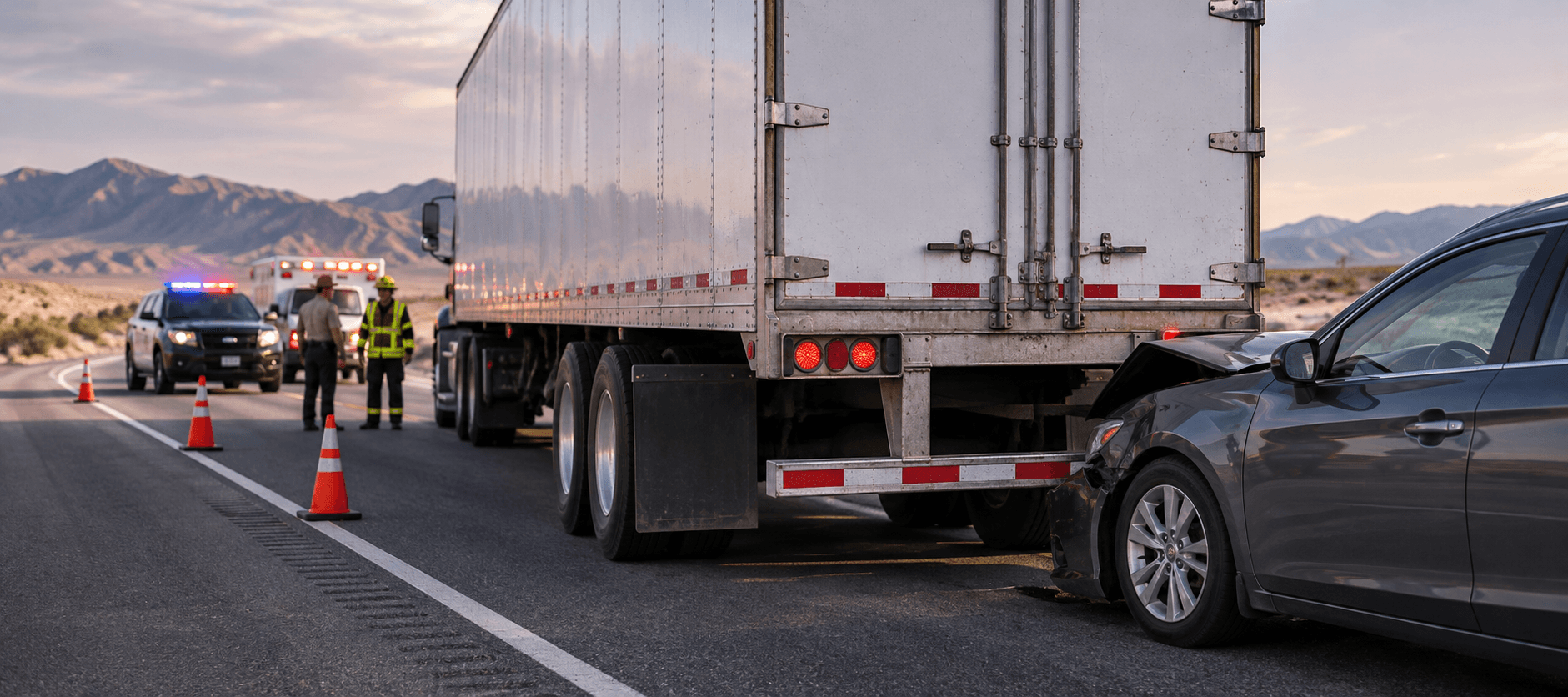
A rear-end truck crash can involve underride, where a smaller vehicle slides under the back of a trailer. Federal rules require rear impact guards on many trailers to reduce that risk. Underride claims can raise questions about the guard and the truck’s condition, as well as the drivers’ conduct, which is why these cases can differ from an ordinary rear-end crash.
This guide explains how rear-end truck crashes and underride claims work in Nevada and which rules may apply.
Key Takeaways
- Many trailers of 10,000 pounds or more built on or after January 26, 1998 must have rear impact guards meeting FMVSS No. 223 and 224.
- In 2024 two-vehicle fatal crashes involving a large truck, the truck was struck in the rear in 22.1% of cases.
- Nevada’s following-distance law applies to all drivers, including truck drivers.
- In Nevada, a rear-end collision does not make the following driver negligent as a matter of law; negligence is a question for the jury.
- Comparative negligence under NRS 41.141 can reduce a recovery or bar it.
What Is an Underride Crash?
In an underride crash, a car or other smaller vehicle goes partly under a truck or trailer. Because a trailer sits higher than a car’s hood, the trailer may strike the passenger area. Rear impact guards are designed to reduce how far a vehicle can go under the trailer.
What Do Federal Rules Require for Rear Impact Guards?
Under 49 CFR 393.86, trailers and semitrailers with a gross vehicle weight rating of 10,000 pounds or more manufactured on or after January 26, 1998 must have a rear impact guard meeting Federal Motor Vehicle Safety Standard No. 223, and the vehicle must meet FMVSS No. 224. Certain vehicles, such as pole trailers and low chassis vehicles, are excluded. For many older vehicles, a guard is required when the rear is more than 30 inches above the ground when empty.
Who Can Be Responsible in a Rear-End Truck Crash?
| Situation | Who may be reviewed |
|---|---|
| A truck hits a car from behind | The truck driver and carrier, including following distance, speed, and hours |
| A car hits the back of a truck | Both drivers, the truck’s lighting, reflectors, and guard |
| A guard fails or is missing | The carrier’s maintenance, and possibly the guard’s maker |
| A truck stops suddenly or is parked | Why it stopped and whether warnings were used |
If a part failed, see how auto defect claims work.
How Does Nevada Law Treat Rear-End Fault?
Under NRS 484B.127, a driver may not follow another vehicle more closely than is reasonable and prudent. In Nehls v. Leonard, a 1981 decision, the Nevada Supreme Court held that a rear-end collision does not make the following driver negligent as a matter of law, and that negligence is a question for the jury. See rear-end fault in Nevada.
Under NRS 41.141, a plaintiff’s comparative negligence does not bar recovery unless it is greater than the negligence of the defendant or defendants combined. Otherwise, damages are reduced by the plaintiff’s percentage of negligence.
What Does Crash Data Show About Rear Impacts?
In NHTSA’s Large Trucks: 2024 Data, the large truck was struck in the rear in 22.1% of two-vehicle fatal crashes involving a large truck, compared with 6.8% for the other vehicle. See truck accident statistics.
What Evidence Matters in an Underride Claim?
- The trailer and guard, in their post-crash condition
- Inspection and maintenance records
- Lighting, reflectors, and conspicuity
- Driver logs, vehicle data, and video
- Photos and the police report
Because the trailer may be repaired or returned to service, early preservation can matter. See truck accident investigation.
What Is the Deadline?
Nevada generally allows 2 years to sue for personal injury or wrongful death under NRS 11.190(4)(e), with exceptions. If a family member died, see wrongful death lawsuits in Nevada.
Talk With a Nevada Truck Accident Lawyer
Vaksman Khalfin, PC handles Nevada truck accident claims and has an office in Las Vegas. A lawyer can review your situation and explain the options that may be available. Contact us or visit our Nevada truck accident page to learn more.
General information, not legal advice. This page is provided for general informational purposes only and is not medical advice. No attorney-client relationship is formed by reading this page or contacting the firm. Prior results do not guarantee a similar outcome.
Reviewed by Robert B. Vaksman, Partner, Vaksman Khalfin, PC (admitted in Nevada). Last reviewed: 11/12/2026
Frequently Asked Questions
It is a crash where a smaller vehicle goes partly under a truck or trailer. Rear impact guards are designed to reduce how far a vehicle can go under the trailer.
Many trailers of 10,000 pounds or more built on or after January 26, 1998 must have rear impact guards under 49 CFR 393.86. Some vehicle types are excluded, and older vehicles have separate rules.
It depends on the evidence. A rear-end collision does not make the following driver negligent as a matter of law. The truck's conduct, lighting, and guard may also be reviewed.
Not always. A lawyer may help when injuries are serious, fault is disputed, or the guard or truck condition may be at issue.
