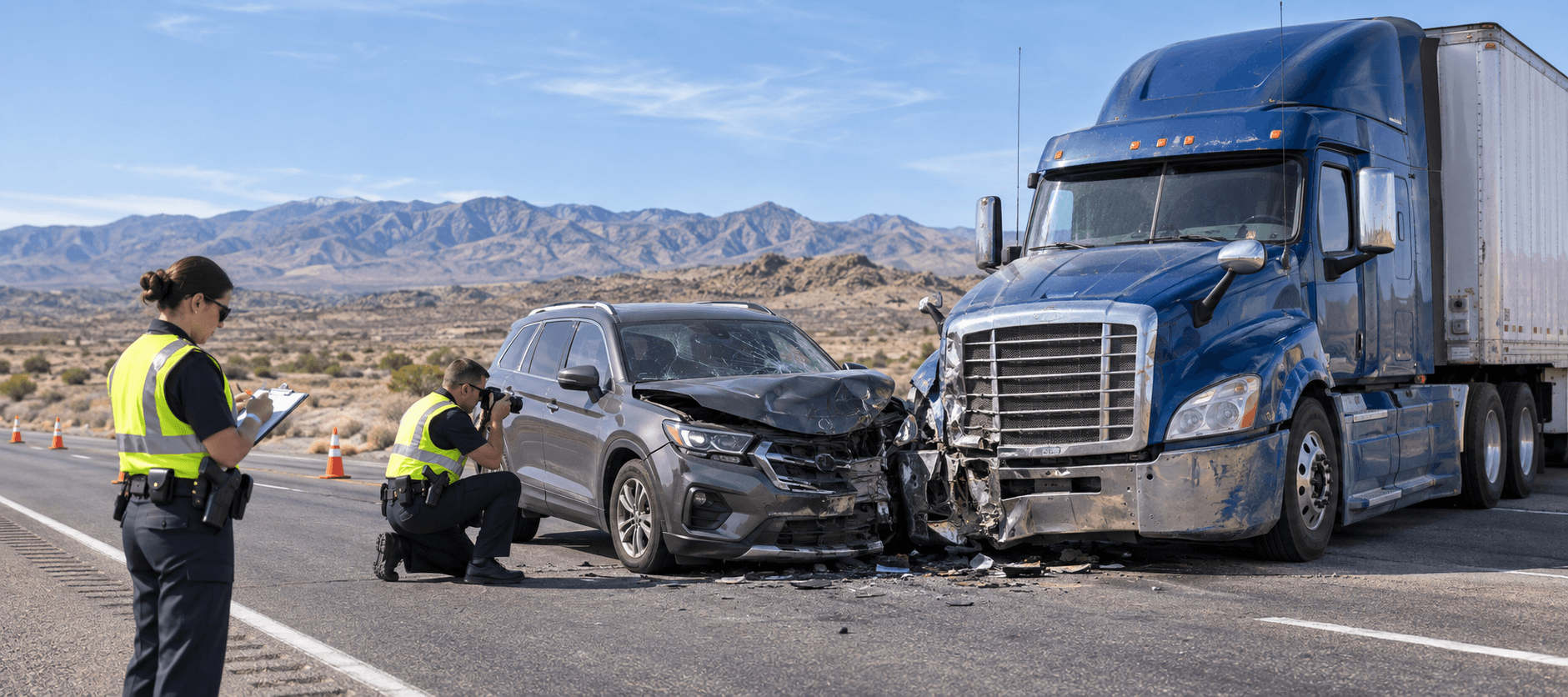
A truck accident claim in Nevada usually moves from the crash and early evidence preservation, through an investigation of the driver and trucking company, to an insurance claim, and then to a settlement or lawsuit. Nevada generally allows 2 years to sue for personal injury, and federal trucking rules often shape the evidence.
Truck claims can involve more parties, more insurance, and more records than a typical car crash. This guide explains each stage, who may be responsible, and which deadlines apply.
Key Takeaways
- A truck claim may involve the driver, the trucking company, and others connected to the truck or its cargo.
- Federal rules require certain records, and some are kept for limited periods.
- Federal minimum insurance for many for-hire interstate carriers of general freight is $750,000.
- Under NRS 41.141, an injured person’s own negligence can reduce a recovery or bar it.
- Nevada generally allows 2 years to sue for personal injury under NRS 11.190(4)(e).
What Are the Stages of a Nevada Truck Accident Claim?
| Stage | What happens |
|---|---|
| At the scene | Information is exchanged, injuries are treated, and the crash is reported |
| Preservation | Requests go out to keep driver logs, vehicle data, and video |
| Investigation | Fault, the companies involved, and insurance are reviewed |
| Treatment and documentation | Medical care continues and losses are recorded |
| Demand and negotiation | The claim is presented to the insurers and offers are exchanged |
| Lawsuit, if needed | A complaint is filed, followed by discovery, arbitration or mediation, and possibly trial |
| Resolution | A release is signed and funds are distributed after fees, costs, and liens |
Who Can Be Responsible in a Truck Accident Claim?
- The truck driver. The driver’s own negligence, such as speeding or distraction, may be at issue.
- The trucking company. Depending on the facts, a trucking company may be legally responsible for a driver’s conduct within the scope of employment, and its own practices, such as hiring, training, and maintenance, may also be reviewed.
- Other companies. Depending on the facts, a cargo loader, maintenance provider, or parts maker may be involved. See how auto defect claims work.
- Other drivers. Another motorist may share fault.
Which Rules Apply to Trucks and Truck Drivers?
Federal Motor Carrier Safety Regulations govern areas such as driver hours, vehicle maintenance, and driver testing. Nevada’s regulations under NAC Chapter 706 adopt many of these federal rules by reference. A violation may be evidence in a claim. See negligence per se in Nevada.
How Much Insurance Does a Truck Carry?
Under 49 CFR 387.9, the federal minimum for for-hire carriers of nonhazardous property in interstate commerce using vehicles of 10,001 pounds or more is $750,000. Higher minimums apply to certain hazardous materials. These are minimums, and a carrier may carry more. Intrastate carriers and smaller vehicles can be subject to different requirements.
How Does Fault Affect a Truck Claim?
Under NRS 41.141, a plaintiff’s comparative negligence does not bar recovery unless it is greater than the negligence of the defendant or defendants combined. Otherwise, damages are reduced by the plaintiff’s percentage of negligence. Where comparative negligence is asserted against multiple defendants, each is generally liable for its own share, and the statute lists exceptions. See comparative negligence in Nevada.
What Damages Can Be Claimed?
Depending on the facts, a claim may include medical expenses, lost income, reduced earning capacity, property damage, and pain and suffering. If a family member died, see wrongful death lawsuits in Nevada.
What Are the Deadlines?
Under NRS 11.190(4)(e), Nevada generally allows 2 years to sue for personal injury or wrongful death, and NRS 11.190(3)(c) generally allows 3 years for injury to personal property. Exceptions can apply. Some federal record retention periods are shorter. For example, 49 CFR 395.8(k) requires carriers to keep records of duty status for at least 6 months.
Does a Truck Claim Go to Arbitration?
It may. Under NRS 38.250, many district court cases arising in Nevada with $100,000 or less at issue per plaintiff, not counting attorney’s fees, interest, and court costs, go to nonbinding arbitration. NRS 38.255 directs court rules to exclude certain types of cases. A case may also be in federal court, depending on the parties.
Talk With a Nevada Truck Accident Lawyer
Vaksman Khalfin, PC handles Nevada truck accident claims and has an office in Las Vegas. A lawyer can review your situation and explain the options that may be available. Contact us or visit our Nevada truck accident page to learn more.
General information, not legal advice. This page is provided for general informational purposes only and is not medical advice. No attorney-client relationship is formed by reading this page or contacting the firm. Prior results do not guarantee a similar outcome.
Reviewed by Robert B. Vaksman, Partner, Vaksman Khalfin, PC (admitted in Nevada). Last reviewed: 11/11/2026
Frequently Asked Questions
A claim usually moves through evidence preservation, investigation, medical treatment and documentation, a demand to the insurers, and negotiation. If it does not resolve, a lawsuit may follow before the deadline.
Payment usually comes from the insurance of the party or parties responsible, which may include the trucking company. Your own coverage, such as uninsured or underinsured motorist coverage, may also apply.
Nevada generally allows 2 years for personal injury under NRS 11.190(4)(e) and 3 years for injury to personal property under NRS 11.190(3)(c). Exceptions can apply.
Truck claims can involve federal safety rules, company records, more than one responsible party, and larger insurance policies. Some key records may be kept for limited periods.