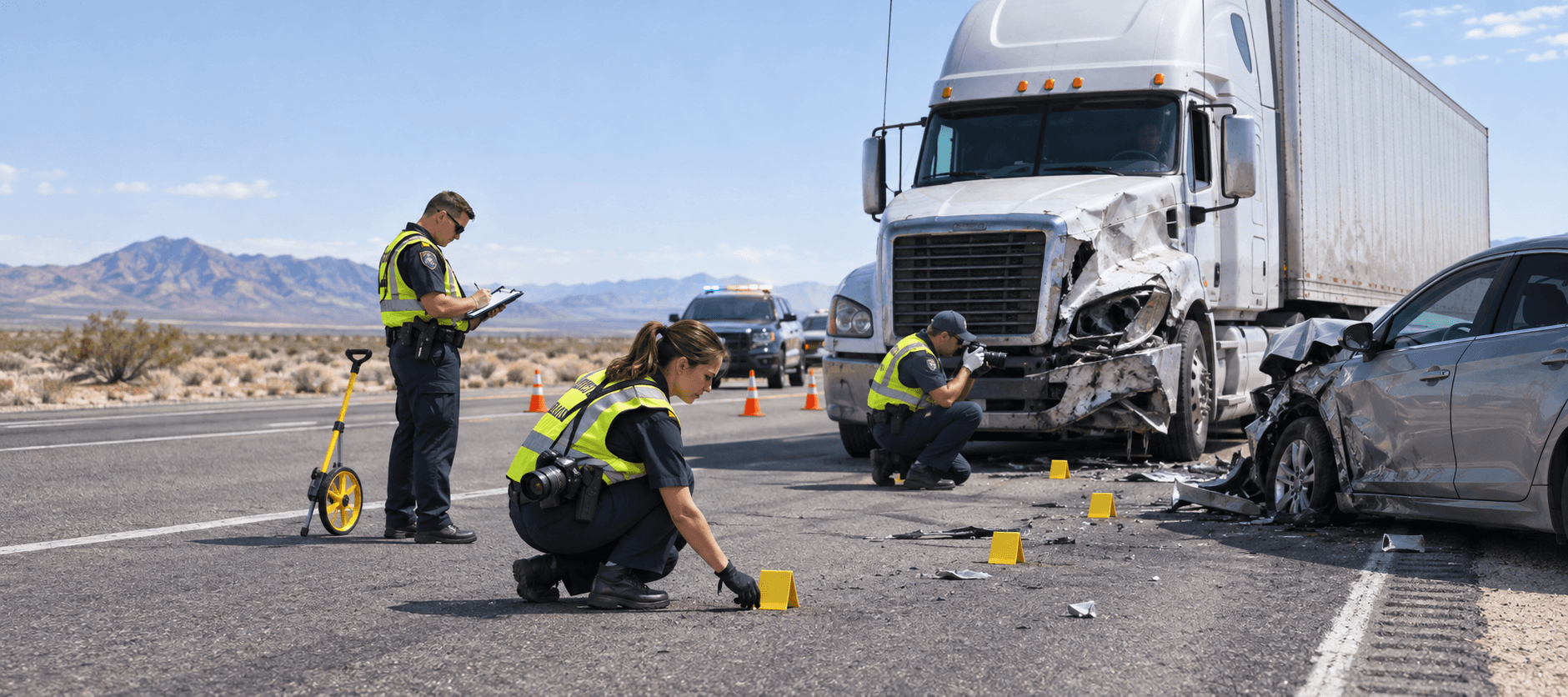
A truck accident investigation gathers the evidence that shows what happened, including driver logs, vehicle data, inspection and maintenance records, drug and alcohol test results, and video. Some of these records are kept only for limited periods under federal rules, so preservation requests are often sent soon after a crash.
This guide explains what evidence exists in a truck crash, how long some of it is kept, and how Nevada law treats evidence that is lost.
Key Takeaways
- Carriers must keep records of duty status and supporting documents for at least 6 months.
- Carriers must keep an accident register for 3 years.
- Post-accident drug and alcohol testing is required in certain crashes, within set time limits.
- Nevada law allows an adverse inference when evidence is negligently lost after litigation is reasonably foreseeable.
- A preservation letter can put a company on notice to keep evidence.
What Evidence Is Collected in a Truck Accident Investigation?
| Evidence | What it can show | Federal rule |
|---|---|---|
| Records of duty status (ELD data) | Driving time and duty status | 49 CFR 395.8; kept at least 6 months |
| Accident register | The carrier’s record of crashes | 49 CFR 390.15; kept 3 years |
| Post-accident test results | Alcohol or drug use | 49 CFR 382.303 |
| Inspection and maintenance records | The truck’s condition | 49 CFR Part 396 |
| Vehicle data and dashcam video | Speed, braking, and events before impact | Varies by vehicle |
| Phone records | Possible distraction | May be sought in discovery; access can be limited |
| Police report, photos, and witnesses | The scene and what people saw | No specific federal rule |
When Is Post-Accident Drug and Alcohol Testing Required?
Under 49 CFR 382.303, employers must test surviving drivers after a crash involving a death. Testing is also required when the driver is cited for a moving violation arising from the crash within 8 hours for alcohol or 32 hours for drugs, and the crash involved an injury requiring immediate treatment away from the scene, or disabling damage requiring a tow. If an alcohol test is not given within 2 hours, the employer must document why. If it is not given within 8 hours, or a drug test within 32 hours, the employer must stop trying and document why.
Why Does Evidence Disappear?
- Some records are kept only for the minimum periods required
- Trucks may be repaired, returned to service, or sold
- Video may be recorded over
- Witnesses may become harder to find
What Is a Preservation Letter?
A preservation letter, sometimes called a spoliation letter, asks a company to keep specific evidence. It can put the company on notice that a claim is expected. In Bass-Davis v. Davis, a 2006 decision, the Nevada Supreme Court said a party is on notice when litigation is reasonably foreseeable. When evidence is negligently lost or destroyed after that, a jury may infer it would have been adverse. A stronger presumption applies only to willful suppression.
Who Investigates a Truck Crash?
Police investigate the crash itself. The trucking company and its insurer may also investigate quickly. An injured person’s lawyer may work with crash reconstruction and other experts. See how a truck accident lawyer can help.
What Can You Keep After a Truck Crash?
- Photos of the vehicles, scene, and injuries
- The police report number
- Names and contact details for witnesses
- The truck’s carrier name and USDOT number, if visible
- Your own dashcam footage
- Medical records and bills
See first steps after a truck accident.
How Does Evidence Fit Into the Claim?
Evidence helps show duty, breach, legal causation, and damages. A violation of a safety rule may be evidence of negligence. See negligence per se. Nevada generally allows 2 years to sue for personal injury under NRS 11.190(4)(e), but some evidence may be lost well before then.
Talk With a Nevada Truck Accident Lawyer
Vaksman Khalfin, PC handles Nevada truck accident claims and has an office in Las Vegas. A lawyer can review your situation and explain the options that may be available. Contact us or visit our Nevada truck accident page to learn more.
General information, not legal advice. This page is provided for general informational purposes only and is not medical advice. No attorney-client relationship is formed by reading this page or contacting the firm. Prior results do not guarantee a similar outcome.
Reviewed by Robert B. Vaksman, Partner, Vaksman Khalfin, PC (admitted in Nevada). Last reviewed: 11/12/2026
Frequently Asked Questions
Under 49 CFR 395.8(k), carriers must keep records of duty status and supporting documents for at least 6 months. They may keep them longer.
It is a request asking a company to preserve evidence, such as logs, vehicle data, and video. It can put the company on notice that a claim is expected.
Under Bass-Davis v. Davis, a jury may infer that negligently lost evidence would have been adverse. A stronger presumption applies to willful suppression.
Under 49 CFR 382.303, testing is required after a crash involving a death, and after certain crashes where the driver is cited and there is an injury or disabling damage.