
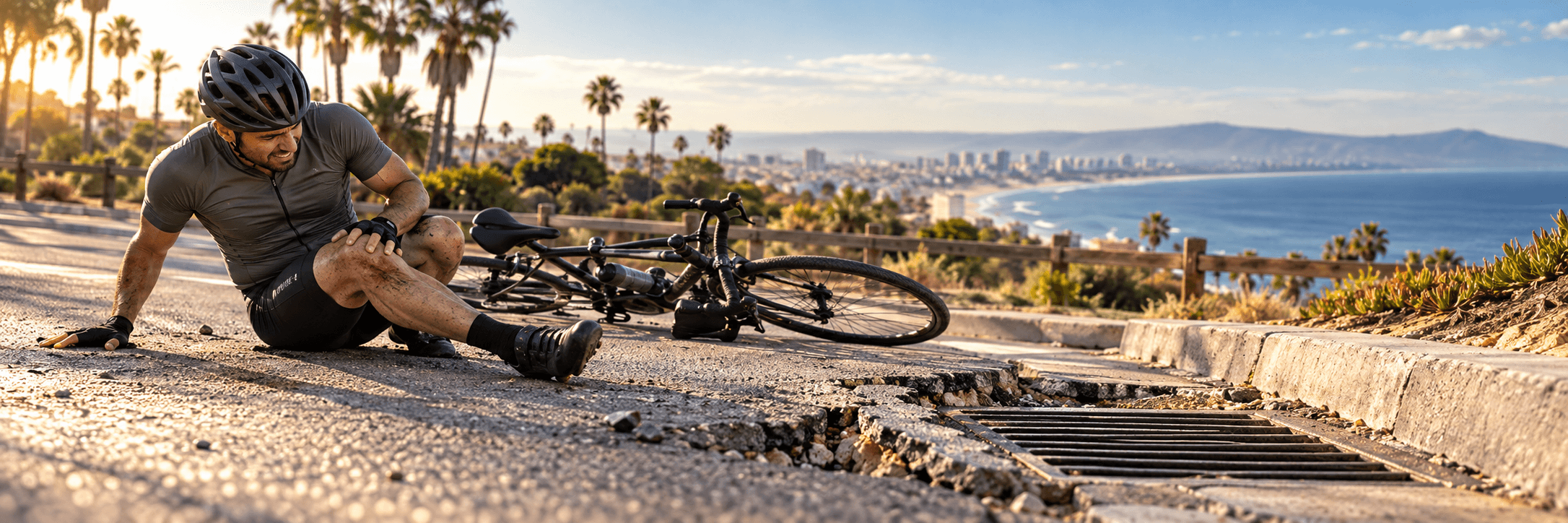
A fall with no vehicle involved is not automatically nobody’s fault. Most information about bicycle falls treats them as accidents in the ordinary sense — something that happened, to be recovered from. Some of them are, and some of them are not. Where a road surface, a bikeway design, a bicycle component or a condition on someone’s property caused a rider to go down, there may be a party responsible for it. This page covers the three routes that arise most often in California, what has to be established for each, and why the first days after a solo fall matter more than they do after a collision with a car.
Key Takeaways
- No car does not mean no claim. Road surfaces, bikeway design, components and private property conditions all give rise to potential responsibility.
- Where a public entity is responsible for the road or bikeway, a written claim must be presented within six months of the injury, before any lawsuit.
- Where a component failed, California product liability does not require proving that anyone was careless.
- Everyone in a product’s chain of distribution may be a potential defendant, not only the manufacturer.
- The bicycle itself is frequently the single most important piece of evidence, and repairing it can end a claim.
- After a solo fall nothing happens automatically. No report is taken, no other party exchanges information, and no insurer opens a file.
“No Car Was Involved” Is Not the Same as “No One Is Responsible”
The assumption that a solo fall is the rider’s own problem is the reason most of these situations are never looked at. Our page on California bicycle accident claims sets out who may be responsible in a cycling case, and the list includes parties who have nothing to do with a moving vehicle: a public entity responsible for a roadway or bikeway, a bicycle or component manufacturer where a defective product may have failed, and a property owner where a dangerous condition on private property contributed. Whether any of them is legally responsible in a given case is a question of evidence rather than assumption — which is exactly why the evidence is worth keeping.
Route One: The Road Surface or the Bikeway
Conditions that a driver would never notice can put a cyclist on the ground. Pavement defects, uneven surfaces where lanes have been joined or trenched, drainage grates, debris in a bike lane and bikeway design all affect a bicycle in ways that would barely register in a car.
Where a city, county, transit agency or state body is responsible for that road or bikeway, the claim runs against a public entity, and the timeline is the thing to understand first.
A written claim must be presented to the entity before any lawsuit. The California Courts self-help guide states the deadline as six months from the injury where the claim concerns injury to a person or damage to something owned. It further states that the government has 45 days to respond, and that where a claim is denied there are six months from the date the rejection was mailed to file suit.
Six months is a short window for something a rider may spend the first weeks of simply recovering from, and it runs from the date of the fall rather than from the date anyone identifies who maintains the road.
There is a second reason to move early, and it is practical rather than legal. Conditions get repaired. A pothole is filled, a grate is replaced, a surface is resurfaced, and the thing that caused the fall stops existing. Photographing the location and the defect, with something in frame for scale, preserves evidence that may be gone within weeks. Roads in many areas are maintained by more than one agency, so establishing which one is responsible for a particular stretch is part of the work.
Route Two: The Bicycle or One of Its Components
Where a frame, fork, wheel, brake, handlebar, stem or other component failed, the claim is a product claim, and California treats those differently from ordinary negligence claims in a way that matters a great deal.
There is generally no need to prove anyone was careless. Our page on California defective product claims explains that in a strict liability product claim what matters is that the product was defective and that the defect caused harm, rather than proof of negligence by any particular person. That page sets out the three theories California recognises: a manufacturing defect, where the item differs from its intended design; a design defect, where the design itself is unsafe; and a failure to warn, where the product carried inadequate warnings.
The potential defendants extend beyond the brand on the frame. Anyone in the chain of distribution may be a defendant — the manufacturer of the finished bicycle, the manufacturer of a component part, distributors, wholesalers, retailers, and in some circumstances those who lease or rent equipment. This matters in cycling specifically, where components are frequently made by companies other than the one whose name is on the bicycle, and where a manufacturer may be overseas.
Do not repair the bicycle
This is the single most consequential thing a rider can get wrong after a fall that may involve a component failure, and the instinct runs the other way, because people want their bicycle back.
Our defective products page is direct about it: do not discard, repair, return, or allow anyone to inspect and take away the product. A failed component that has been replaced and thrown out, or a frame that has been repaired, may take the claim with it. Keep packaging, labels, manuals and warnings where they exist, along with proof of purchase, and record model and serial numbers.
A shop asking to send a part back to the manufacturer under warranty is a common route by which this evidence disappears, and it usually happens with everyone acting in good faith.
Route Three: A Condition on Private Property
Where the fall happened on private property — a parking structure, a commercial forecourt, a private road or path, an apartment complex — the claim runs against whoever controlled that property rather than against a public entity, and the framework is different again.
Our page on California premises liability claims sets out what has to be shown: that the owner or occupier controlled the property, that a dangerous condition existed, that they knew or should have known about it and had a reasonable opportunity to fix or warn about it, and that this was a substantial factor in causing the injury.
The knowledge element is usually where these claims are contested, which is another reason that photographs, maintenance history and any prior complaints matter.
What the Other Side Will Raise
The arguments are predictable and worth anticipating.
In a product claim: that the product was misused or altered after it left the manufacturer’s hands in a way that was not reasonably foreseeable; that something other than the product caused the harm; and that the rider’s own share of responsibility reduces the recovery. On that last point, California reduces a recovery by the share assigned rather than barring it, and our page on pure comparative fault explains how that operates.
In a road or premises claim: that the condition was open and obvious, that the entity or owner had no notice of it, that it was not the cause of the fall, or that the rider’s speed, line or attention was. Each of these is answered with evidence rather than with argument, which is why the record built in the first weeks tends to decide the outcome.
Why the First Days Matter More Here Than After a Collision
When a car is involved, a process starts on its own. Someone calls the police, a report is generated, information is exchanged, and an insurer opens a file. The event is documented whether or not anyone is thinking about a claim.
After a solo fall, none of that happens. There is frequently no report at all. There is no other party, no exchange of details, and no insurer taking an interest. A rider gets home, deals with what needs dealing with, and the only record that the fall occurred may be a treatment record and a damaged bicycle in a garage. Meanwhile the defect is repaired, the component is replaced, and the memory of exactly where and how it happened blurs.
That asymmetry is the practical argument for treating a solo fall seriously in the first days even where no claim has been decided on.
What to Preserve
- The bicycle, unrepaired, together with every component involved, however minor it seems. Do not return anything to a shop or a manufacturer.
- Photographs of the location, including the defect, taken from several distances, with something in frame for scale.
- The exact location, recorded precisely enough to find again — a dropped pin, a cross street, a mile marker.
- Purchase records, along with model and serial numbers, service history and any recall or safety notices received.
- Recorded ride data from a cycling computer, watch or app, exported and saved rather than left on a device.
- Contact details for anyone who saw it happen or stopped afterwards.
- Clothing and equipment in the condition they are in, unwashed and unrepaired.
- A dated note of what happened while it is fresh, and a record of any expenses.
Talk to a California Bicycle Accident Lawyer
Vaksman Khalfin, PC represents injured cyclists throughout California. If you went down without another vehicle involved and the road, the bikeway, your bicycle or someone’s property may have had something to do with it, a free consultation can review which of these routes applies, who may be responsible, and what should be preserved before it is gone. Call (650) 250-0705, schedule a free consultation, or read more about California bicycle accident claims and the wider California personal injury practice.
Reviewed by Alan D. Khalfin, Partner and Managing Attorney, Vaksman Khalfin, PC (admitted in California). Last reviewed: 10/05/2026
Frequently Asked Questions
Possibly. A fall caused by a road or bikeway condition, by a component failure, or by a dangerous condition on private property may give rise to a claim against the public entity, the parties in the product's chain of distribution, or the property owner respectively. Whether any of them is legally responsible depends on the evidence, which is why preserving it early matters.
Generally the public entity responsible for maintaining that road or bikeway, which may be a city, a county, a transit agency or a state body. Roads in many areas are maintained by more than one agency, so identifying the right entity is part of the work, and it needs to happen quickly because of the claim deadline.
A written claim must be presented to the entity before any lawsuit. The California Courts self-help guide states the deadline as six months from the injury for a claim about injury to a person, that the government has 45 days to respond, and that a denial gives six months from the date the rejection was mailed to file suit. Because this is much shorter than the general period for claims against private parties, it should be confirmed immediately rather than estimated.
Not before it has been looked at in the context of a possible claim. Repairing, discarding or returning a failed component can remove the evidence a product claim depends on. Keep the bicycle and the component as they are, along with proof of purchase and the model and serial numbers.
It can be. A warranty return sends the item to the party who may later be a defendant, and it usually cannot be recovered. It is worth pausing that process until the situation has been reviewed.
It may still matter. Responsibility in a California product claim can extend through the chain of distribution rather than resting only with the seller a rider dealt with, which is relevant where a manufacturer is overseas or no longer trading. The purchase route is one of the facts worth establishing rather than a reason to assume there is nothing there.
California reduces a recovery by the share of responsibility assigned rather than barring the claim. Being partly responsible is not a reason to conclude there is nothing to look at.
Yes, and preserving the bicycle and the location details is worth doing before the cause is known. Causes are frequently identified by examining the bicycle and the site afterwards rather than being obvious at the time.
The initial consultation is free. If the firm takes a case, attorney's fees are contingent on a recovery; case costs are a separate category, and how they are handled is set out in the written fee agreement before any representation begins.
