
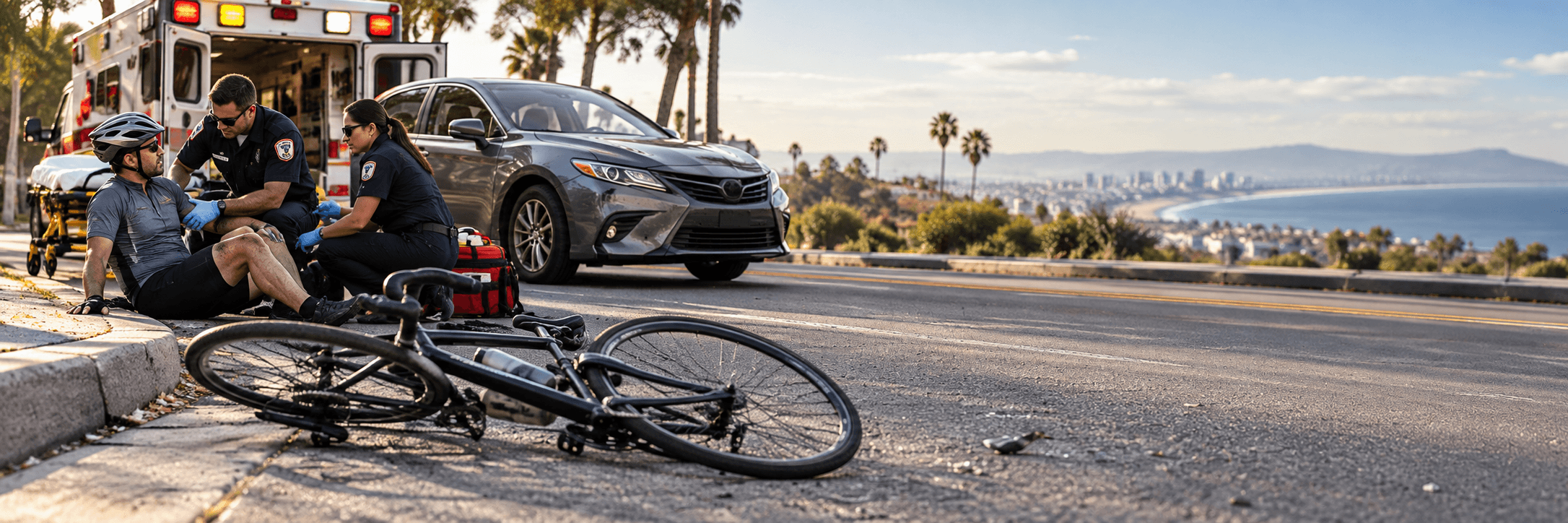
A cyclist’s injury claim carries a documentation burden that a driver’s claim does not, and the reason is structural rather than medical. When two cars collide, the vehicles themselves communicate how much force was involved. An adjuster looks at the photographs and forms a view before reading a single medical record. A bicycle does not do that work. It is lighter, it costs a fraction of what a car costs to replace, and a machine that came through a serious impact can look largely intact to someone whose experience is in evaluating vehicles. What a cyclist’s claim has to supply, in other words, is the evidence that a damaged car would otherwise supply on its own.
Key Takeaways
- Property damage is used as an informal proxy for force, and that proxy works against cyclists.
- A low repair or replacement cost is not evidence of a low-force impact, but it is frequently treated as though it were.
- Four records carry the weight: the bicycle and gear, the scene, the treatment history, and the functional record.
- Cyclists frequently hold something most injured people cannot produce — a detailed record of what they were capable of before.
- California recognises categories of loss rather than a figure, and there is no preset value for any claim.
- Helmet use goes to the extent of harm rather than to who caused the collision.
Why a Cyclist’s Claim Starts at a Disadvantage
Insurance adjusters evaluate a great many vehicle collisions and comparatively few bicycle collisions. The habits formed by the first carry over to the second, and the most consequential of those habits is reading property damage as a measure of impact.
The logic is not unreasonable when applied to two cars. It breaks down entirely when applied to a bicycle. A bicycle absorbs and transmits force differently from a vehicle built with crumple zones. Components fail in ways that are not visually dramatic. A carbon frame can sustain damage that is not obvious in a photograph. A wheel can be destroyed while the frame appears fine. And the replacement cost of the whole machine may be a small fraction of the cost of repairing a car’s door.
The practical result is that the number on the property damage line of a cyclist’s claim is small, and the inference drawn from it is that the impact was minor. Closing that gap is what the rest of the record has to do.
The Four Records a Claim Is Built From
The bicycle and the gear
The bicycle is evidence, not salvage, and it is worth treating as evidence from the first day. Photograph it before anything is moved or cleaned, from multiple angles and distances, including close images of any component that failed or deformed. Keep it unrepaired and do not return any part of it to a shop or a manufacturer. Helmets, clothing, shoes, eyewear and luggage carry impact information too, and should be kept in the condition they are in rather than cleaned or discarded.
Where a component may have failed rather than simply been damaged, the preservation question becomes more important still, and our page on California defective product claims sets out why.
The scene and the mechanism
How a collision happened bears directly on what it could have done. The position of the vehicle and the bicycle, the direction of travel, sight lines, lane markings, the road surface, and any camera footage from nearby homes, businesses or transit vehicles all contribute to establishing the mechanism. Footage is the element with the shortest life, frequently overwritten within days.
The treatment record
This is the record insurers read most closely. What matters is not eloquence but continuity and consistency: that care was sought, that referrals were followed rather than allowed to lapse, that the same account was given to each provider, and that any interruption in treatment has its reason recorded somewhere at the time rather than explained long afterwards.
Where an injury is one that standard imaging may not show, the evidentiary problem changes shape and the record has to be built differently. Our page on California brain injury claims covers that situation in detail, including the evidence categories that carry weight when a scan appears normal.
The functional record
Categories of loss that concern a person’s life rather than their bills are established through specific, dated, functional detail: what could be done before and cannot be done now, described in terms of tasks rather than feelings, and recorded by a provider or an employer rather than only remembered. Work missed, duties changed, and activities given up all belong in this record, and it is built over months rather than assembled at the end.
The Baseline Most Injured People Cannot Produce
This is where cyclists hold an advantage that is worth understanding, because very few injured people have anything like it.
A person injured in a car collision who says they used to be more active has their word and little else. A cyclist frequently has years of recorded rides — distances, durations, routes, elevation, frequency, and how all of that changed after a particular date. A cycling computer, a GPS watch, or a training or navigation app produces a continuous, timestamped record of physical capability created long before anyone contemplated a claim, which is precisely what makes it credible.
Two practical points follow. Export it rather than leaving it where it sits. Accounts lapse, devices are reset, subscriptions end and services close. And preserve the period after the collision as well as the period before it, because the comparison is what carries the meaning — a gap in the record is itself part of the record.
The same logic extends beyond ride data to anything that documents a routine that changed: club or event participation, training logs, commute patterns, work attendance.
What California Recognises, and What It Does Not Promise
Our page on California bicycle accident claims sets out the categories: past and future medical expenses, lost income and reduced earning capacity, damage to the bicycle and equipment, pain and suffering and loss of enjoyment of life, and loss of consortium in claims brought by a spouse. Where a collision is fatal, certain surviving family members may be able to bring a wrongful death claim, which follows its own rules.
Collisions between a bicycle and a motor vehicle can produce catastrophic outcomes, and those claims involve documentation of future needs rather than only past expenses. There is no preset value for a claim and no attorney can promise a figure. What documentation does is remove arguments rather than generate numbers.
Where responsibility is shared, a recovery is reduced by the share assigned rather than barred, and our page on pure comparative fault explains how that operates.
Where Helmet Use Fits
It is raised frequently and it belongs in a narrower place than it is usually put. Helmet use concerns the extent of the harm rather than who caused the collision, and California’s helmet requirement applies to riders under 18. The bicycle accident page sets out how that works and what follows for an adult rider. It is not an answer to the question of whether a driver was responsible for a crash.
What Helps, in Practice
- Photograph the bicycle and all gear before anything is cleaned, repaired or moved, and keep every item.
- Get evaluated promptly and follow through on referrals rather than letting them lapse.
- Give each provider the full history, including any prior injury to the same area.
- If treatment has to pause, make sure the reason is recorded at the time.
- Export ride data covering the period before the collision and keep recording afterwards.
- Describe limitations in terms of specific tasks rather than pain levels.
- Keep dated notes alongside the clinical record, plus bills, receipts and mileage to appointments.
- Track work missed and duties changed, with something from an employer where possible.
- Secure camera footage quickly, because it is overwritten on a short cycle.
Talk to a California Bicycle Accident Lawyer
Vaksman Khalfin, PC represents injured cyclists throughout California. A free consultation can review what has been documented so far, what is likely to be contested, and what should be preserved before it is gone. Call (650) 250-0705, schedule a free consultation, or read more about California bicycle accident claims, the San Mateo office, and the wider California personal injury practice.
Reviewed by Alan D. Khalfin, Partner and Managing Attorney, Vaksman Khalfin, PC (admitted in California). Last reviewed: 10/05/2026
Frequently Asked Questions
Property damage is an unreliable measure of force in a bicycle collision. A bicycle is lighter and cheaper than a vehicle, absorbs force differently, and can sustain damage that is not visually obvious. A low repair or replacement figure is not evidence about what happened to the rider, though it is frequently used as though it were, which is why the rest of the record matters.
Not before it has been photographed thoroughly and, where a component may have failed, examined. The bicycle is evidence. Repairing it, or returning a part to a shop or manufacturer, can remove information that cannot be recovered later.
Four categories carry most of the weight: the bicycle and gear in their post-collision condition, evidence of the scene and how the collision happened, the treatment record with its continuity and consistency, and a functional record of what changed in daily life and work.
It is frequently among the most useful evidence a cyclist has, because it documents physical capability before the collision in a form created long before any claim existed. Export it rather than leaving it on a device or in an account, and keep recording afterwards, since the comparison is what carries meaning.
Not by itself, though it will be raised. What helps is having the reason recorded contemporaneously rather than explained much later, and resuming and completing treatment.
Through a different evidentiary route, built from the treatment record over time, testimony about observed changes, employment or academic records, and contemporaneous personal documents. Our brain injury page sets out how those claims are established.
No. California's helmet requirement applies to riders under 18, and helmet use concerns the extent of harm rather than who caused the collision. It does not determine whether a driver was responsible.
The initial consultation is free. If the firm takes a case, attorney's fees are contingent on a recovery; case costs are a separate category, and how they are handled is set out in the written fee agreement before any representation begins.
