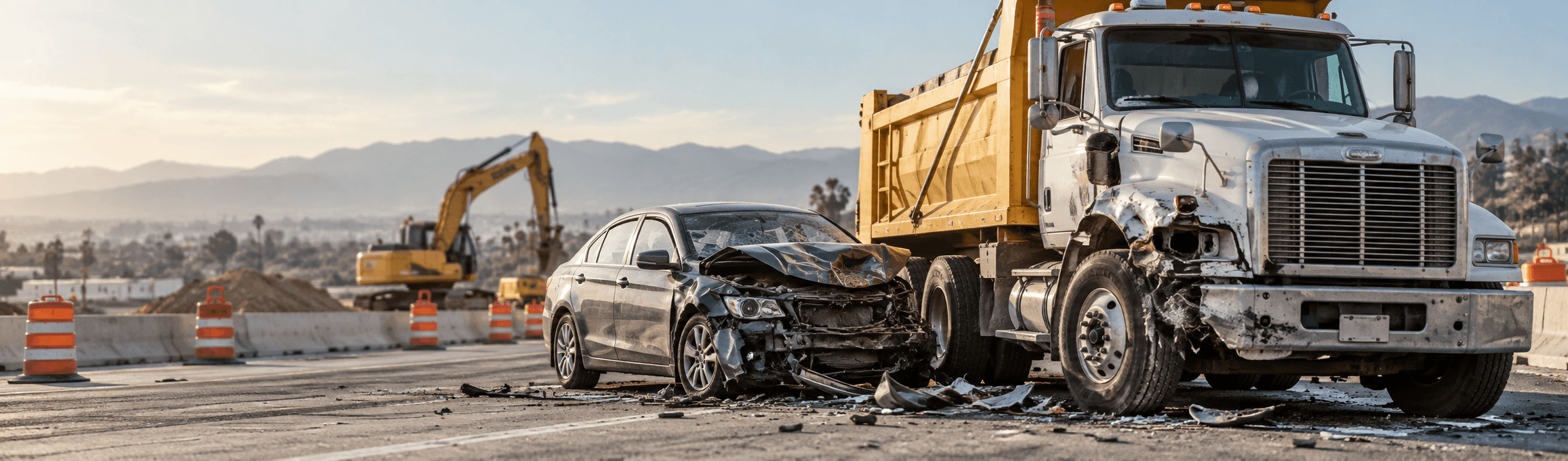
The first question after a construction vehicle crash is not who was at fault. It is who was hurt. A driver, cyclist or pedestrian struck by a dump truck, mixer or crane truck is in an ordinary injury claim. A construction worker injured on the site is primarily in the workers’ compensation system, which operates differently and generally takes the place of a claim against their own employer — while sometimes leaving separate claims available against other companies working the same site. Those two paths diverge immediately, and almost everything else follows from which one you are on.
Key Takeaways
- Members of the public injured by a construction vehicle bring ordinary injury claims. Workers injured on site are in a different system for claims against their own employer.
- An injured worker may still have separate claims against parties who were not their employer — a general contractor, another subcontractor, an equipment owner, a trucking company.
- When an employee suffers a serious injury or death at a place of employment, California requires the employer to report it to Cal/OSHA within eight hours. That creates a state record most people never hear about.
- Construction sites multiply the number of companies that may be involved, which means more insurers, slower claims, and preservation demands that have to reach several places at once.
- Where a public agency is responsible for the roadway or the traffic control plan, a much shorter claim-presentation requirement applies.
First: Which Path Are You On?
If you were a member of the public — driving past a site, walking near a lane closure, cycling alongside a haul route — your claim is an ordinary personal injury claim against whichever parties turn out to be responsible. Nothing about the construction context changes the basic framework; it changes how many parties there are and what evidence exists.
If you were working on the site, the picture is different. Workers’ compensation is the primary route for a claim arising out of and in the course of employment, and it generally operates in place of suing your own employer. It is a no-fault system with its own procedures, its own forms, and its own timelines. Separately from that, a worker may have ordinary injury claims against parties who were not their employer — the general contractor if you worked for a sub, another subcontractor, the company that owned or maintained the vehicle, the trucking firm that delivered material. Those are usually called third-party claims, and they sit alongside a comp claim rather than replacing it.
To be direct about what we do: Vaksman Khalfin handles personal injury claims. Workers’ compensation claims themselves are a separate system and are not among our practice areas. If you were hurt at work, you may need both a comp claim and a look at whether any third-party claim exists, and it is worth understanding that those are two different pieces of work before anyone tells you otherwise.
Construction Sites Multiply the Possible Defendants
An ordinary collision usually involves two drivers and two insurers. A construction site crash can involve a general contractor, one or more subcontractors, the company that owns or leases the vehicle, a separate trucking or hauling firm, whoever loaded the material, the property owner or developer, a maintenance provider, and a public agency responsible for the road or the work zone.
That is not a reason for optimism or pessimism by itself. Whether any particular party is legally responsible is a question of evidence rather than assumption. But it has three practical consequences worth knowing early:
- Preservation has to reach several entities. A demand sent to one company does not preserve records held by another, and on a busy site the relevant records are scattered.
- The insurance is layered. Contractors typically carry their own policies, subcontracts often allocate risk between the companies, and additional-insured arrangements are common. Identifying what applies is early work.
- More parties means slower. Each insurer investigates separately, and they frequently spend time pointing at each other before engaging with the injured person at all.
The Record Nobody Mentions at the Scene
This is the part most guides on this subject leave out entirely.
California regulation requires that “Every employer shall report immediately to the Division of Occupational Safety and Health any serious injury or illness, or death, of an employee occurring in a place of employment or in connection with any employment.” And “immediately” is defined: “as soon as practically possible but not longer than 8 hours after the employer knows or with diligent inquiry would have known of the death or serious injury or illness.” The report is made by telephone or through the online mechanism Cal/OSHA maintains for it.
So where a worker is seriously hurt on a site, a report to a state agency exists within hours, whether or not anyone at the scene mentions it. Where Cal/OSHA opens an inspection, more records follow. Those materials can be sought, and they are often the most neutral account of the event available.
One important limit: that reporting duty concerns injuries to employees. If you were a member of the public struck by a construction vehicle and no worker was hurt, the rule does not create a report about your collision. Where a worker was also injured in the same event, it does.
Work Zones, Traffic Control, and Public Agencies
Lane closures, flaggers, cones, detours and signage in a work zone are planned rather than improvised. There is normally a traffic control plan, often a permit from the city, the county, or the state agency responsible for the road, and a contractor obligated to set the zone up as specified.
That matters in two ways. The configuration at the moment of a crash — where the cones actually were, whether a flagger was present, whether signage gave adequate warning — is evidence, and it is evidence that changes by the hour as work progresses. Photographs and video taken at the time are close to irreplaceable.
And where a public entity may bear responsibility, the deadline to present a claim is materially shorter than the general deadline for a lawsuit. That is worth confirming early rather than discovering late, because work-zone cases involve public agencies more often than ordinary collisions do.
The Vehicles Themselves
Dump trucks, concrete mixers, crane and boom trucks, water trucks, and material haulers are heavy, have restricted sight lines, and carry loads whose securement and distribution matter. Many of them fall above the federal motor carrier thresholds, which brings a documentary framework with it — our page on California truck accident claims covers how those records work and what they establish. Some site vehicles fall below those thresholds, and the available evidence then looks quite different.
Where a load shifted, spilled, or was improperly secured, the company that loaded the vehicle may be a separate party from the company that drove it. That distinction is often not visible from outside the truck.
What to Preserve
- Photographs of the whole scene including the work zone configuration — cones, barriers, signage, flagger positions — before it changes.
- The vehicle in full: company name, license plate, any USDOT or CA number, unit or fleet numbers, and any visible markings identifying a contractor.
- Names of every company visibly working the site, not only the one whose vehicle was involved.
- The police report number, and witness details including workers who saw what happened.
- Prompt medical evaluation, with treatment kept continuous.
- If you were working: your own report to your employer, and a note of when you made it and to whom.
Our guide on what to do after a car accident covers the general scene-level steps, and they apply here in full.
Shared Fault
California allocates responsibility by percentage rather than using it as a bar, so being assigned some share of responsibility does not end a claim — it reduces the recovery by that share. Our page on pure comparative fault explains how the allocation works, including where several defendants are involved, which is common in construction cases.
Deadlines
California sets a deadline for filing a personal injury lawsuit. A materially shorter claim-presentation requirement applies where a public entity may be responsible, which is a live possibility in any work-zone case. Workers’ compensation has its own separate reporting and filing requirements, running on their own clock. Because which of these applies depends on who was responsible and on your relationship to the site, confirming them early is worth considerably more than estimating them later.
Construction Claims in San Mateo County
Most civil matters for this area are handled by the San Mateo County Superior Court. Where a crash involves a haul route, a work zone on a county or state road, or a site with several contractors on it, the identification work described above is where a claim starts.
If you were struck while walking or cycling near a site, our pages on pedestrian accidents and bicycle accidents cover those claims specifically.
Talk to a California Construction Vehicle Accident Lawyer
If you were injured by a construction vehicle in San Mateo County or elsewhere in California, Vaksman Khalfin, PC offers a free consultation to review which parties may be involved, what records should be preserved and from whom, and what deadlines apply. Call (650) 250-0705, schedule a free consultation, or read more about our California personal injury practice and our San Mateo office.
Reviewed by Alan D. Khalfin, Partner and Managing Attorney, Vaksman Khalfin, PC (admitted in California). Last reviewed: 10/01/2026
Frequently Asked Questions
An ordinary personal injury claim against whichever parties turn out to be responsible. The construction context does not change the framework, but it usually increases the number of companies potentially involved and the amount of evidence held by those companies rather than by the people at the scene.
For a claim against your own employer, workers' compensation is generally the route, and it operates in place of a lawsuit. Separately, you may have ordinary injury claims against parties who were not your employer — a general contractor if you worked for a sub, another subcontractor, an equipment owner, a hauling company. Whether any exists depends on the facts, and it is worth having both questions looked at.
No. Workers' compensation is a separate system and is not among our practice areas. We handle personal injury claims, which for an injured worker means the third-party claims that may exist alongside a comp claim rather than the comp claim itself.
California requires an employer to report a serious injury, illness or death of an employee at a place of employment to Cal/OSHA within eight hours. What follows from a report varies. Where an inspection does occur it generates records, and those records can be sought as part of a claim.
Potentially the driver, the driver's employer, a general contractor, a subcontractor, the owner or lessor of the vehicle, whoever loaded it, a maintenance provider, the property owner, or a public agency responsible for the roadway or work zone. Whether any of them is legally responsible is a question of evidence rather than assumption.
More than one clock can run. California sets a deadline for filing a personal injury lawsuit, a much shorter claim-presentation requirement applies where a public entity may be responsible, and workers' compensation carries separate reporting and filing requirements. Which applies depends on who was responsible and on whether you were working at the time.