
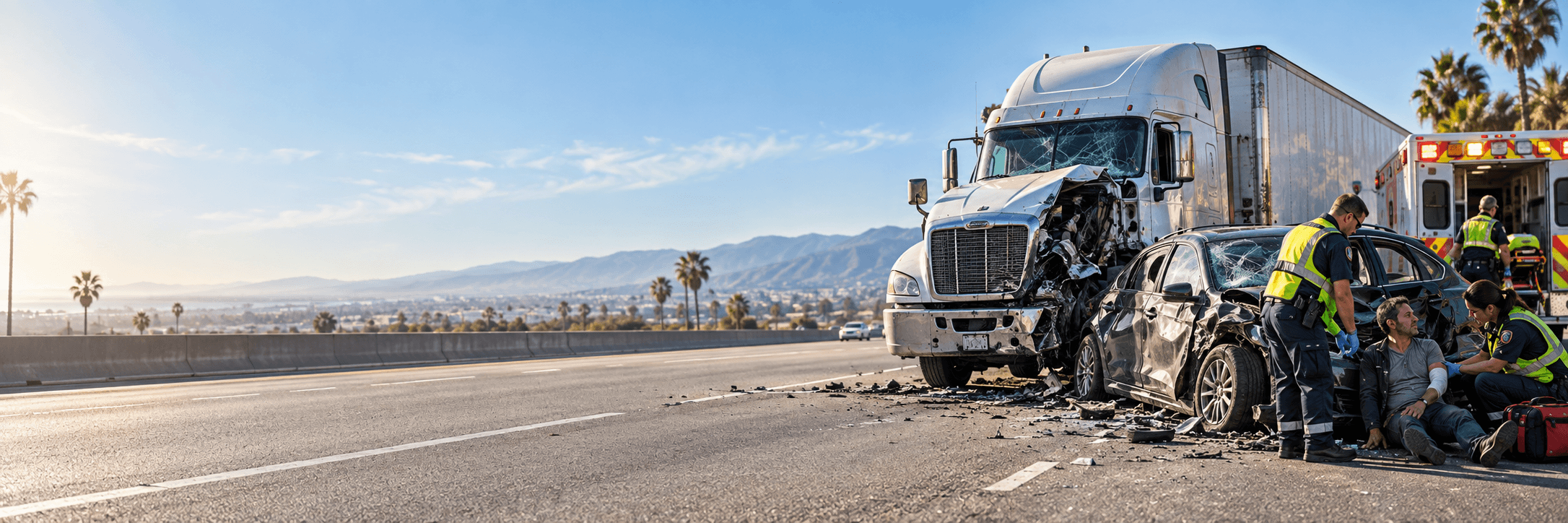
A loaded tractor-trailer is many times heavier than a car and sits much higher off the road. That difference shapes the injuries people suffer: underride impacts at windshield height, crush injuries, brain and spinal cord trauma, burns, and amputations. These injuries usually require long treatment and often change a person’s ability to work and manage daily life.
This guide covers the injury patterns truck crashes tend to cause, why they happen, what the medical record needs to show for each, and how California law measures losses that may continue for years. For the federal records a trucking company must keep, see what a truck accident lawyer does.
Truck crashes often cause several serious injuries at once, and some, especially brain injuries, may not be apparent in the first days. In a California claim, the medical record has to connect each injury to the crash and show how it affects the person over time. California law compensates for all the harm the crash caused, including future harm reasonably certain to occur, which is usually documented through treating physicians, life care planners, and economists.
Key Takeaways
- The size and weight difference between a truck and a car produces injury patterns that are less common in car-to-car crashes.
- In an underride crash, the trailer strikes the car’s windshield and roof, bypassing the car’s crumple zones and airbags.
- Federal rules require rear impact guards on most trailers of 10,000 pounds or more built on or after January 26, 1998.
- Brain and spinal cord injuries are usually documented over months of specialist care, not in one visit.
- Future losses are recoverable when they are reasonably certain to occur, and they must be proven.
Truck Accident Injury Patterns and What They Require
| Injury | How truck crashes commonly cause it | What the medical record needs to show |
|---|---|---|
| Traumatic brain injury | Underride, high-speed impact, the head striking the interior | Initial findings, neurological and neuropsychological evaluations, changes over time |
| Spinal cord injury | Crush forces, rollover, cabin compression | Imaging, the level of injury, rehabilitation, equipment and home modification needs |
| Fractures and orthopedic injuries | Intrusion into the cabin, side impacts | Surgery, hardware, therapy, risk of future surgery or arthritis |
| Internal injuries | Blunt force from seat belts, the steering wheel, or intrusion | Emergency imaging, surgery, follow-up for complications |
| Burns | Fuel fires, hazardous cargo | Burn unit records, grafting, scarring, reconstruction |
| Amputation | Crush or degloving injuries | Surgery, prosthetic needs and replacement schedule, effect on work |
| Soft tissue and whiplash injuries | Rear-end impacts from a heavy vehicle | Consistent treatment, functional limits, response to therapy |
Truck crashes often cause several of these at once, and some, particularly brain injuries, may not be obvious for days.
Underride: The Injury Mechanism Unique to Large Trucks
In an underride crash, a car slides under the rear or side of a trailer. Instead of meeting the car’s front bumper, the trailer’s frame strikes the windshield and roof, which bypasses the crumple zones and airbags designed to protect the people inside.
Under 49 C.F.R. section 393.86, most trailers and semitrailers with a gross vehicle weight rating of 10,000 pounds or more manufactured on or after January 26, 1998, must have a rear impact guard. The bottom edge of the guard may be no more than 22 inches above the ground across its full width, and the guard must extend to within 4 inches of each side of the trailer. Some trailer types are excluded, including pole trailers, pulpwood trailers, low chassis vehicles, special purpose vehicles, and wheels back vehicles.
After an underride crash, the guard’s presence, condition, height, and strength become evidence. A missing, damaged, or poorly maintained guard can point to the carrier’s maintenance or, in some cases, to the manufacturer.
Brain and Spinal Cord Injuries
These are among the most serious truck crash injuries because their effects can last a lifetime.
- Brain injuries can cause memory problems, slower thinking, irritability, headaches, and sensitivity to light and noise, even when early scans look normal.
- Spinal cord injuries can affect movement, sensation, breathing, bladder and bowel function, and the ability to live independently.
Proving these injuries usually takes months of evaluation by specialists rather than a single appointment. See our California brain injury page.
How California Measures Losses After a Truck Accident Injury
Civil Code section 3333 measures damages as the amount that compensates for all the detriment proximately caused, whether it could have been anticipated or not. Civil Code section 3283 allows damages for detriment certain to result in the future. For serious truck crash injuries, the categories usually include:
- Past and future medical care: surgery, hospitalization, rehabilitation, medication, equipment, and attendant care
- Lost earnings and earning capacity: wages already lost and a reduced ability to earn in the future
- Household and life changes: home modifications, transportation, and help with daily tasks
- Non-economic losses: physical pain, emotional distress, disfigurement, and loss of enjoyment of life
Future losses are usually documented through treating physicians, life care planners who project lifetime medical and support needs, and economists who calculate the present value of those needs and of lost earnings. There is no preset value for any of these categories, and no figure offered before the facts are known would be meaningful.
Keeping the Injury Record Complete
Insurers often point to gaps in treatment or inconsistencies in the record. A few habits help keep the record complete:
- Go to specialist referrals and keep follow-up appointments.
- Tell each provider about every symptom, including changes in memory, mood, and sleep.
- Disclose earlier injuries or conditions. The question is what the crash caused, including any worsening of a prior condition, and a complete history is more credible.
- Keep a simple log of symptoms, missed work, and activities you can no longer do.
- Save receipts for travel to appointments, equipment, and help at home.
When More Than One Party Is Responsible
A truck crash can involve the driver, the carrier, and other companies. Under California’s pure comparative fault rule, a share of fault assigned to the injured person reduces the recovery but does not bar it, and Civil Code section 1431.2 generally limits each defendant’s liability for non-economic damages to its own share of fault. For who may be responsible, see our California truck accident page.
If the Crash Was Fatal
When a truck crash causes a death, Code of Civil Procedure section 377.60 allows certain family members, including a surviving spouse or domestic partner and children, to bring a wrongful death claim. See truck accident wrongful death.
Deadlines
- General rule. An injury lawsuit generally must be filed within two years (Code of Civil Procedure section 335.1).
- Children. The time a person is a minor generally does not count toward that deadline (section 352(a)), but that pause does not apply to claims against public entities (section 352(b)).
- Public entities. If a government agency may share responsibility, a written claim generally must be presented within six months (Government Code section 911.2).
A settlement of a minor’s claim generally requires court approval, through a petition under Code of Civil Procedure section 372 and the California Rules of Court.
Get Help With a Truck Accident Injury Claim
Vaksman Khalfin, PC can help document the injuries, identify who may be responsible, and track the deadline that applies. The first conversation is free. Injury matters are handled on contingency under a written agreement that states the fee percentage and explains case costs separately. Call (650) 250-0705 or visit our San Mateo office page.
This page provides general information about California law and is not legal advice. Reading it or contacting the firm does not create an attorney-client relationship. Every case is different, and prior results do not guarantee a similar outcome.
Reviewed by Alan D. Khalfin, Partner and Managing Attorney, Vaksman Khalfin, PC (admitted in California). Last reviewed: 10/20/2026
Frequently Asked Questions
Brain injuries, spinal cord injuries, fractures, internal injuries, burns, amputations, and soft tissue injuries. Because of the size and weight difference, several often occur together.
A crash in which a car slides under the rear or side of a trailer, so the trailer strikes the windshield and roof. Federal rules require rear impact guards on most trailers of 10,000 pounds or more built on or after January 26, 1998.
Usually through treating physicians, a life care plan projecting future medical and support needs, and an economist who calculates present value. California allows damages for detriment certain to result in the future.
That does not end a claim. The question is what the truck crash caused, including any worsening of the earlier condition, and disclosing the prior condition fully supports credibility.
The time a child is a minor generally does not count toward the two-year deadline, but a claim against a public entity still generally requires a written claim within six months. A settlement of a child's claim generally requires court approval.
Two years from the injury is the usual window to sue. If a government agency may share responsibility, its written claim is typically due within six months.
