
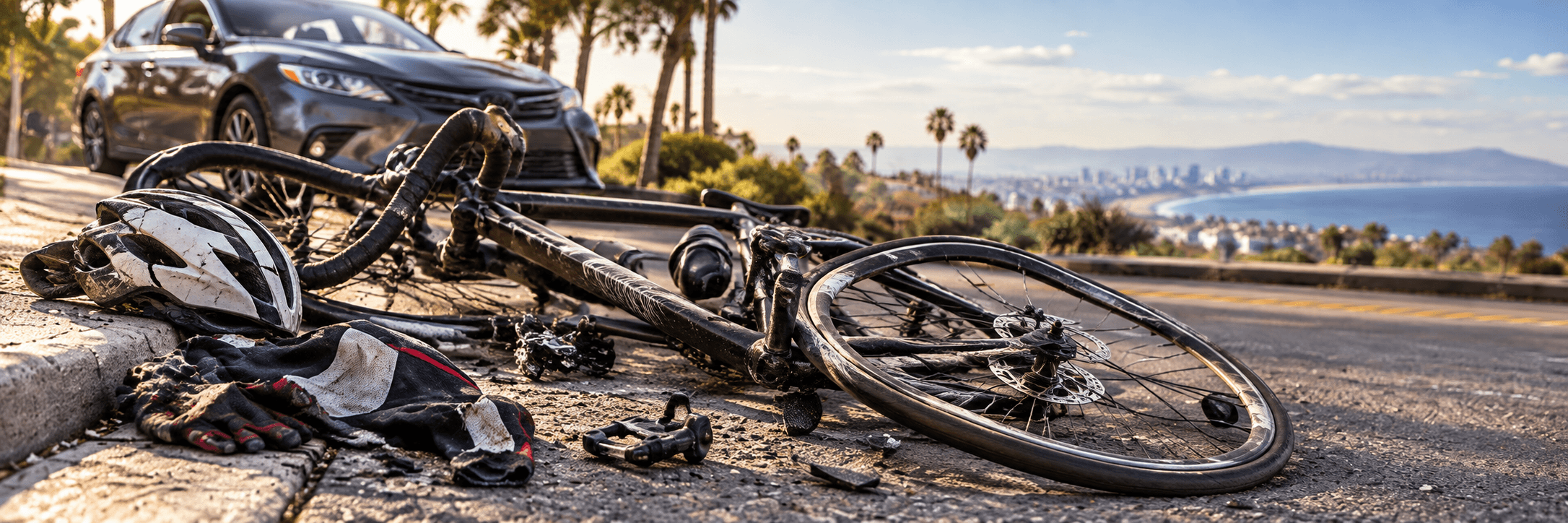
After a collision a bicycle is two things at once, and they pull in opposite directions. It is a damaged possession you want replaced, and it is evidence of what happened to you. The property claim is usually the one that moves first — an adjuster calls within days, wants the bicycle assessed, and offers to close that part of the file long before anyone knows what the injury picture looks like. This page covers which coverage pays for a bicycle and gear, how a bicycle gets valued, and why resolving the property side quickly can create a problem on the other side.
Key Takeaways
- The property claim and the injury claim are handled separately and move at different speeds.
- What is signed to close the property side can affect the rest, so it is worth reading before signing anything.
- The bicycle is evidence. Letting an insurer take it, or repairing it, can remove information the injury claim depends on.
- Uninsured motorist property damage is capped at $3,500 and only pays where the uninsured driver has been identified.
- Actual cash value in California means fair market value, which is not the same as what a replacement costs today.
- Helmets, clothing, shoes, electronics and luggage are property too and are routinely left out of a claim.
The Property Claim and the Injury Claim Are Not the Same Claim
They are frequently handled by different adjusters, on different timelines, and the property side resolves far faster because the numbers look small and the questions look simple.
That speed is the risk. What a person signs to resolve the property claim can carry wider effect than the subject it appears to cover, and by the time the medical picture is understood the paperwork may already have been returned. Our page on uninsured motorist coverage in California makes the related point that settling directly with the other driver’s insurer without first considering your own coverage can create a problem.
None of that means the property claim should be left unresolved. It means the document that closes it is worth reading carefully, or having read, before it is signed.
The Conflict Nobody Warns Cyclists About
An insurer handling the property claim will often want to inspect the bicycle, assess it, and in many cases take possession of it — particularly if it is treated as a total loss, because an insurer that pays out on an item generally takes the item.
That bicycle is also the physical record of the collision. Its damage pattern carries information about direction, angle and force, which matters precisely because a bicycle communicates none of that to an adjuster the way a crumpled car does. If a component failed rather than simply breaking on impact, the bicycle is the only place that can be established, and our page on California defective product claims explains why preserving it is decisive there.
The two purposes are in direct tension, and the resolution is a sequencing question rather than a choice between them. Photograph everything thoroughly before any inspection. Do not have the bicycle repaired, and do not allow any part of it to be returned to a shop or manufacturer, including under warranty. And where the injury side is unresolved, the question of who holds the bicycle and on what terms is worth raising before agreeing to hand it over.
Which Coverage Pays for the Bicycle
The responsible driver’s property damage liability coverage is the primary route where a motorist was at fault.
Uninsured motorist property damage applies where the at-fault driver had no insurance, and it is narrow. The California Department of Insurance states that this coverage “pays for the damage to your car from an accident with an uninsured driver who is at fault,” that “the limit is $3,500,” and that “this only pays if the uninsured driver is identified.” Our uninsured motorist page draws out the consequence: in an unsolved hit-and-run, uninsured motorist property damage does not respond.
Collision coverage is the other route the Department describes, covering damage caused by physical contact with another vehicle or object, subject to a deductible.
There is a point worth noticing about all three. The Department’s definitions are written around a car — damage “to your car,” from “an accident.” Whether a bicycle falls within these coverages, and on what terms, is a question of the particular policy rather than something the general definitions answer. Homeowners and renters policies, and standalone bicycle policies as a product category, may cover the machine itself where auto coverage does not. This firm has no relationship with any insurer or provider of such coverage and recommends none.
Our page on California bicycle accident claims lists damage to the bicycle and equipment among the categories a California claim can include.
How a Bicycle Gets Valued
This is where expectations and outcomes separate, and the reason is a definition rather than an insurer being difficult.
The California Department of Insurance defines actual cash value this way: “Unless otherwise defined in the policy, actual cash value in California means fair market value. The fair market value of an item is the dollar amount that a knowledgeable buyer (under no unusual pressure) is willing to pay, and a knowledgeable seller (under no unusual pressure) is willing to accept.”
Fair market value is not what a comparable new bicycle costs today, and it is not what was paid originally. It is what the bicycle as it stood immediately before the collision would have changed hands for. For a machine several seasons old, those figures can differ considerably, and that gap is a frequent source of dispute rather than a sign that something has gone wrong.
The Department defines a total loss as damage or destruction to property to such an extent that it cannot be rebuilt or repaired to its condition prior to the loss, or where it would be cost prohibitive to repair or rebuild in comparison to the value of the property before the loss. Applied to bicycles, that threshold arrives sooner than people expect, because the value being compared against is the fair market value rather than the replacement cost.
What helps is evidence of what the bicycle actually was: the original purchase record, the specification including any component upgrades, the service history, and comparable listings for the same model and condition.
The Helmet and the Gear
These are the items most often left out, and they are property like anything else.
A helmet involved in an impact, cycling shoes, clothing, eyewear, gloves, a computer or phone mount, lights, a rack, luggage and its contents, and anything carried at the time all belong on the list. So do items that were not visibly damaged but were part of the same loss.
The same preservation rule applies to all of it. Photograph everything, keep it unwashed and unrepaired, and do not dispose of anything — a helmet in particular carries impact information and should not be thrown away because it looks finished.
Documenting the Damage
- Photograph the bicycle and every item before anything is moved, cleaned or handled, from several distances, with close images of any component that failed or deformed.
- Record the make, model, year, frame size and serial number, along with any component upgrades that differ from the standard specification.
- Gather purchase records, invoices for upgrades, and service history.
- Keep every damaged item, including gear that appears worthless.
- Collect comparable listings for the same model and condition while they are visible.
- Keep correspondence from any adjuster, with dates and claim numbers.
- Do not repair, replace or return anything, and do not send a component back under warranty, before the position is understood.
One thing this page deliberately does not do is tell you whether a bicycle is safe to ride again. That is a mechanical judgment for a qualified bicycle mechanic, and it is worth getting independently of anything to do with a claim.
If the Insurer Is Handling It Badly
Disagreement about value is ordinary and is not by itself improper. Where your own insurer is involved, our page on bad faith insurance claims in California explains that being wrong is not enough, and that what matters is whether the insurer actually investigated, responded in reasonable time and explained its position.
Where responsibility for the collision is disputed or shared, that affects the property claim as it affects the rest. California reduces a recovery by the share of responsibility assigned rather than barring it, and our page on pure comparative fault explains how that works.
Talk to a California Bicycle Accident Lawyer
Vaksman Khalfin, PC represents injured cyclists throughout California. A free consultation can review which coverage may respond to the damage, what should be preserved before anything is inspected or handed over, and how the property side fits with the rest. Call (650) 250-0705, schedule a free consultation, or read more about California bicycle accident claims, the San Mateo office, and the wider California personal injury practice.
Reviewed by Alan D. Khalfin, Partner and Managing Attorney, Vaksman Khalfin, PC (admitted in California). Last reviewed: 10/05/2026
After a collision a bicycle is two things at once, and they pull in opposite directions. It is a damaged possession you want replaced, and it is evidence of what happened to you. The property claim is usually the one that moves first — an adjuster calls within days, wants the bicycle assessed, and offers to close that part of the file long before anyone knows what the injury picture looks like. This page covers which coverage pays for a bicycle and gear, how a bicycle gets valued, and why resolving the property side quickly can create a problem on the other side.
Key Takeaways
- The property claim and the injury claim are handled separately and move at different speeds.
- What is signed to close the property side can affect the rest, so it is worth reading before signing anything.
- The bicycle is evidence. Letting an insurer take it, or repairing it, can remove information the injury claim depends on.
- Uninsured motorist property damage is capped at $3,500 and only pays where the uninsured driver has been identified.
- Actual cash value in California means fair market value, which is not the same as what a replacement costs today.
- Helmets, clothing, shoes, electronics and luggage are property too and are routinely left out of a claim.
The Property Claim and the Injury Claim Are Not the Same Claim
They are frequently handled by different adjusters, on different timelines, and the property side resolves far faster because the numbers look small and the questions look simple.
That speed is the risk. What a person signs to resolve the property claim can carry wider effect than the subject it appears to cover, and by the time the medical picture is understood the paperwork may already have been returned. Our page on uninsured motorist coverage in California makes the related point that settling directly with the other driver’s insurer without first considering your own coverage can create a problem.
None of that means the property claim should be left unresolved. It means the document that closes it is worth reading carefully, or having read, before it is signed.
The Conflict Nobody Warns Cyclists About
An insurer handling the property claim will often want to inspect the bicycle, assess it, and in many cases take possession of it — particularly if it is treated as a total loss, because an insurer that pays out on an item generally takes the item.
That bicycle is also the physical record of the collision. Its damage pattern carries information about direction, angle and force, which matters precisely because a bicycle communicates none of that to an adjuster the way a crumpled car does. If a component failed rather than simply breaking on impact, the bicycle is the only place that can be established, and our page on California defective product claims explains why preserving it is decisive there.
The two purposes are in direct tension, and the resolution is a sequencing question rather than a choice between them. Photograph everything thoroughly before any inspection. Do not have the bicycle repaired, and do not allow any part of it to be returned to a shop or manufacturer, including under warranty. And where the injury side is unresolved, the question of who holds the bicycle and on what terms is worth raising before agreeing to hand it over.
Which Coverage Pays for the Bicycle
The responsible driver’s property damage liability coverage is the primary route where a motorist was at fault.
Uninsured motorist property damage applies where the at-fault driver had no insurance, and it is narrow. The California Department of Insurance states that this coverage “pays for the damage to your car from an accident with an uninsured driver who is at fault,” that “the limit is $3,500,” and that “this only pays if the uninsured driver is identified.” Our uninsured motorist page draws out the consequence: in an unsolved hit-and-run, uninsured motorist property damage does not respond.
Collision coverage is the other route the Department describes, covering damage caused by physical contact with another vehicle or object, subject to a deductible.
There is a point worth noticing about all three. The Department’s definitions are written around a car — damage “to your car,” from “an accident.” Whether a bicycle falls within these coverages, and on what terms, is a question of the particular policy rather than something the general definitions answer. Homeowners and renters policies, and standalone bicycle policies as a product category, may cover the machine itself where auto coverage does not. This firm has no relationship with any insurer or provider of such coverage and recommends none.
Our page on California bicycle accident claims lists damage to the bicycle and equipment among the categories a California claim can include.
How a Bicycle Gets Valued
This is where expectations and outcomes separate, and the reason is a definition rather than an insurer being difficult.
The California Department of Insurance defines actual cash value this way: “Unless otherwise defined in the policy, actual cash value in California means fair market value. The fair market value of an item is the dollar amount that a knowledgeable buyer (under no unusual pressure) is willing to pay, and a knowledgeable seller (under no unusual pressure) is willing to accept.”
Fair market value is not what a comparable new bicycle costs today, and it is not what was paid originally. It is what the bicycle as it stood immediately before the collision would have changed hands for. For a machine several seasons old, those figures can differ considerably, and that gap is a frequent source of dispute rather than a sign that something has gone wrong.
The Department defines a total loss as damage or destruction to property to such an extent that it cannot be rebuilt or repaired to its condition prior to the loss, or where it would be cost prohibitive to repair or rebuild in comparison to the value of the property before the loss. Applied to bicycles, that threshold arrives sooner than people expect, because the value being compared against is the fair market value rather than the replacement cost.
What helps is evidence of what the bicycle actually was: the original purchase record, the specification including any component upgrades, the service history, and comparable listings for the same model and condition.
The Helmet and the Gear
These are the items most often left out, and they are property like anything else.
A helmet involved in an impact, cycling shoes, clothing, eyewear, gloves, a computer or phone mount, lights, a rack, luggage and its contents, and anything carried at the time all belong on the list. So do items that were not visibly damaged but were part of the same loss.
The same preservation rule applies to all of it. Photograph everything, keep it unwashed and unrepaired, and do not dispose of anything — a helmet in particular carries impact information and should not be thrown away because it looks finished.
Documenting the Damage
- Photograph the bicycle and every item before anything is moved, cleaned or handled, from several distances, with close images of any component that failed or deformed.
- Record the make, model, year, frame size and serial number, along with any component upgrades that differ from the standard specification.
- Gather purchase records, invoices for upgrades, and service history.
- Keep every damaged item, including gear that appears worthless.
- Collect comparable listings for the same model and condition while they are visible.
- Keep correspondence from any adjuster, with dates and claim numbers.
- Do not repair, replace or return anything, and do not send a component back under warranty, before the position is understood.
One thing this page deliberately does not do is tell you whether a bicycle is safe to ride again. That is a mechanical judgment for a qualified bicycle mechanic, and it is worth getting independently of anything to do with a claim.
If the Insurer Is Handling It Badly
Disagreement about value is ordinary and is not by itself improper. Where your own insurer is involved, our page on bad faith insurance claims in California explains that being wrong is not enough, and that what matters is whether the insurer actually investigated, responded in reasonable time and explained its position.
Where responsibility for the collision is disputed or shared, that affects the property claim as it affects the rest. California reduces a recovery by the share of responsibility assigned rather than barring it, and our page on pure comparative fault explains how that works.
Talk to a California Bicycle Accident Lawyer
Vaksman Khalfin, PC represents injured cyclists throughout California. A free consultation can review which coverage may respond to the damage, what should be preserved before anything is inspected or handed over, and how the property side fits with the rest. Call (650) 250-0705, schedule a free consultation, or read more about California bicycle accident claims, the San Mateo office, and the wider California personal injury practice.
Reviewed by Alan D. Khalfin, Partner and Managing Attorney, Vaksman Khalfin, PC (admitted in California). Last reviewed: 05/10/2026
Frequently Asked Questions
Where a motorist was responsible, their property damage liability coverage is the primary route. Where the driver was uninsured but identified, uninsured motorist property damage may apply, subject to a $3,500 limit. Collision coverage, homeowners or renters coverage, or a standalone bicycle policy may respond depending on the terms of the particular policy.
Not usually, and not because anything has gone wrong. The California Department of Insurance defines actual cash value as fair market value — what a knowledgeable buyer under no unusual pressure would pay and a knowledgeable seller would accept. That is the value of the bicycle as it stood before the collision, rather than its original price or the cost of a new equivalent.
Not without thinking about the injury side first. The bicycle is physical evidence of the collision, and if a component may have failed it is the only place that can be established. Photograph everything thoroughly, and raise the question of who holds the bicycle and on what terms before agreeing to hand it over.
Property and injury claims are frequently handled separately, but what is signed to close one can carry wider effect. The document that resolves the property claim is worth reading carefully, or having read, before it is signed.
These are property and belong in the claim, though they are routinely omitted. Helmets, shoes, clothing, eyewear, electronics, lights and luggage all count. Keep every item rather than discarding anything that looks finished.
Uninsured motorist property damage only pays where the uninsured driver has been identified, so in an unsolved hit-and-run it does not respond. Collision coverage or another policy may, depending on the terms.
Possibly, and it is worth having looked at rather than assumed either way. Damage is not always visible, and whether a bicycle remains safe to ride is a question for a qualified mechanic rather than for a website.
The initial consultation is free. If the firm takes a case, attorney's fees are contingent on a recovery; case costs are a separate category, and how they are handled is set out in the written fee agreement before any representation begins.
