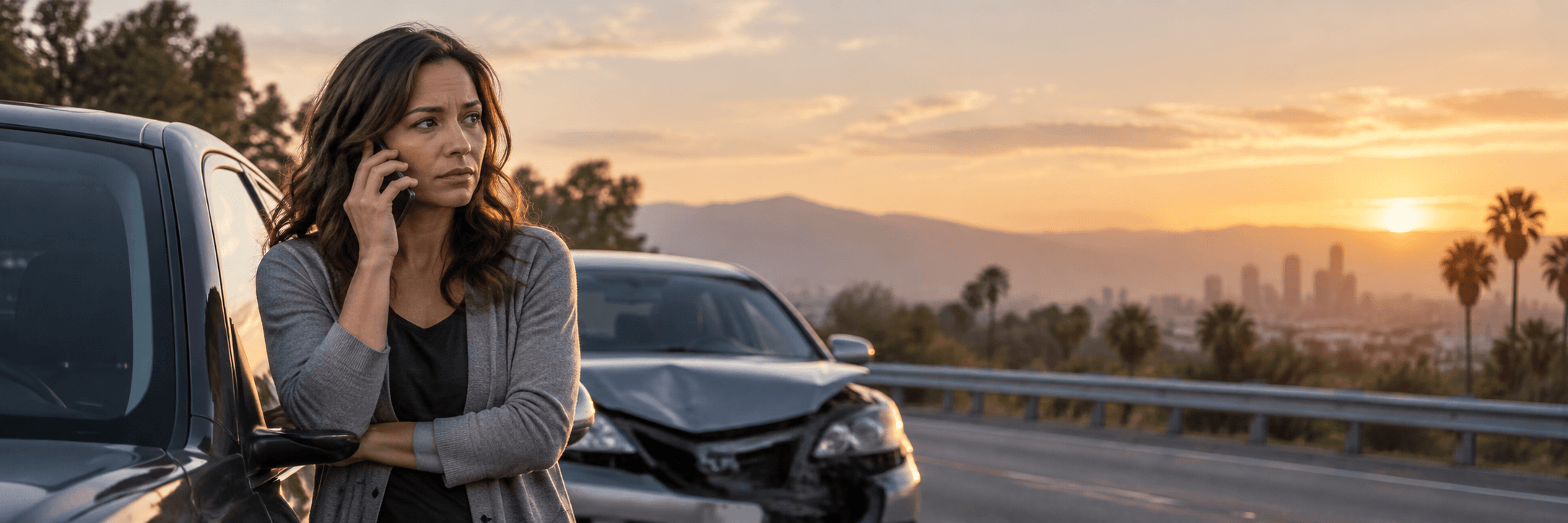
Uninsured motorist (UM) coverage is part of your own auto policy. It pays for bodily injury caused by a driver who has no insurance, and in some circumstances by a hit-and-run driver. Underinsured motorist (UIM) coverage applies where the at-fault driver has insurance but not enough. In California, insurers must include this coverage in every bodily injury liability policy unless you agree in writing to delete it or to take lower limits — which means many drivers carry it without knowing.
Most published explanations of uninsured motorist coverage are written for a national audience, and California differs in ways that decide real claims. The two that matter most: how the state defines an “underinsured” vehicle, and the fact that a claim against your own insurer has its own deadline that negotiating with your adjuster does not satisfy.
Key Points
- UM/UIM is optional to buy but mandatory to offer. Declining it requires your written agreement, so if an insurer says you have none, ask them to produce the signed rejection.
- California defines an underinsured vehicle by comparing the other driver’s liability limits to your UM limits — not to your losses.
- That definition means minimum-limits UIM coverage can be worth nothing against a minimum-limits driver.
- A UM/UIM claim is a claim against your own insurance company, and disputes over fault and damages generally go to arbitration rather than to court.
- The claim has its own accrual deadline under Insurance Code section 11580.2. Talking to your adjuster does not preserve it.
- California’s minimum liability limits have been $30,000 per person, $60,000 per accident, and $15,000 for property damage since January 1, 2025.
What Uninsured Motorist Coverage Actually Is
The California Department of Insurance describes uninsured/underinsured motorist coverage as coverage for accidents where the other driver is at fault and either has no insurance or does not have enough. The Department is explicit that insurers must offer the coverage, that declining it requires a signed waiver, and that uninsured motorist bodily injury is offered at limits tied to the liability limits on the same policy.
The practical structure is that you make a claim against your own insurer, and your insurer stands in the shoes of the driver who hurt you. You still have to establish that the other driver was at fault and that your injuries and losses are what you say they are. The coverage is not a benefit that pays out on proof of a collision; it is a substitute defendant.
UM and UIM are not the same thing
| Uninsured motorist (UM) | Underinsured motorist (UIM) | |
| When it applies | The at-fault driver has no liability insurance, or fled and cannot be identified | The at-fault driver has liability insurance, but their limits are lower than your UM limits |
| Who you claim against | Your own insurer | Your own insurer, after the other policy is resolved |
| What it pays | Bodily injury damages up to your UM limit | The difference between the other driver’s limits and yours |
The California Definition That Catches People Out
Under Insurance Code section 11580.2, an “underinsured motor vehicle” is an insured vehicle insured for an amount less than the uninsured motorist limits carried on the vehicle of the injured person.
Read that comparison carefully, because it is not the one most people assume. California does not compare the other driver’s limits to your medical bills. It compares them to your own UM limits. The consequence:
- You carry UM limits of $30,000. The at-fault driver carries liability limits of $30,000. Their vehicle is not underinsured under the statute, no matter how large your losses are. There is no UIM claim to make.
- You carry UM limits of $250,000. The at-fault driver carries $30,000. Their vehicle is underinsured, and your UIM coverage addresses the gap above what their policy pays.
This is why buying UM/UIM at the state minimum offers far less protection than the price suggests. The coverage only does work when your limits are higher than the other driver’s — and the other driver, in the situation where this matters most, is usually carrying the minimum.
California law also generally requires that the at-fault driver’s liability coverage be exhausted before underinsured motorist coverage is reached, which is one reason settling directly with the other driver’s insurer without first considering your own coverage can create a problem.
Do You Already Have It?
Probably, and more often than people expect. Section 11580.2 requires an insurer to provide uninsured motorist coverage in each bodily injury liability policy it issues, and permits deletion or reduction of that coverage only by agreement with the applicant — the statute prescribes the language of that written agreement.
Two practical consequences:
- Check the declarations page of every auto policy in the household, not just the one on the car involved. Coverage can extend to resident relatives, and to you as a pedestrian, cyclist, or passenger in someone else’s vehicle, depending on the policy and the statutory definitions.
- If an insurer says there is no UM coverage, that assertion depends on a signed written rejection existing in the file. It is reasonable to ask for a copy.
The Deadline Nobody Warns You About
This is the failure that ends otherwise good claims.
A UM claim is not governed only by the general personal injury deadline. Under Insurance Code section 11580.2, no cause of action accrues to the insured unless, within two years of the date of the accident, one of three things has happened: suit has been filed against the uninsured motorist in a court of competent jurisdiction, agreement has been reached on the amount due under the policy, or the insured has formally instituted arbitration by notifying the insurer in writing sent by certified mail, return receipt requested.
Negotiating with your own adjuster is not on that list. It is entirely possible to spend eighteen months in cooperative discussions with your insurer, receive an offer afterwards, and find the claim has already lapsed. Where the two-year mark is approaching and none of the three steps has been taken, the written arbitration demand is usually the simplest to complete.
Your Own Insurer Is Now the Other Side
The relationship changes the moment a UM claim is opened. Your insurer is contractually obliged to handle the claim in good faith, and it is also the party that pays if you succeed. Both things are true at once.
Section 11580.2 requires policies to provide that disputes about whether the insured is legally entitled to recover, and how much, are decided by agreement or, failing that, by arbitration. So a contested UM claim does not usually end up in front of a jury. It ends up in an arbitration your insurer’s counsel will defend, on the same issues any defendant would raise: fault, causation, pre-existing conditions, and the reasonableness of treatment.
The practical implication is that a UM claim is built the same way a claim against a negligent driver is built — with documentation — and the fact that you pay the premiums does not change how it is evaluated.
What UM Coverage Does Not Do
- It is not health insurance. It responds to legal liability for bodily injury, not to medical bills as they arrive.
- It does not cover your vehicle damage automatically. Damage to your car runs through collision coverage or through uninsured motorist property damage (UMPD), a separate coverage. Per the Department of Insurance, UMPD is limited to $3,500 and pays only where the uninsured driver has been identified.
- It does not pay above your limit. Your UM limit is the ceiling, however serious the injury.
- It does not apply to a driver who is adequately insured. If the at-fault driver’s limits equal or exceed yours, neither UM nor UIM is triggered.
Hit-and-Run Collisions
Uninsured motorist bodily injury coverage can apply where the at-fault driver flees and cannot be identified, and it is often the only realistic source of recovery in those cases. Both the statute and typical policy language impose conditions on these claims, including prompt reporting, and the specific requirements matter.
The vehicle damage side works differently. The Department of Insurance states that uninsured motorist property damage pays only where the uninsured driver has been identified — so in an unsolved hit-and-run, UMPD does not respond, and damage to the car falls to collision coverage if you carry it.
If a driver left the scene, reporting the collision to law enforcement promptly and notifying your own insurer early are both worth doing before anything else. Our page on what to do after a car accident covers the reporting duties that apply regardless of fault.
Should You Reject It?
That is a personal financial decision rather than a legal one, and this page is not advice on what to buy. What is worth understanding before signing a rejection is the shape of the risk: liability coverage protects other people from you, and UM/UIM is the only part of an auto policy that protects you from a driver who cannot pay. Where a driver carries the state minimum in liability and nothing else, a serious injury caused by an uninsured driver has no obvious source of recovery, because a driver who carries no insurance frequently has no assets worth pursuing either.
The related point is that limits matter more than the presence of the coverage. Because of how California defines an underinsured vehicle, UM/UIM at the minimum does comparatively little work.
How Vaksman Khalfin Can Help
We can pull and read every policy in the household, confirm what UM and UIM limits actually exist and whether any rejection was signed, evaluate whether the at-fault vehicle meets the statutory definition of underinsured, preserve the claim within the statutory period, and handle the arbitration if the claim is contested. We can also advise on the sequence — what has to happen with the at-fault driver’s policy before a UIM claim can be reached — which is where these claims are most often damaged by a well-intentioned early settlement.
The firm’s personal injury practice is led by Alan D. Khalfin, admitted in California. We handle these matters on a contingency-fee basis: there is no upfront attorney’s fee, and attorney’s fees are owed only if we recover compensation for you. Case costs are a separate category from attorney’s fees, and how they are handled is set out in the written fee agreement we review with you before anything is signed. Initial consultations are free.
To talk with a California car accident attorney about a UM or UIM claim, call (877) 780-4727 or schedule a free consultation. Related reading: our California car accident page, our explanation of how injury claims are valued, and our California personal injury guides.
Reviewed by Alan D. Khalfin, Partner and Managing Attorney, Vaksman Khalfin, PC (admitted in California). Last reviewed: 09/09/2026
Frequently Asked Questions
No, but insurers must offer it. Under Insurance Code section 11580.2, uninsured motorist coverage is included in each bodily injury liability policy unless the insured agrees in writing to delete it or to take lower limits. Many California drivers therefore carry it without realizing.
UM applies where the at-fault driver has no liability insurance or cannot be identified after fleeing. UIM applies where the at-fault driver has insurance but is insured for less than your own uninsured motorist limits, and it addresses the gap between the two.
It responds to bodily injury liability, not to medical bills as an insurance benefit, and it does not exceed your policy limit. Damage to your own vehicle runs through collision coverage or uninsured motorist property damage, which the Department of Insurance limits to $3,500 and which pays only where the uninsured driver has been identified. It also does not apply where the at-fault driver's limits equal or exceed your own UM limits.
You would generally open a claim under your own UM coverage for bodily injury, and under collision or uninsured motorist property damage for the vehicle. You still have to establish that the other driver was at fault. Suing the uninsured driver directly is possible but frequently impractical, because a driver with no insurance often has no recoverable assets.
Insurance Code section 11580.2 sets its own requirement: within two years of the accident, you must have filed suit against the uninsured motorist, reached agreement on the amount due, or formally demanded arbitration in writing by certified mail with return receipt requested. Negotiating with your adjuster does not satisfy it.
Usually not. Section 11580.2 requires policies to provide that disagreements over whether the insured is legally entitled to recover, and how much, are resolved by agreement or by arbitration.
Usually to reduce the premium. The trade-off is that UM/UIM is the only part of an auto policy that protects you against a driver who cannot pay, and rejecting it in California requires a signed written agreement that the insurer should be able to produce on request.
That is a decision for you and your broker rather than a legal question, but the statutory definition is worth knowing when you make it: because an underinsured vehicle is defined by comparison to your own UM limits, higher UM limits are what give the underinsured coverage room to operate.