
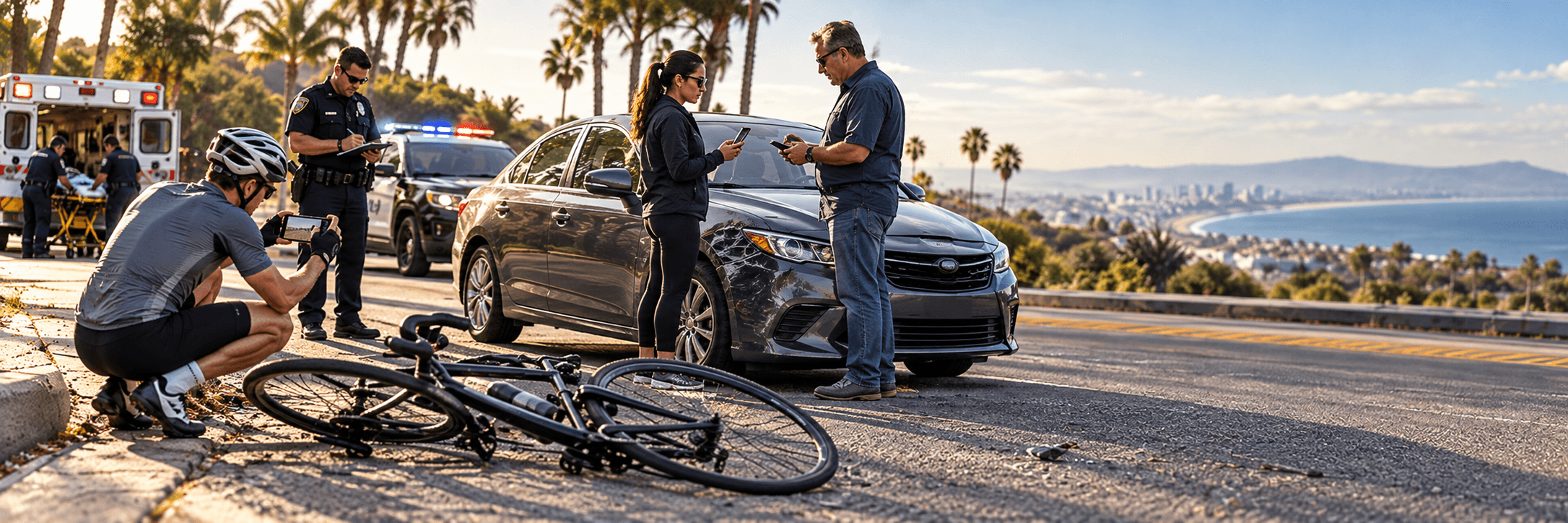
Almost all the advice written about what to do after a collision assumes you are a driver, and a driver’s situation is not a cyclist’s. A driver stays with their vehicle, exchanges information, photographs the damage and drives home. A cyclist is frequently the only person hurt, may be taken from the scene before anything is exchanged, and owns none of the evidence that a damaged car would otherwise supply. What follows is written for the second situation. It covers what to do at the scene if you are able, what can still be recovered if you were not, and the reporting requirement most cyclists have never heard of.
Key Takeaways
- Emergency responders come first. Everything on this page is secondary to that and to medical care.
- A cyclist is often removed from the scene before details are exchanged, and a great deal can still be reconstructed afterwards.
- The DMV requires a report within 10 days where there was an injury, a death, or property damage over $1,000, regardless of fault.
- The bicycle, the helmet and the gear are evidence. Repairing, washing or returning any of it can remove information permanently.
- Recorded ride data is frequently the most objective account of what happened, and it should be exported rather than left on a device.
- Where a public entity may be responsible for the road, a much shorter deadline applies than for a claim against a driver.
Why the Standard Advice Does Not Quite Fit
Four differences change what matters in the first hours.
You may not be at the scene for long. A cyclist who is hurt may leave by ambulance before a driver’s details are written down, before witnesses are asked for names, and before anyone photographs the road. Advice that assumes you are standing there with a phone is not much use afterwards.
There is no vehicle of yours to document. The photographs a driver takes of their own car do evidentiary work later. A cyclist has a bicycle, which is not intuitive to read, and gear, which most people throw away.
The bicycle is evidence rather than property to be repaired. The instinct after a crash is to get the bicycle fixed and ride again. That instinct can remove the record of what happened to it.
In a solo fall, nothing happens automatically. No other party is present, no report may be taken, and no insurer opens a file. Whatever exists later is what someone chose to preserve.
At the Scene, If You Are Able
Follow the instructions of emergency responders without exception. Nothing below is more important than that, and none of it is worth doing if it delays care or puts you back into traffic.
If you are able, and it is safe:
- The driver’s details — name, contact information, licence number, insurance details, licence plate, and the make and model of the vehicle.
- The vehicle itself, photographed including the plate, and the point of contact if it is visible.
- The scene — the road surface, lane markings, signage, sight lines, signals, debris, and the final positions of everything before anyone moves it.
- Witnesses — names and phone numbers, including anyone who stops and then leaves. These are almost impossible to find later.
- The responding agency and, if one is taken, the report number.
- Your bicycle and gear, photographed before anything is moved or cleaned.
Say what happened factually and avoid speculating about cause or apologising reflexively. An apology offered out of ordinary politeness at a roadside is routinely treated later as an admission, and what gets said first tends to anchor how responsibility is argued afterwards.
If You Were Taken From the Scene
This is the situation most guidance skips, and a great deal is still recoverable.
- Ask someone to return to the location promptly and photograph it, including the road surface and anything that may have contributed. Conditions get repaired, and a photograph taken a week later may show a different road.
- Identify the responding agency and request the collision report once it is available.
- Find out where the bicycle went. It may have been taken by a tow operator, a bystander, a family member, or left where it fell. Recovering it intact matters.
- Ask about camera footage early. Nearby homes, businesses and transit vehicles overwrite on a short cycle, and a request made in the first days is a different proposition from one made in the second week.
- Write down what you remember as soon as you are able, dated, including things that seem unimportant.
- Keep everything you were wearing and carrying in the condition it arrived in.
The Reporting Requirement Most Cyclists Have Not Heard Of
The California Department of Motor Vehicles states that “California law requires traffic accidents on a California street/highway or private property to be reported to the Department of Motor Vehicles (DMV) within 10 days if there was an injury, death or property damage in excess of $1,000.” The report is made on form SR-1. The DMV states that “the law requires the driver to file this SR 1 form with DMV regardless of fault,” and that “an insurance agent, attorney, or other designated representative may file the report for the driver.” It also notes that untimely reporting can result in a driver licence suspension.
Two points are worth drawing out. Any injury triggers the requirement — the dollar threshold attaches only to the property damage limb. And the obligation runs regardless of fault, so it is not answered by the fact that someone else caused the collision.
The DMV frames the duty as the driver’s. How that applies to a cyclist involved in a collision, rather than to the motorist, is a question worth putting to a lawyer rather than assuming in either direction. California also imposes separate reporting obligations to law enforcement after a collision involving injury, and our page on what to do after a car accident sets those out for drivers.
What Not to Repair, Wash or Return
Keep the bicycle exactly as it is, including any component that failed or deformed. Keep the helmet, the clothing, the shoes, the eyewear and anything that was on the bicycle, unwashed and unrepaired. Photograph all of it before anything is touched.
One route by which this evidence disappears deserves naming, because it happens with everyone acting in good faith: a shop offering to send a failed component back to the manufacturer under warranty. That sends the item to a party who may later be a defendant, and it usually cannot be recovered. Where a component may have failed rather than simply broken in the crash, our page on California defective product claims explains why preservation matters.
Export Your Ride Data
If you were recording — a cycling computer, a GPS watch, a phone, a training or navigation app — that file documents speed, route and position by time, created before anyone contemplated a claim. It is frequently the most objective account of the minutes before a collision that exists.
Export it and store it somewhere permanent rather than leaving it on the device or in an account. Devices get reset, subscriptions lapse and services close. Keep recording afterwards as well, because the comparison between before and after carries meaning of its own.
Insurers
An adjuster may make contact quickly. Keep what they send and note what was said, and decline recorded statements and sign nothing — including medical authorisations — before speaking with a lawyer.
Notify your own insurer early, particularly where the driver left the scene or carried no coverage. Our page on uninsured motorist coverage in California explains that this coverage can apply to a cyclist, that hit-and-run claims carry prompt reporting conditions, and that it is worth checking the declarations page of every auto policy in the household rather than only the one on the car involved.
The Deadlines Sitting Behind All of This
The reason the first days matter is that two separate clocks are running and neither waits.
The legal deadlines depend on who was responsible, and where a public entity may be responsible for a road or bikeway a much shorter period applies before any lawsuit. Our page on California bicycle accident claims sets out the deadlines and the variants.
The practical clock is shorter still. Footage is overwritten within days. Road surfaces get repaired. Bicycles get fixed or discarded. Witnesses become unreachable. A claim brought well inside every legal deadline can still fail because the material that would have proved it no longer exists.
Talk to a California Bicycle Accident Lawyer
Vaksman Khalfin, PC represents injured cyclists throughout California. A free consultation can identify what should be preserved now, what reporting requirements apply, and which deadlines are running. Call (650) 250-0705, schedule a free consultation, or read more about California bicycle accident claims, the San Mateo office, and the wider California personal injury practice.
Reviewed by Alan D. Khalfin, Partner and Managing Attorney, Vaksman Khalfin, PC (admitted in California). Last reviewed: 10/05/2026
Frequently Asked Questions
Get medical attention and follow the instructions of emergency responders. After that, and only if you are able and it is safe, the priorities are the driver's details, photographs of the vehicle and the scene, witness contact details, and the responding agency and report number.
No. Much of it can be reconstructed: the collision report can be requested from the responding agency, the location can be photographed by someone else, camera footage can be sought while it still exists, and the bicycle can be recovered. Acting in the first days rather than the first weeks is what matters.
The DMV states that accidents must be reported within 10 days where there was an injury, a death, or property damage over $1,000, on form SR-1, and that the obligation applies regardless of fault. The DMV frames the duty as the driver's, and how that applies to a cyclist rather than a motorist is worth confirming with a lawyer.
Not before it has been photographed thoroughly and, where a component may have failed, looked at. The bicycle carries information about the collision, and repairing it, replacing a part or returning anything to a shop or manufacturer can remove that permanently.
It can be. Injuries are not always apparent immediately, damage to a bicycle is easy to underestimate, and an informal arrangement leaves no record of what happened or who was involved. Details and documentation are worth having whether or not a claim is ever made.
Report it to law enforcement promptly and notify your own insurer early. Uninsured motorist coverage is the usual route where a driver cannot be identified, and those claims carry prompt reporting conditions.
It is better not to. Posts are routinely obtained and used to argue about the severity of an injury or the circumstances of a collision, and an offhand line written while upset is difficult to explain later.
Not necessarily, and a consultation costs nothing. What is worth avoiding is deciding that a claim is minor before the medical picture is clear and before anyone has looked at what caused the crash, because by then the evidence may be gone.
The initial consultation is free. If the firm takes a case, attorney's fees are contingent on a recovery; case costs are a separate category, and how they are handled is set out in the written fee agreement before any representation begins.
