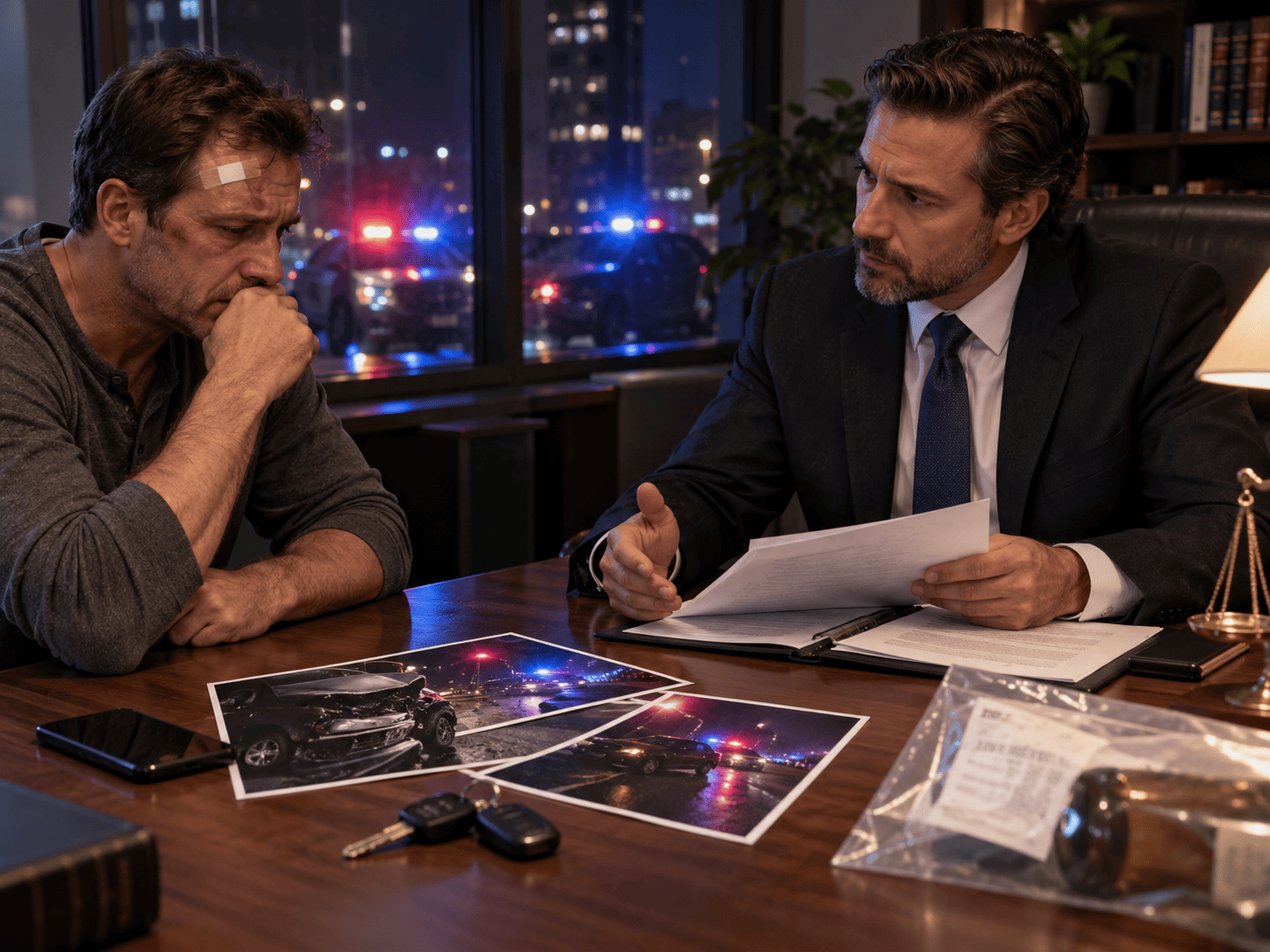
If you were injured by a drunk driver in California, you have a civil claim that is separate from the criminal DUI case. The criminal case punishes the driver; your civil claim is how you recover for medical care, lost income, and other losses. Drunk driving cases also differ from ordinary collision claims in one significant way: California law allows punitive damages against a driver whose intoxicated driving showed a conscious disregard for the safety of others — though that is a demanding standard, not an automatic consequence of a DUI.
This page is for people injured by an impaired driver. If you are the driver facing a DUI charge, you need a criminal defense attorney; that is not work this firm does, and nothing here is guidance for a defendant.
Key Points
- Your civil claim and the driver’s criminal case run on separate tracks, with different parties, different burdens of proof, and different deadlines.
- Waiting for the criminal case to finish before speaking with a civil attorney can cost evidence and, in some circumstances, time on a filing deadline.
- Punitive damages may be available where the circumstances show conscious disregard, but a DUI arrest by itself does not establish it.
- Even a strong punitive damages claim raises a separate practical question about what is actually collectible.
- California is unusually protective of people and businesses who serve alcohol, so claims against a bar or a host are narrow.
- Impaired drivers are disproportionately likely to be uninsured or minimally insured, which makes your own coverage a central question rather than an afterthought.
The Criminal Case Is Not Your Case
People often assume that the DUI prosecution will take care of things. It will not, and the distinction matters practically.
- Different parties. The criminal case is the State against the driver. You are a witness in it, not a party.
- Different burdens. A criminal conviction requires proof beyond a reasonable doubt. A civil claim is decided on the lower civil standard, which is why an acquittal or a reduced charge does not end a civil claim.
- Different remedies. A criminal court may order restitution, but restitution is not the same as civil damages and generally does not address the full range of losses a civil claim covers.
- Different clocks. The civil deadline runs on its own schedule and does not wait for a criminal case to conclude.
A conviction can be useful evidence in the civil case. But the civil claim has to be built independently, and the evidence that builds it — vehicle data, surveillance footage, witness recollection — degrades while a criminal case is pending.
Punitive Damages: What California Actually Requires
This is the part of a drunk driving claim most often described inaccurately online, usually as though a DUI produces punitive damages automatically. It does not.
Punitive damages in California are governed by Civil Code section 3294, which requires proof by clear and convincing evidence that the defendant acted with oppression, fraud, or malice. That is a materially higher standard than the one governing the rest of a negligence claim.
In Taylor v. Superior Court (1979) 24 Cal.3d 890, the California Supreme Court held that operating a vehicle while intoxicated may constitute malice under section 3294 where it is done under circumstances disclosing a conscious disregard of the probable dangerous consequences. Note the word “may.” The court did not hold that every drunk driving collision supports punitive damages, and later decisions have examined closely what circumstances beyond intoxication itself are present — a driver’s knowledge of their own history, the manner of driving, and what they did before and after.
Three things follow:
- Whether punitive damages are available is a question about the circumstances, not about the existence of a DUI charge.
- The facts that support it — prior incidents, where and how much the driver had been drinking, driving behavior before impact — have to be developed. They do not arrive with the police report.
- Punitive damages are awarded by a court or jury, not by an insurance adjuster, and California law limits an insurer’s liability for a loss caused by the willful act of its insured. A punitive award and a collectible punitive award are different things, and that gap is worth understanding before it becomes the centerpiece of a claim.
Who Else May Be Responsible
Depending on the evidence, the impaired driver may not be the only party:
- An employer, where the driver was acting within the scope of employment
- A vehicle owner, in some circumstances, where a vehicle was entrusted to someone the owner knew was unfit to drive
- A commercial carrier, where a commercial truck was involved, since federal and state rules governing commercial drivers add another layer
- A rideshare platform, in some circumstances, in an Uber or Lyft collision
Can you sue the bar that served them?
Usually not, and California is unusual here. Most states have dram shop laws that let an injured person sue a business that over-served a driver. California’s statutes take the opposite approach: the law treats the consumption of alcohol, rather than the serving of it, as the cause of injuries an intoxicated person inflicts. That framing largely shields both commercial servers and social hosts from civil liability.
There are narrow statutory exceptions, most of which involve alcohol furnished to someone under 21. Whether any exception applies is fact-specific and worth asking about rather than assuming, but the default answer in California is different from what people expect based on other states.
Evidence That Matters in an Impaired Driving Claim
These cases turn on material that ordinary collision claims do not involve, and much of it has a short life:
- Chemical test results and the testing procedure behind them
- The collision report and any field sobriety documentation
- Where the driver had been — receipts, card records, and venue surveillance, which is typically overwritten within days or weeks
- Witness accounts of driving behavior before the impact
- Vehicle event data, where the vehicles are still available to inspect
- The driver’s history, to the extent it is discoverable
The timing problem is real. Surveillance footage from a restaurant or bar is often gone before a criminal case has its first hearing. Preservation letters have to go out early, which is one of the main reasons not to wait for the criminal process.
What Can Be Recovered
California recognizes economic and non-economic damages. Depending on the evidence, the categories that may apply include past and future medical care, lost income and reduced earning capacity, property damage, pain and suffering and loss of enjoyment of life, and loss of consortium in a claim brought by a spouse. Where a crash is fatal, certain surviving family members may bring a wrongful death claim, which follows its own rules.
No lawyer can tell you what a claim is worth from a description of the crash. How claims are actually valued is explained on our page about back and neck injury claims.
If the Drunk Driver Was Uninsured or Underinsured
This is the question that most often determines what an injured person actually recovers. A judgment is only worth what can be collected, and a driver with no insurance frequently has no assets worth pursuing.
Since January 1, 2025, California’s minimum liability limits have been $30,000 per person, $60,000 per accident, and $15,000 for property damage — modest against the cost of a serious injury. Your own uninsured and underinsured motorist coverage is often the more important policy, and insurers must offer it in California unless you signed a written rejection.
Deadlines
Most California personal injury lawsuits must be filed within two years of the injury under Code of Civil Procedure section 335.1. Where a public entity may share responsibility, a written claim must be presented to that entity first, on a substantially shorter timeline. Uninsured and underinsured motorist claims run against your own insurer and carry their own requirements. The criminal case has no effect on any of these. If a claim cannot be resolved with the insurers, our page on car accident lawsuits explains what filing involves.
Drunk Driving Collisions in San Mateo and on the Peninsula
Our office at 15 North Ellsworth Avenue, Suite 105, San Mateo, CA 94401 handles injury claims across San Mateo County, and civil matters for this area are generally heard in the San Mateo County Superior Court. Impaired driving collisions on the Peninsula involve the same range of victims as any other crash — people in other vehicles, and pedestrians, cyclists, and motorcyclists, for whom the consequences of the same impact are usually more serious. Where a head injury is involved, our brain injury page covers that overlap. More about the office is on our San Mateo page.
How Vaksman Khalfin Can Help
We can move on evidence while it still exists — preservation letters to venues and vehicle custodians, obtaining the collision report and chemical testing records, and identifying witnesses — evaluate whether the circumstances support a punitive damages claim rather than assuming they do, identify every party and policy involved including your own uninsured and underinsured coverage, and handle the insurers directly while you are treating. Where a reasonable resolution is not offered, we are prepared to litigate.
The firm’s personal injury practice is led by Alan D. Khalfin, admitted in California. We handle these matters on a contingency-fee basis: there is no upfront attorney’s fee, and attorney’s fees are owed only if we recover compensation for you. Case costs are a separate category from attorney’s fees, and how they are handled is set out in the written fee agreement we review with you before anything is signed. Initial consultations are free.
To talk with a California drunk driving accident lawyer, call 650-250-0705 or schedule a free consultation. Related reading: our California car accident page, what to do after a car accident, and our California personal injury guides.
Reviewed by Alan D. Khalfin, Partner and Managing Attorney, Vaksman Khalfin, PC (admitted in California). Last reviewed: 09/09/2026
Frequently Asked Questions
Yes. A civil claim against an impaired driver is separate from the criminal DUI case and proceeds regardless of what happens in criminal court. You do not need a conviction to bring it, and an acquittal or reduced charge does not end it, because the civil standard of proof is lower.
It depends on facts that cannot be assessed from a general description — how serious the injuries are, what the medical record documents, and above all what insurance and assets are actually available. A judgment against someone with neither is difficult to collect, which is why the first questions in these cases are usually about coverage rather than about liability.
No, and waiting carries real cost. Venue surveillance is commonly overwritten within days or weeks, vehicles get repaired or scrapped, and witness recollection fades. The civil filing deadline also runs independently of the criminal case.
Sometimes. California's punitive damages statute requires clear and convincing evidence of oppression, fraud, or malice, and the Supreme Court held in Taylor v. Superior Court that intoxicated driving may constitute malice where the circumstances show a conscious disregard of the probable dangerous consequences. A DUI charge alone does not establish that; the surrounding circumstances have to be developed and proven.
Usually not. California treats the consumption of alcohol rather than the serving of it as the cause of injuries an intoxicated person inflicts, which largely shields commercial servers and social hosts. Narrow statutory exceptions exist, most involving alcohol furnished to someone under 21. Whether one applies is fact-specific.
Uninsured motorist coverage on your own policy may apply, and underinsured motorist coverage may apply where they had insurance but not enough. Insurers must offer this coverage in California and declining it requires a signed written rejection, so it is worth checking your own declarations page even if you do not remember buying it.
Most California personal injury lawsuits must be filed within two years of the injury under Code of Civil Procedure section 335.1. A much shorter timeline applies where a public entity may share responsibility, and uninsured or underinsured motorist claims carry their own requirements under your policy.
Vaksman Khalfin, PC handles these matters on a contingency-fee basis. There is no upfront attorney's fee, and attorney's fees are owed only if we recover compensation for you. Case costs are treated separately from attorney's fees, and the written fee agreement sets out how both are handled. Initial consultations are free.