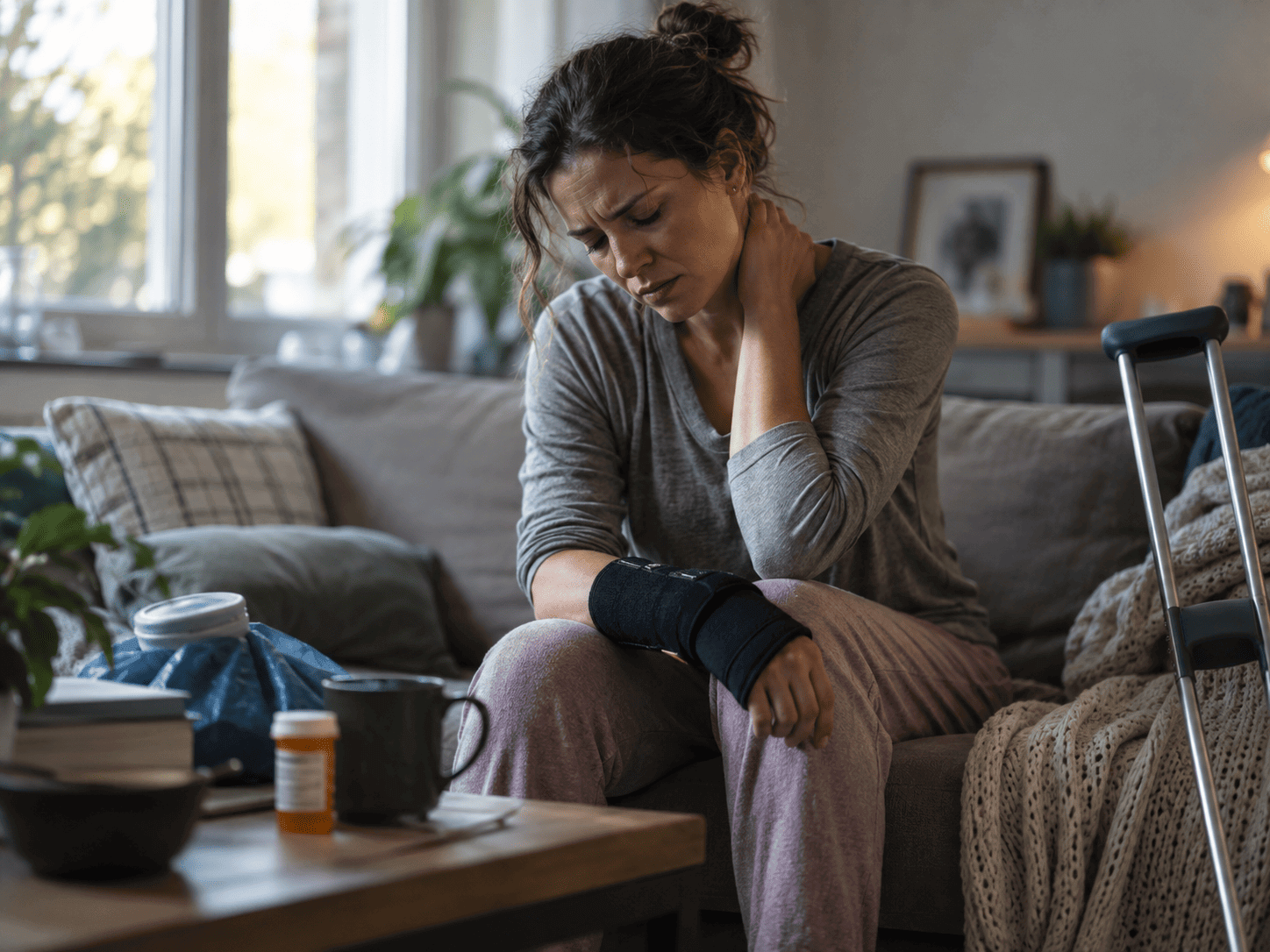
In California injury law, “pain and suffering” is shorthand for non-economic damages — the harm an injury causes that has no receipt attached to it. California’s pattern jury instruction lists what counts: physical pain, mental suffering, loss of enjoyment of life, disfigurement, physical impairment, inconvenience, grief, anxiety, humiliation, and emotional distress. The same instruction tells jurors that no fixed standard exists for deciding the amount, and that they must use their judgment based on the evidence. There is no formula in California law, and the “multiplier” and “per diem” methods described online are insurer conventions rather than legal rules.
This page covers what the category actually includes, how a subjective harm gets proven with objective evidence, and the two situations where California limits or removes it.
Key Points
- “Pain and suffering” is a colloquial name for a broader category the law calls non-economic damages.
- California’s jury instruction expressly states there is no fixed standard for the amount.
- The multiplier and per diem methods are negotiating conventions, not law, and no court is bound by either.
- Ordinary California negligence claims carry no cap on non-economic damages. Medical malpractice is the exception.
- A spouse’s loss of consortium is a separate claim belonging to the spouse, not part of the injured person’s award.
- A temporary rule allowing recovery of a deceased person’s pre-death pain and suffering expired at the end of 2025.
What California Counts as Pain and Suffering
The Judicial Council’s pattern instruction on this category, CACI No. 3905A, Physical Pain, Mental Suffering, and Emotional Distress (Noneconomic Damage), sets out the specific items a jury may award. They are:
- Physical pain
- Mental suffering
- Loss of enjoyment of life
- Disfigurement
- Physical impairment
- Inconvenience
- Grief
- Anxiety
- Humiliation
- Emotional distress
Two things follow that most explanations miss. First, the category is considerably wider than “pain” — loss of enjoyment of life, disfigurement, and inconvenience are separate items, and a claim that describes only pain leaves several of them undeveloped. Second, both past and future harm are covered, but future non-economic damages must be proven to a standard: that the person is reasonably certain to suffer that harm.
“No Fixed Standard Exists”
That phrase is not a paraphrase. It is what the instruction tells the jury: no fixed standard exists for deciding the amount of these non-economic damages, and the jury must use its judgment to decide a reasonable amount based on the evidence and common sense.
This is the direct answer to “how is pain and suffering calculated in California,” and it is not the answer most sources give. Understanding it changes how you read an offer: an adjuster’s number is not derived from a rule, and there is no benchmark it can be measured against. What it can be measured against is the evidence.
The multiplier and per diem methods
Two methods circulate widely enough that people treat them as law.
| Method | What it actually is |
| Multiplier | Multiplying economic damages by some number chosen for severity. A rule of thumb used in negotiation and by some claims software. No basis in California law, and no court instructs a jury to apply it |
| Per diem | Assigning a daily amount for each day the person lives with the injury. An argument a lawyer might make to a jury, not a standard a jury is bound by |
Neither is wrong to use in negotiation. Both are wrong to treat as the measure of a claim, and an insurer quoting a multiplier is stating a position rather than applying a rule.
How a Subjective Harm Gets Proven
This is where these claims are actually won or lost, and it is the part of the topic with the least useful coverage online.
- Contemporaneous medical records. Consistent reporting of symptoms and limitations across providers, recorded close in time. Inconsistencies between what was told to different doctors are the first thing a defense reviewer looks for.
- Treating providers rather than commentary. A treating physician describing functional limits carries a different weight than an assertion in a demand letter.
- Specific, not general, descriptions. “I’m in pain” establishes very little. What can no longer be done, for how long, and what was given up is evidence. The named items in the instruction — loss of enjoyment of life, inconvenience, humiliation — each need their own facts.
- Before-and-after witnesses. People who knew the person before the injury and can describe the change, which is often more persuasive than the injured person’s own account.
- Records of what changed. Employment records, cancelled commitments, activities stopped.
A word on pain journals, which are frequently recommended online. They can help, but anything created for the claim is discoverable and will be read closely by the other side. A sporadic or exaggerated journal does more damage than no journal. If one is kept, it should be honest, including about good days.
Is There a Cap on Pain and Suffering in California?
In ordinary negligence claims — car collisions, premises claims, most injury cases — California imposes no cap on non-economic damages.
Medical malpractice is the significant exception. California caps non-economic damages in professional negligence claims against health care providers, and that cap was restructured by 2022 legislation to increase on a schedule over a period of years. The consequence is that the applicable figure depends on when the claim arose, and a great deal of published material still quotes the single fixed figure that applied for decades before the change. If a medical negligence claim is involved, the current figure needs to be checked rather than assumed.
Two Adjacent Claims People Confuse
Loss of consortium
Where a serious injury affects a marriage, the spouse may have a claim for loss of consortium. It is the spouse’s own claim for their own loss, not an item of the injured person’s damages, and it is pleaded separately.
A decedent’s pre-death pain and suffering
This one changed recently and a lot of published material is now out of date.
California traditionally did not allow a decedent’s estate to recover for the pain and suffering the decedent experienced before death. Legislation created a temporary exception for a defined window of filings, and that window closed at the end of 2025. For survival actions filed on or after January 1, 2026, California has returned to its longstanding rule.
A wrongful death claim brought by surviving family members is a separate action with its own rules about who may sue and what may be recovered — our wrongful death page covers that. Anyone reading about survival damages should check the date on what they are reading.
What Reduces a Non-Economic Award
California uses pure comparative fault, so any share of responsibility attributed to the injured person reduces the recovery proportionally — including the non-economic portion. Available insurance also constrains what is collectible regardless of what a claim is worth, which is why uninsured and underinsured motorist coverage often matters more than people expect.
How these inputs combine into a settlement figure, and what is deducted from that figure before payment, is covered on our page about car accident settlements. For a specific injury category, our page on back and neck injury claims goes further into how insurers contest this kind of harm.
How Vaksman Khalfin Can Help
Non-economic damages are proven with evidence, and evidence has to be built deliberately — the named items in the jury instruction each need facts behind them, and the ones people leave undeveloped are usually loss of enjoyment of life and the effect on daily function. We document that alongside the medical record, identify the witnesses who can describe the change, and negotiate against an insurer’s position rather than accepting a formula as though it were a rule.
Our California personal injury practice is led by Alan D. Khalfin, admitted in California, and works from our San Mateo office at 15 North Ellsworth Avenue, Suite 105. We handle injury matters on a contingency-fee basis: there is no upfront attorney’s fee, and attorney’s fees are owed only if we recover compensation for you. Case costs are a separate category from attorney’s fees, and how both are handled is set out in the written fee agreement we go through with you before anything is signed. Initial consultations are free.
To speak with a California personal injury attorney, call 650-250-0705 or schedule a free consultation. Related reading: our California car accident page and our California personal injury guides.
Reviewed by Alan D. Khalfin, Partner and Managing Attorney, Vaksman Khalfin, PC (admitted in California). Last reviewed: 09/09/2026
Frequently Asked Questions
It is the common name for non-economic damages: harm from an injury that has no receipt attached. California's pattern jury instruction lists the specific items — physical pain, mental suffering, loss of enjoyment of life, disfigurement, physical impairment, inconvenience, grief, anxiety, humiliation, and emotional distress.
Not in law. They are two items in a longer list of non-economic damages. Physical pain is bodily discomfort; mental suffering is the psychological toll. A claim can involve one without much of the other, and the instruction treats several further categories — disfigurement, inconvenience, loss of enjoyment of life — as distinct items again.
There is no calculation prescribed by law. California's jury instruction states that no fixed standard exists for deciding the amount and directs the jury to use its judgment based on the evidence and common sense. Multiplier and per diem methods are negotiating conventions used by adjusters and lawyers, not legal standards.
There is no reliable average, and a figure would not tell you anything about a specific claim. Published averages pool cases with different injuries, different evidence, different fault apportionment, and different insurance limits. What can be assessed is whether an offer reflects the documented harm and the coverage available.
Not in ordinary negligence claims. Medical malpractice is the exception: California caps non-economic damages in claims against health care providers, and 2022 legislation restructured that cap to increase on a schedule, so the applicable figure depends on when the claim arose. Much of the published material still quotes the older fixed figure.
With contemporaneous medical records, treating providers describing functional limits, specific rather than general descriptions of what changed, witnesses who knew the person before the injury, and records of activities and commitments given up. Consistency across sources matters more than volume.
Sometimes, but the rules are narrower and more technical than for distress accompanying a physical injury, and whether a claim exists depends heavily on the circumstances. It is worth asking about rather than assuming either way.
A temporary rule allowing an estate to recover a decedent's pre-death pain and suffering in a survival action expired at the end of 2025, and California has returned to its longstanding position for actions filed on or after January 1, 2026. A wrongful death claim by surviving family members is a separate action with its own rules.