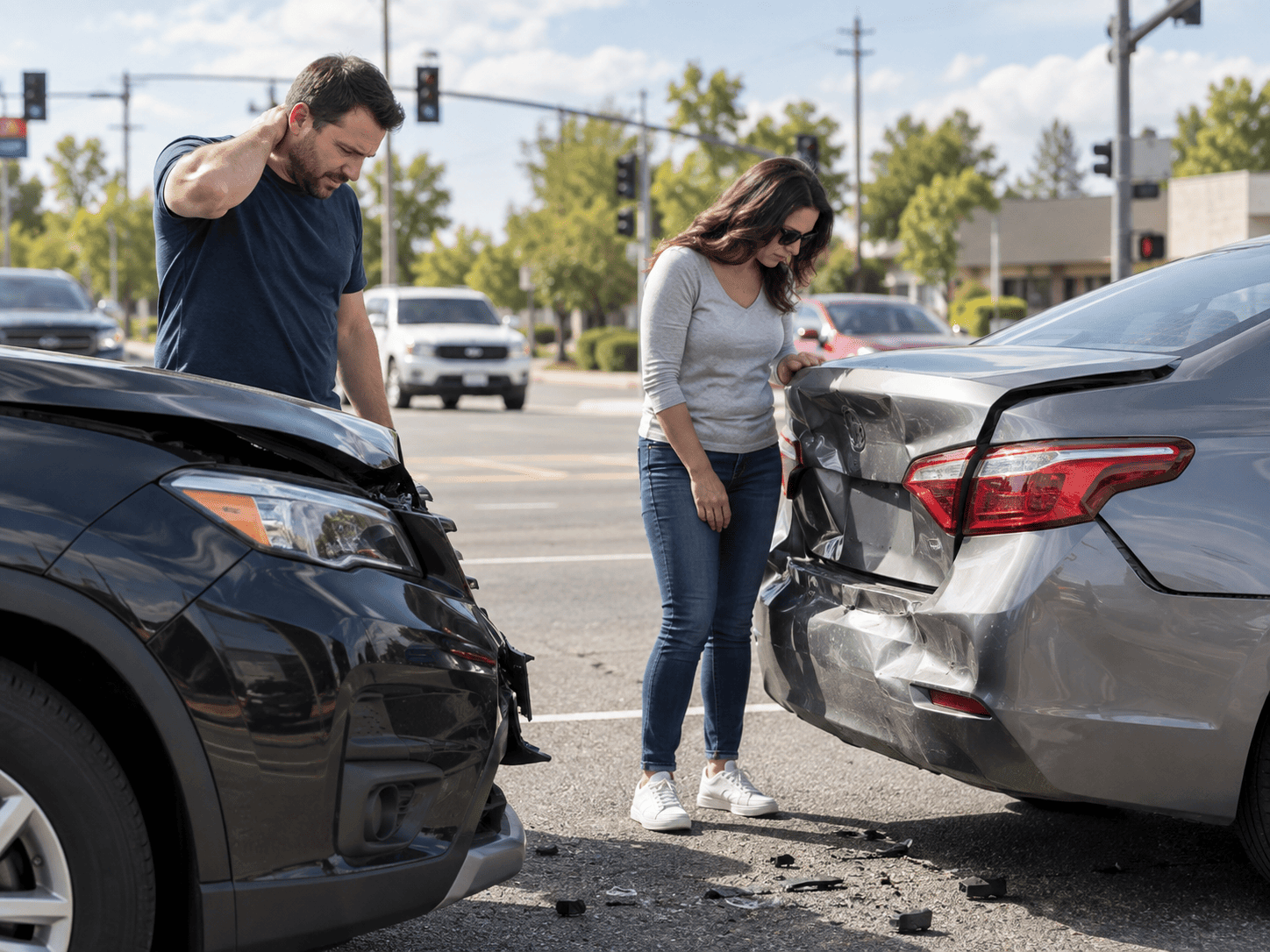
Being rear-ended means another vehicle struck the back of yours. In California the rear driver is usually found at fault, but not automatically — there is no rule making the rear driver liable by definition. What exists is a statute requiring drivers not to follow more closely than is reasonable and prudent, a rebuttable presumption that arises when a driver violates a safety statute, and a comparative fault system that allows responsibility to be divided between drivers. In most rear-end collisions those combine to put fault on the rear driver. In some, they do not.
This page explains how fault is actually determined after a rear-end collision in California, the situations where it shifts or gets shared, and the arguments insurers raise against people who were hit from behind.
Key Points
- California has no rear-end-specific liability rule. Fault is decided on evidence like any other collision.
- Following too closely is a Vehicle Code violation, and a safety-statute violation can create a presumption that the driver failed to use due care — a presumption the driver is entitled to try to rebut.
- California uses pure comparative fault, so responsibility can be apportioned between drivers rather than assigned entirely to one.
- Being rear-ended does not make a claim straightforward. Insurers routinely contest injury and causation even where fault is not seriously in dispute.
- In a chain-reaction collision, who struck whom first is a question of evidence, not of position in the line.
- Symptoms after a rear-end impact are frequently delayed, and a gap between the collision and the first medical record is one of the most common arguments against a claim.
Is the Rear Driver Always at Fault?
No — and the reason matters, because the shorthand version circulates widely enough that people accept an unfair outcome on the strength of it.
There are three mechanisms doing the work.
The following-distance statute
Under Vehicle Code section 21703, a driver must not follow another vehicle more closely than is reasonable and prudent, with regard to the speed of that vehicle and the traffic and condition of the roadway. Note what the statute does not do: it sets no fixed distance in feet or car lengths. What counts as reasonable and prudent on a wet, crowded stretch of US-101 at speed is different from an empty surface street.
The negligence per se presumption
California’s Evidence Code provides that a person’s failure to exercise due care is presumed where they violated a statute, the violation proximately caused the injury, the injury was of the kind the statute was designed to prevent, and the injured person was within the class the statute protects. Critically, the code also provides that this presumption may be rebutted — including by proof that the driver did what a person of ordinary prudence desiring to comply with the law would reasonably have done in the circumstances.
So a rear-end collision does not produce automatic liability. It produces a presumption that the rear driver has an opportunity to answer.
Pure comparative fault
California divides responsibility rather than assigning it wholesale. A driver found partly responsible can still recover, with the recovery reduced by their share. This is why insurers invest so heavily in establishing that the front driver contributed something — every percentage point assigned to you reduces what is paid.
When Fault Can Shift or Be Shared
Circumstances that can complicate the ordinary picture include:
- The front vehicle reversed. A car backing into the vehicle behind it is a rear-end collision in appearance only.
- The front driver stopped abruptly without cause. Sudden braking that no reasonable driver would anticipate is a common defense argument, though “they stopped short” is also the most reflexive thing a rear driver says at the scene.
- Brake lights were not working. This is contested with photographs, repair records, and vehicle inspection.
- The front vehicle cut in. A driver who changes lanes into a gap and then brakes has not given the following driver a reasonable interval.
- The front vehicle was stopped where it should not have been. A vehicle left in a live traffic lane, unlit at night, raises a different question.
- A third vehicle started it. If you were struck from behind and pushed into the car ahead, the driver who hit you may bear responsibility for both impacts.
None of these is a conclusion. Each is a factual dispute resolved with evidence — the collision report, photographs, vehicle damage patterns, any dashcam or nearby camera footage, and what each driver said at the scene.
Chain-Reaction Collisions
Multi-vehicle rear-end collisions are where the shorthand breaks down entirely. If three cars are involved and you are in the middle, your position in the line says nothing about your responsibility. What matters is the sequence: whether you struck the car ahead before being hit, or only because you were hit.
That sequence is established by physical evidence — the damage patterns on each vehicle, the resting positions, and the statements taken at the scene — which is why documentation before the vehicles are moved matters more in a chain-reaction collision than in almost any other kind. Each driver’s insurer will be reconstructing the same event with an interest in a different answer.
What Insurers Argue Even When Fault Is Clear
People assume that being rear-ended makes a claim simple. Liability is often the easiest part; the dispute moves to injury and causation instead. The arguments that recur:
| The argument | What the record can address |
| The vehicle damage was minor, so the injury must be minor | Collision mechanics, occupant position, and the clinical findings themselves |
| There was a gap before the first medical visit | When symptoms appeared, what was reported at the scene, and why care began when it did |
| Imaging shows changes that pre-date the crash | Whether symptoms, function, and treatment changed after the collision |
| The treatment was excessive | Referrals, treating-provider recommendations, and the documented response to care |
| You stopped short and caused it | Traffic conditions, the reason for stopping, and any independent record of the sequence |
How these disputes translate into what a claim is worth is covered on our page about back and neck injury claims.
Delayed Symptoms After Being Hit From Behind
Symptoms after a rear-end impact commonly appear later rather than at the scene — hours or a day or more afterwards. Neck, back, and head symptoms are the ones people most often notice late, partly because adrenaline masks them and partly because the body has absorbed a sudden force it had no time to brace against.
Two practical consequences. First, “I’m fine” said at the roadside is quoted back later. Second, a same-day medical evaluation creates a record close in time to the collision, which is the single most effective answer to a causation argument. Where a head impact or loss of consciousness is involved, our brain injury page covers that overlap.
What to Do After Being Rear-Ended
The immediate steps are the same as after any California collision: stop, check for injuries and call 911 if anyone may be hurt, exchange information, photograph the scene before the vehicles move, and get evaluated. California also imposes reporting duties that apply regardless of fault, including a written report to law enforcement within 24 hours where anyone was injured and an SR-1 report to the DMV within 10 days where there was injury, death, or property damage over $1,000. Those are set out on our page on what to do after a car accident.
One addition specific to rear-end collisions: photograph the other vehicle’s front-end damage and your own rear damage from several angles and distances. Where fault is later contested, damage patterns are often the most objective evidence of what happened.
Deadlines and Coverage
Most California injury lawsuits must be filed within two years of the injury under Code of Civil Procedure section 335.1, and a much shorter timeline applies where a public entity may share responsibility. If the driver who hit you had no insurance or carried only minimum limits, your own uninsured and underinsured motorist coverage may be the more important question. Where a claim cannot be resolved with the insurers, our page on car accident lawsuits explains what filing involves.
Rear-End Collisions on the Peninsula
Our office at 15 North Ellsworth Avenue, Suite 105, San Mateo, CA 94401 handles injury claims across San Mateo County, and civil matters for this area are generally heard in the San Mateo County Superior Court. Stop-and-go conditions on US-101 and I-280 and at the signalized intersections along El Camino Real are where rear-end collisions tend to happen, and the same dynamics apply where the vehicle struck was a motorcycle or a bicycle, where the consequences of the same impact are usually more serious. Where a commercial truck or an Uber or Lyft vehicle was the striking vehicle, additional parties and policies may be involved. More about the office is on our San Mateo page.
How Vaksman Khalfin Can Help
We can preserve the evidence that decides a contested rear-end claim — the collision report, damage documentation, and any camera footage before it is overwritten — identify every party and policy involved, work with the medical record so causation is documented rather than asserted, and handle the insurers directly. Where a reasonable resolution is not offered, we are prepared to litigate.
The firm’s personal injury practice is led by Alan D. Khalfin, admitted in California. We handle these matters on a contingency-fee basis: there is no upfront attorney’s fee, and attorney’s fees are owed only if we recover compensation for you. Case costs are a separate category from attorney’s fees, and how they are handled is set out in the written fee agreement we review with you before anything is signed. Initial consultations are free.
To talk with a California car accident attorney, call 650-250-0705 or schedule a free consultation. Related reading: our California car accident page and our California personal injury guides.
Reviewed by Alan D. Khalfin, Partner and Managing Attorney, Vaksman Khalfin, PC (admitted in California). Last reviewed: 09/09/2026
Frequently Asked Questions
It means another vehicle crashed into the back of yours. In a claim, the striking vehicle is the rear vehicle and the vehicle that was hit is the front or lead vehicle.
Usually the rear driver, but not automatically. California has no rule assigning fault by position. The rear driver is often found at fault because following too closely violates Vehicle Code section 21703, and a safety-statute violation can create a presumption that the driver failed to use due care. That presumption can be rebutted, and California's pure comparative fault system allows responsibility to be divided.
Yes, in whole or in part. Situations that come up include the front vehicle reversing, stopping abruptly without cause, having non-functioning brake lights, cutting into the lane and braking, or being stopped where it should not have been. Each is a factual dispute rather than an automatic answer.
Your position in a chain-reaction collision does not determine responsibility. What matters is the sequence — whether you struck the vehicle ahead before being hit or only as a result of being hit — and that is established with damage patterns, resting positions, and statements taken at the scene.
Not necessarily. Where injuries were minor, liability is undisputed, and the insurer is handling the claim reasonably, many people resolve these themselves. It is worth a conversation where treatment went beyond brief care, where the insurer is contesting causation, where several vehicles were involved, or where the other driver's coverage may be insufficient.
That is common after a rear-end impact and does not defeat a claim. It does invite an argument from the insurer that the injury is unrelated, which is why getting evaluated promptly and reporting symptoms consistently matters.
Uninsured motorist coverage on your own policy may apply, and underinsured motorist coverage may apply where the driver had insurance but not enough. Insurers must offer this coverage in California, and declining it requires a signed written rejection, so it is worth checking your own declarations page.
Most California personal injury lawsuits must be filed within two years of the injury under Code of Civil Procedure section 335.1. A much shorter timeline applies where a public entity may share responsibility, and uninsured or underinsured motorist claims are governed by your own policy and carry their own requirements.