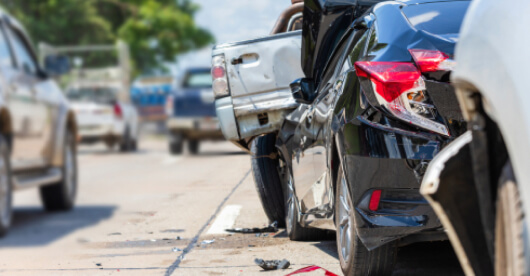
After a car accident in California: stop at the scene, check for injuries and call 911 if anyone may be hurt, move to safety if the vehicles are drivable, exchange identifying and insurance information, photograph everything before the cars are moved, and get medically evaluated the same day even if you feel fine. California then adds two reporting duties most drivers do not know about — a written report to law enforcement within 24 hours if anyone was injured or killed, and an SR-1 report to the DMV within 10 days if there was any injury, a death, or property damage over $1,000.
The steps below cover what to do at the scene, what to avoid saying, and the California deadlines that run whether or not you ever file a claim.
Key Deadlines After a California Collision
| What | When | Applies when |
| Written report to CHP or city police | Within 24 hours | Anyone was injured or killed |
| SR-1 report to the DMV | Within 10 days | Any injury, any death, or property damage over $1,000 — regardless of fault |
| Notice to your own insurer | Set by your policy | Most policies require prompt notice |
| Lawsuit against another driver | Generally two years from the injury | Most personal injury claims |
| Claim involving a public entity | Substantially shorter than two years | A city, county, transit agency, or state agency may share responsibility |
At the Scene: The First Five Things
1. Stop, and make the scene safe
Leaving the scene of a collision is a criminal offense in California, and that is true even in a parking lot and even where the only damage is to property. Turn on hazard lights. If the vehicles are drivable and are blocking traffic, moving them to the shoulder is usually safer than leaving them in a lane — photograph their positions first if you can do it without standing in traffic.
2. Call 911 if anyone may be hurt
Call if there is any injury, if a driver seems impaired, or if the scene is blocking traffic. Which agency responds depends on where the collision happened: the California Highway Patrol has responsibility on state highways, and city police departments handle collisions on city streets.
A responding officer’s report includes a “primary collision factor” — the officer’s assessment of what caused the crash. It carries weight with insurers, but it is evidence rather than a binding legal determination of fault, and it can be disputed.
3. Exchange information
California requires drivers involved in a collision to exchange identifying and insurance information. Collect:
- Full name, address, and phone number of every driver
- Driver’s license number
- Insurance company, policy number, and the name on the policy
- License plate, make, model, and the registered owner’s name if the driver does not own the car
- Names and phone numbers of any passengers and witnesses
Where property is damaged and the owner is not present — a parked car, a fence, a sign — Vehicle Code section 20002 requires leaving your name and address, either with the owner or in a written notice left in a conspicuous place on the property, and notifying law enforcement.
4. Document before anything moves
Photographs taken at the scene are usually the only record of it. Capture, in this order of priority:
- Vehicle positions and the overall scene, before the cars are moved
- Damage to every vehicle, from several angles and distances
- License plates and the other driver’s insurance card
- Skid marks, debris, glass, and fluid on the roadway
- Traffic signals, signage, lane markings, and sightlines
- Weather, lighting, and road conditions
- Any visible injury
Note the time, the direction each vehicle was travelling, and what you remember of the sequence — memory for this degrades within hours, and a contemporaneous note is worth more later than a reconstruction.
5. Get evaluated the same day
Adrenaline masks injury, and back, neck, and head symptoms frequently appear a day or more after the collision. A same-day evaluation creates a medical record close in time to the crash. Where an injury is later disputed, a gap between the collision and the first medical visit is one of the most common arguments an insurer raises against causation.
What Not to Do After a Car Accident
- Do not apologize or accept blame at the scene. “I’m sorry” and “I didn’t see you” get recorded as admissions. Describe what happened factually to the officer and leave conclusions about fault to the investigation.
- Do not tell anyone you are uninjured before you know. “I’m fine” at the scene is quoted back later.
- Do not agree to handle it privately. A handshake settlement does not satisfy the DMV reporting duty, and an injury claim can surface weeks afterward.
- Do not give a recorded statement to the other driver’s insurer. You are not required by law to do so, and the request usually comes before the extent of an injury is known.
- Do not sign a blanket medical authorization. A request for your complete medical history is broader than a claim requires.
- Do not accept the first offer before treatment is finished. A settlement resolves the claim in full, including care and lost income that have not yet been quantified.
- Do not repair or dispose of the vehicle before it is photographed and documented.
- Do not post about the collision on social media.
The Two California Reports Most Drivers Miss
The 24-hour report to law enforcement
Under Vehicle Code section 20008, a driver involved in a collision resulting in injury or death must make or cause to be made a written report within 24 hours — to the California Highway Patrol, or, if the collision happened within a city, to the CHP or that city’s police department. If officers investigated at the scene, that requirement is generally satisfied by their report; if no one responded, it is not.
The 10-day SR-1 to the DMV
The DMV requires an SR-1 report within 10 days of a collision if anyone was injured, however minor, if anyone was killed, or if property damage exceeded $1,000. This obligation applies regardless of who was at fault, and the DMV is explicit that reports made to the police, the CHP, or your insurance company do not satisfy it. You, your insurance agent or broker, or your legal representative may file it. Failure to file can lead to suspension of driving privileges.
The $1,000 figure is lower than most people assume. Bumper and sensor repair on a modern vehicle frequently exceeds it, which means the SR-1 duty attaches to many collisions drivers think of as minor.
If the Accident Seemed Minor
Low visible vehicle damage does not reliably indicate low injury, and it does not remove the reporting duties above. Two things are worth doing even when a collision looks trivial: photograph the damage before repairs, and check whether the $1,000 SR-1 threshold has been crossed once you have a repair estimate rather than at the roadside.
If the Accident Was Not Your Fault
Reporting duties do not depend on fault — the SR-1 and the 24-hour report apply to every involved driver. Two further points matter.
First, California uses pure comparative fault, so a share of responsibility reduces a recovery rather than barring it. Establishing that share is a central part of what insurers investigate, which is why documentation from the scene matters even when fault seems obvious.
Second, whether to open a claim with your own insurer is a separate question from who caused the crash. Your own policy may include collision coverage, medical payments coverage, and uninsured or underinsured motorist coverage, and those can matter a great deal where the other driver is uninsured or carries only minimum limits. Since January 1, 2025, California’s minimum liability limits have been $30,000 per person, $60,000 per accident, and $15,000 for property damage — modest against the cost of a serious injury.
Talking to the Insurance Companies
Notify your own insurer promptly; most policies require it, and delay can create a coverage problem independent of the crash itself. The other driver’s adjuster will usually make contact quickly, often within days.
That adjuster represents the other driver’s insurer. It is reasonable to give basic factual information — that a collision occurred, when, and where — and to decline a recorded statement or a broad medical release until you have had advice. None of this implies an insurer is behaving improperly; the interests simply are not aligned.
Deadlines That Affect a Claim Later
Most California personal injury lawsuits must be filed within two years of the injury under Code of Civil Procedure section 335.1. Where a public entity may share responsibility — a city vehicle, a transit agency, a dangerous roadway condition — California’s Government Claims Act requires a written claim to be presented first, on a timeline far shorter than two years. Uninsured and underinsured motorist claims run against your own insurer under your policy, which can impose its own notice requirements. Our California car accident page covers how these interact, and how claims are valued is explained on our back and neck injury page.
After a Collision on the Peninsula
Our office at 15 North Ellsworth Avenue, Suite 105, San Mateo, CA 94401 handles injury claims across San Mateo County, and civil matters for this area are generally heard in the San Mateo County Superior Court. On US-101 and I-280 the CHP typically responds; on El Camino Real and the surface streets feeding it, the city police department usually does — which determines where a collision report is later requested from.
The same steps apply where a collision involves a motorcycle, a bicycle, a pedestrian, an Uber or Lyft vehicle, or a commercial truck, though each raises additional questions about who may be responsible and which policies apply.
How Vaksman Khalfin Can Help
We can handle the reporting and the insurers while you deal with treatment: confirming which reports are required and filing them, requesting the collision report, identifying every policy that may apply including your own uninsured and underinsured coverage, preserving evidence before it disappears, and taking over communications with the adjusters. Where a reasonable resolution is not offered, we are prepared to litigate.
The firm’s personal injury practice is led by Alan D. Khalfin, admitted in California. We handle these matters on a contingency-fee basis: there is no upfront attorney’s fee, and attorney’s fees are owed only if we recover compensation for you. Case costs are a separate category from attorney’s fees, and how they are handled is set out in the written fee agreement we review with you before anything is signed. Initial consultations are free.
To speak with a California car accident attorney, call 650-250-0705 or schedule a free consultation. Further explanations are collected in our California personal injury guides.
Reviewed by Alan D. Khalfin, Partner and Managing Attorney, Vaksman Khalfin, PC (admitted in California). Last reviewed: 09/09/2026