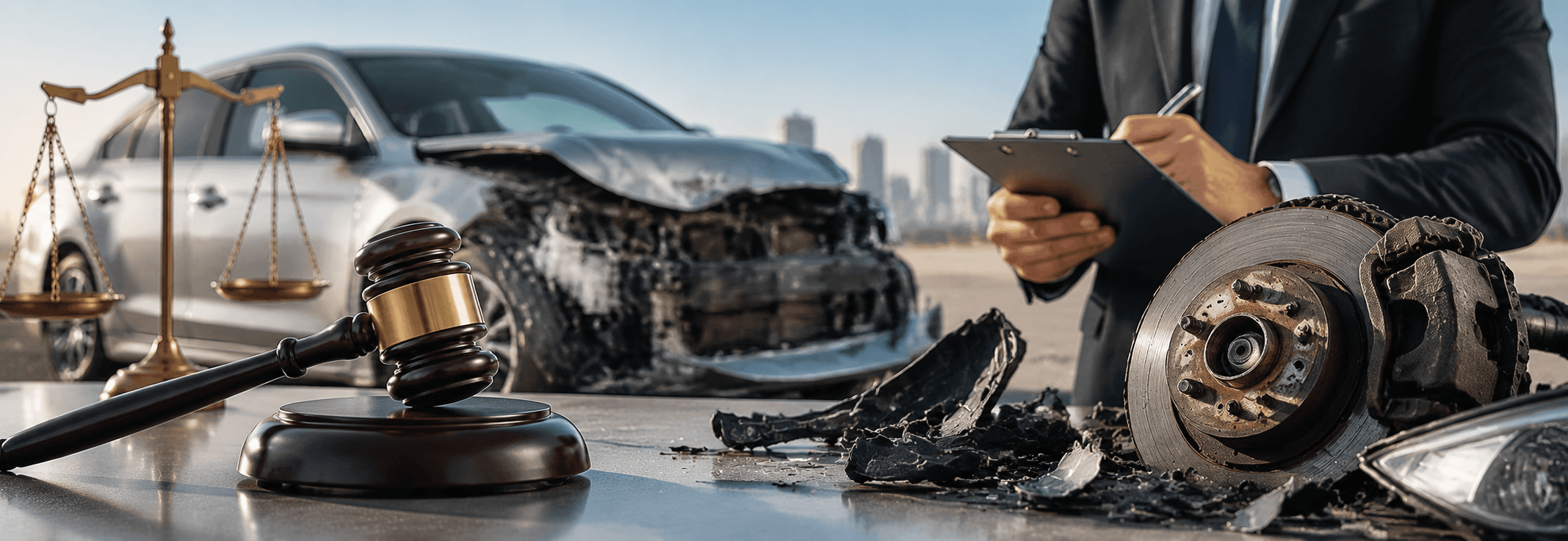
“Auto defect attorney” covers two different problems handled by two different kinds of lawyer. If a vehicle or component failure caused a crash or an injury, that is an auto product liability claim against the manufacturer and others in the chain of distribution, and the priority is preserving the vehicle before it is repaired or salvaged. If the vehicle has a persistent defect the dealer cannot fix and nobody was hurt, that is a warranty and consumer protection matter aimed at a repair, replacement, or buyback, handled by a consumer warranty practice. Before calling anyone, you can check your own VIN against NHTSA’s recall database for free.
Google’s own AI answer for this search says these cases fall into two categories and then lists mostly firms from the second one. Working out which category you are in is the most useful thing you can do first, and this article is built around that. For the general product liability framework, see our California defective product lawyer page. To talk through a crash or injury involving a vehicle failure, call our San Mateo office at 650-250-0705.
Key Takeaways
- Injury from a vehicle failure and a car that will not stay fixed are different legal problems with different remedies and different lawyers.
- NHTSA lets you check your specific vehicle by VIN for open recalls, and search by year, make and model for recalls, investigations, complaints, and manufacturer communications.
- Manufacturers must file a public report describing a safety-related defect and must notify owners by mail within 60 days of notifying NHTSA of a recall decision.
- Do not repair or salvage the vehicle after a crash involving a suspected defect. That is the step most often lost.
- Vaksman Khalfin handles the injury side. Warranty-only and lemon law matters are a separate practice area.
Two Problems, Two Kinds of Lawyer
| A failure caused a crash or injury | The car has a defect that will not stay fixed | |
| Type of claim | Auto product liability, usually strict liability, alongside the underlying collision claim | Warranty and consumer protection, including California’s consumer warranty statute |
| Core question | Was the vehicle or component defective, and did the defect cause the harm? | Has the manufacturer failed to conform the vehicle to its warranty after a reasonable opportunity? |
| Typical remedy | Medical expenses, lost income and earning capacity, pain and suffering, property damage | Repair, replacement, buyback or restitution, and in some cases statutory penalties |
| Key evidence | The vehicle itself, the failed component, electronic data, and medical records | The repair order history, the warranty, and correspondence with the dealer and manufacturer |
| Who handles it | A personal injury firm with product liability experience | A consumer warranty or lemon law practice |
Some situations are both. A component that fails and causes a collision can produce an injury claim and also implicate warranty obligations. Where the facts straddle the line, the injury claim usually drives the analysis, because the stakes and the evidence windows are different.
When You Need an Auto Product Liability Lawyer
The signals that point to a product claim rather than an ordinary collision claim:
- A component failed rather than a driver erring. Brakes, steering, suspension, a tire, a restraint system, an airbag, a battery, or a software-controlled system behaving unexpectedly.
- The injuries are worse than the crash appears to explain. This is the classic signal for a restraint or airbag issue, where the initial impact was survivable but the protective system did not perform.
- The vehicle behaved in a way the driver did not command. Unintended acceleration, loss of steering or braking, a door or latch opening.
- There is an open recall or an ongoing investigation covering your year, make and model. See the next section.
- A repair shop, dealer, or fleet maintainer recently worked on the failed system. That adds a potential defendant and a different theory.
Because a vehicle claim usually sits inside a collision claim, the product angle is the one most often missed. Attention goes to the other driver and the insurance exchange, and by the time anyone asks whether a part failed, the vehicle has been repaired or sold for salvage. Our page on defective product claims by product type covers the vehicle category in more detail, and our car accident and truck accident pages cover the underlying claims.
When the Problem Is a Warranty Problem Instead
If nobody was hurt and the complaint is that the vehicle keeps failing and the dealer cannot fix it, the route is warranty and consumer protection law rather than personal injury. California has a consumer warranty statute that addresses a manufacturer’s obligation to repurchase or replace a consumer good after a reasonable number of repair opportunities, and a separate statute addressing unfair or deceptive practices in consumer transactions. The remedies are a repair, a replacement, a buyback or restitution, and in some cases a statutory penalty, rather than damages for physical harm.
Those claims run on their own timing rules, and this area has seen recent legislative attention, so the current position should be checked rather than read off an article, including this one.
Vaksman Khalfin’s vehicle work is on the injury side. If your situation is warranty-only, a consumer warranty or lemon law practice is a better fit, and it is worth saying that here rather than after you have spent a consultation finding out.
Look Up Your Own Vehicle First
This is free, takes a few minutes, and no competing page on this keyword mentions it. The National Highway Traffic Safety Administration maintains public tools for exactly this.
- Check your VIN. NHTSA’s recall lookup takes a 17-character VIN or a license plate and tells you whether that specific vehicle needs repair as part of a recall. Your VIN is on the lower left of the windshield and on your registration card.
- Search by year, make and model. The same tool returns general results covering recalls, investigations, complaints, and manufacturer communications. That last category is the one people overlook: technical bulletins a manufacturer sent to dealers about a known problem can be directly relevant to what the company knew and when.
- Search safety issues by date. NHTSA’s safety issue search lets you filter recalls by publication date and investigations by when they were opened or closed.
- Report the problem. Complaints filed with NHTSA go to its Office of Defects Investigation, are screened, and are posted publicly with personally identifying information removed. NHTSA describes its investigative process as screening, analysis, and investigation, and says complaints from a number of people about the same product can indicate a defect warranting an investigation.
Two things worth knowing about recalls. When a recall is issued, whether by the manufacturer or by NHTSA, the manufacturer must file a public report describing the safety-related defect or noncompliance, and must notify owners by mail within 60 days of notifying NHTSA of the recall decision. So the absence of a letter is not proof there is no recall on your vehicle, and a VIN check is the reliable way to find out.
An honest caveat. Consumer complaints in NHTSA’s database are submitted by owners. A complaint is not a finding, and an open investigation is not a conclusion. Finding reports about your vehicle is a reason to look further, not proof that a defect caused your crash. Equally, the absence of a recall does not mean a vehicle was not defective.
Preserve the Vehicle, and the Part
This is the step that decides whether a product theory survives, and it usually has to happen in the first days.
- Do not authorize repairs to the vehicle or the failed system.
- Do not release it for salvage or let an insurer total it and dispose of it. An insurer paying out on the property damage often takes the vehicle with it.
- If a part has already been removed, keep it separately and find out who has it. A shop or dealer may still be holding it, and manufacturers’ representatives sometimes ask for failed components.
- Photograph everything before it moves, including the failed part, the interior, the restraint systems, and the odometer.
- Record the identifiers. VIN, and where visible the part number, date code, or supplier marking on the component.
- Keep the paperwork. Service history, repair orders, recall notices, and any prior complaints you made about the same symptom.
Electronic data matters here too. Modern vehicles record information that can bear on what happened, and it can be lost or overwritten when a vehicle is repaired or its modules are replaced.
“What Not to Tell the Attorney”
Google surfaces this question alongside this search, and it deserves a direct answer, because the premise is backwards.
There is nothing you should hide from your own lawyer. Communications with your attorney are confidential, and a lawyer who does not know the unhelpful facts cannot prepare for them. Facts people are tempted to hold back, such as prior injuries, prior complaints about the vehicle, a modification, a lapsed service interval, or a citation, are exactly the ones the other side will find. A claim that fails because your own lawyer learned something late is worse than a claim assessed honestly from the start.
The question people usually mean is what not to say to the other side. There, the answers are concrete: do not give a recorded statement to the manufacturer or an insurer before getting advice, do not sign a release, do not speculate about causes, and do not agree to hand over the vehicle or a component for “evaluation.”
Deadlines
| Situation | General rule | Source |
| Injury claims against a private party, including a manufacturer | Two years from the date of injury | Code Civ. Proc., § 335.1 |
| Claims where a public entity may be responsible, such as a publicly operated vehicle | A written claim generally must be presented within six months | Gov. Code, § 911.2 |
| Warranty and consumer protection claims | Governed by their own timing rules, which differ from the injury deadline and have seen recent legislative attention | Needs checking for the specific claim |
The practical deadline arrives first. A vehicle repaired or salvaged in week one takes the product theory with it, whatever time remains to file.
Vehicle Defect Claims in San Mateo County
Our office at 15 North Ellsworth Avenue, Suite 105, San Mateo, CA 94401 works with injured people across the Peninsula. Civil cases here are handled by the Superior Court’s Civil Division at the Hall of Justice, 400 County Center, Redwood City.
One local point. Peninsula commuting means a high proportion of freeway miles, and a component failure at freeway speed produces a different injury picture and a different reconstruction problem than a low-speed failure. It also means the vehicle is more likely to be towed somewhere other than home, which makes finding out where it is, and telling the yard not to release or crush it, an early and time-sensitive task.
More about the office is on our San Mateo page, and related explanations are collected in our California personal injury guides.
How Vaksman Khalfin Can Help
For crashes and injuries involving a suspected vehicle or component failure, Vaksman Khalfin, PC can move to locate and preserve the vehicle before it is repaired or salvaged, send preservation demands to the manufacturer, the insurer, and any shop or yard holding it, identify everyone in the chain of distribution for the failed component, obtain the design, testing and complaint records through discovery, work with reconstruction and engineering experts, and pursue the product claim alongside the underlying collision claim.
Where a matter turns out to be warranty-only, we will tell you at the consultation rather than after.
The firm’s California personal injury practice is led by Alan D. Khalfin, admitted in California. Injury matters are handled on a contingency-fee basis: there is no upfront attorney’s fee, and attorney’s fees are owed only if there is a recovery. Case costs, which in vehicle cases frequently include inspection, reconstruction and expert fees, are a separate category from attorney’s fees. How case costs are handled, including whether you may be responsible for them, is set out in the written fee agreement reviewed with you before anything is signed.
To talk about a vehicle failure, call 650-250-0705 or schedule a free consultation. If you know where the vehicle is, say so on the first call.
Reviewed by Alan D. Khalfin, Partner and Managing Attorney, Vaksman Khalfin, PC (admitted in California). Last reviewed: 09/22/2026
Frequently Asked Questions
For an injury claim, a vehicle or component is defective under one of three theories: a manufacturing defect, where the specific unit differs from its intended design; a design defect, where the design itself is unsafe so every unit carries the same risk; or a failure to warn. For a warranty claim, the question is different: whether the vehicle conforms to its warranty and whether the manufacturer has failed to fix it after a reasonable opportunity.
If nobody was injured and the complaint is that the vehicle will not stay fixed, that is a warranty and consumer protection claim rather than a personal injury one. California has a consumer warranty statute addressing a manufacturer's obligation to repurchase or replace after a reasonable number of repair opportunities. Those claims run on their own timing rules and this area has seen recent legislative attention, so the current position should be checked. A consumer warranty or lemon law practice handles them.
Use NHTSA's recall lookup with your 17-character VIN, which is on the lower left of the windshield and on your registration card. Searching by year, make and model instead returns general results covering recalls, investigations, complaints, and manufacturer communications. Manufacturers must notify owners by mail within 60 days of notifying NHTSA of a recall decision, but the absence of a letter is not proof there is no recall, so check the VIN.
No, and the absence of one does not mean you do not. A recall can be useful evidence and is worth documenting, but it does not by itself establish that a defect caused a particular crash or injury. Products can be defective whether or not a recall has issued.
Do not authorize repairs, and do not release it for salvage or let it be disposed of as part of a property damage payout. Find out where it has been towed and make sure the yard does not release or crush it. If a component has already been removed, keep it separately and find out who is holding it. Photograph everything and record the VIN and any part markings.
Nothing. Communications with your own lawyer are confidential, and the unhelpful facts, such as prior injuries, prior complaints about the vehicle, modifications, or a missed service interval, are exactly the ones the other side will find. The question people usually mean is what not to say to the other side: do not give a recorded statement or sign a release before getting advice, do not speculate about causes, and do not hand over the vehicle or a component for evaluation.
A dispute with a repair shop is usually a contract or consumer matter rather than a personal injury claim, and emotional distress is not generally recoverable on its own in that setting. Where faulty repair work caused a crash and physical injury, that is a negligence claim against the shop, and emotional harm may be part of the damages. Claims for emotional distress standing alone have their own requirements, which is a question for a lawyer on the specific facts.
Most injury claims against a private party must be filed within two years of the date of injury under Code of Civil Procedure section 335.1. Where a public entity may be responsible, such as a publicly operated vehicle, a written claim generally must be presented within six months under Government Code section 911.2. Warranty claims follow their own rules.
The firm's vehicle work is on the injury side: crashes and injuries involving a suspected vehicle or component failure. Warranty-only and lemon law matters are a separate practice area, and a consumer warranty practice is a better fit for them.