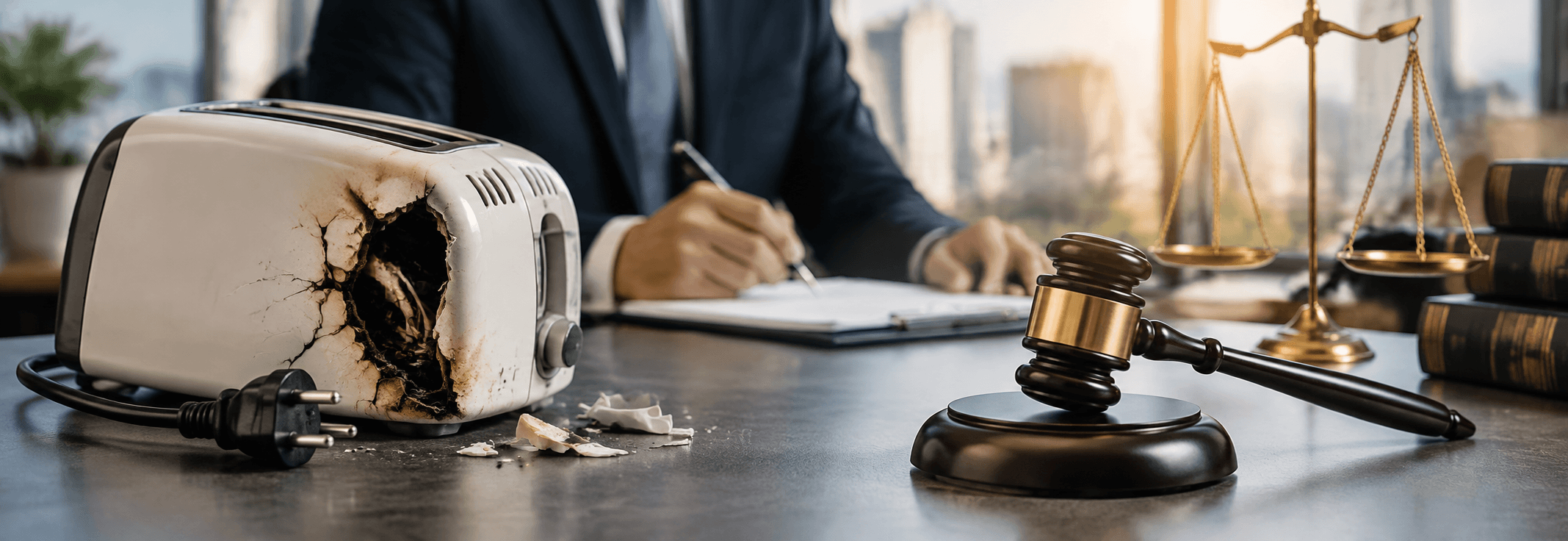
A product liability lawyer represents people injured by defective products. The work is different from an ordinary injury claim in four concrete ways: the product itself is the central piece of evidence and has to be secured before it is repaired, returned, or discarded; the responsible parties may include a manufacturer, a component maker, a distributor, and a retailer rather than one insured driver or owner; proving a defect normally requires engineering or safety experts, which makes these cases expensive to run; and the opposing side is usually a corporation with defense counsel rather than a claims adjuster. Most claims must be filed within two years.
If you are looking for a product liability lawyer, you probably already know the product was the problem. What is less obvious is what a lawyer actually does with that, why these cases run differently from a car accident claim, and what you should be doing this week to keep your options open. This article covers the work rather than the doctrine. For the legal framework, including the three defect theories and the two tests California applies to design defects, see our California defective product lawyer page. To talk through a specific product, call our San Mateo office at 650-250-0705. The consultation is free.
Key Takeaways
- The single most important thing after a product injury is not calling a lawyer, it is not losing the product. Do not return it, repair it, or let anyone collect it for testing.
- Product claims usually involve several potentially responsible parties across the chain of distribution, which changes both the investigation and what insurance may be available.
- These cases normally require experts, so case costs are higher than in a typical injury claim. How costs are handled should be in writing before you sign anything.
- The other side is a company with defense counsel, and it may ask for a recorded statement or offer a replacement product early. Both are worth a conversation with a lawyer first.
- Most claims must be filed within two years. Where a public entity is involved, a written claim comes first, on a much shorter timeline.
What a Product Liability Lawyer Does
Takes custody of the product
In most injury cases the evidence is documents and testimony. In a product case, the evidence is an object, and it is usually in the injured person’s garage, in a repair shop, or already on its way back to the manufacturer. A lawyer’s first job is to secure it, document its condition, and preserve it unaltered. Once the item is gone, a manufacturing defect claim, which depends on comparing the specific unit against its intended design, is generally gone with it. The design and warning theories survive but become considerably harder.
Identifies the whole chain of distribution
California’s strict liability doctrine reaches the parties who put the product into the stream of commerce, not just the name on the box. That can include the maker of the finished product, the maker of a component part, a distributor, a wholesaler, a retailer, and in some circumstances a party that leased or rented the equipment. This matters practically when a manufacturer is overseas, dissolved, or has no assets worth pursuing, because a claim may still be viable against a party inside the state. Working out that chain early also determines who has a duty to preserve records.
Gets the documents only the company has
The evidence that decides a design or warning case is internal: design and engineering files, testing and validation records, quality control and batch records, complaint and adverse-event histories, service bulletins, and any prior claims involving the same product. None of that is public. It comes through formal discovery, which is one of the main reasons product cases take longer than other injury claims and one of the main reasons filing suit is sometimes necessary rather than optional.
Works with the right experts
Establishing which defect theory the evidence supports usually takes a qualified expert: a mechanical or design engineer, a materials or failure analyst, a human factors or warnings specialist, or a medical expert on causation. Part of the lawyer’s judgment is matching the expert to the product and the theory, and doing it early enough that the expert can examine the item before anything changes.
Handles a corporate opponent
In a typical injury claim the other side is an insurance adjuster. In a product case it is usually a company, its product liability insurer, and defense counsel who handle these matters routinely. Early contact often takes the form of a request for a recorded statement, an offer to inspect or collect the product, or a refund or replacement accompanied by a release. Those are not neutral gestures, and a lawyer handles that communication so the injured person is not negotiating with the company’s counsel unrepresented.
Sorts out which body of law applies
A single incident can sit in more than one area at once. A vehicle component failure involves both a product claim and a motor vehicle claim. A machine that injures someone at work brings in the workers’ compensation system alongside a claim against the manufacturer. A medical device involves federal regulation. Establishing which claims are available, and which deadlines govern each, is work that has to happen early rather than near the two-year mark.
Why These Cases Run Differently
| Issue | Typical injury claim | Product liability claim |
| Central evidence | Records, photographs, testimony | A physical object that can be lost, repaired, or returned in the first week |
| Who is responsible | Usually one driver, owner, or business | Potentially several parties along the chain of distribution |
| Key documents | Largely obtainable by request | Internal design, testing, and complaint records, obtained through discovery |
| Experts | Sometimes needed | Normally needed, and often more than one discipline |
| The opponent | A claims adjuster | A company, its insurer, and defense counsel |
| Case costs | Filing fees, records | The same plus expert analysis, testing, and sometimes destructive examination |
What to Do This Week
- Keep the product exactly as it is. Do not clean it, repair it, disassemble it, return it, or accept a replacement in exchange for it. Put it somewhere safe.
- Keep everything that came with it. Packaging, labels, warning stickers, the manual, inserts, the receipt or order confirmation, and any registration or warranty paperwork.
- Record the identifiers. Model number, serial number, lot or batch code, and date of manufacture if shown. Photograph the labels directly.
- Photograph the item and the scene before anything is moved, from several angles and distances, including whatever it was connected to or used with.
- Get medical attention and tell the provider what caused the injury. The record linking the product to the harm is created at the time, not later.
- Do not give a recorded statement to the manufacturer or its insurer, and do not sign a release, before speaking with a lawyer.
- Write down what happened while it is fresh: what you were doing, how the product was being used, what failed, and who saw it.
- Note any recall, but do not assume the absence of one means anything. Products are defective whether or not a recall has issued.
The Legal Framework, in Brief
California recognizes three defect theories: a manufacturing defect, where the item differs from its intended design; a design defect, where the design itself is unsafe; and a failure to warn, where warnings or instructions were inadequate for a known or knowable risk. Design defect can be established two ways, and under one of them, the risk-benefit test, the burden shifts to the defendant once the injured person proves the design was a substantial factor in causing harm. The products liability series in the Judicial Council’s California Civil Jury Instructions begins at CACI No. 1200, and the two design-defect tests appear at CACI No. 1203 and CACI No. 1204.
Our California defective product lawyer page covers all of this in detail, including the burden shift and the defenses a manufacturer is likely to raise. For the underlying negligence framework that product claims can also be brought under, see our guide to the elements of negligence.
How to Evaluate a Firm for a Product Case
Product claims are not interchangeable with other injury work, so a few questions are worth asking whoever you speak to:
- What happens to the product? Who takes custody, where is it stored, and how is its condition documented.
- How are case costs handled? Expert and testing fees are the largest single expense in these cases. Ask what happens to those costs if the claim does not succeed, and get the answer in the written fee agreement rather than from a badge.
- What experts would this case need? A firm that has thought about the product will have a view.
- Who else might be responsible? A firm focused only on the manufacturer may be missing the party actually within reach.
- Is the firm prepared to file? The internal records that decide these cases usually arrive through discovery, which requires a lawsuit.
- Who handles the file day to day, and how will you hear from them.
Deadlines
| Situation | General rule | Source |
|---|---|---|
| Most injury claims against a private party | Two years from the date of injury | Code Civ. Proc., § 335.1 |
| Claims where a public entity may be responsible | A written claim generally must be presented to the entity before any lawsuit, on a much shorter timeline | California’s Government Claims Act |
| Warranty-based claims | Can follow different rules from an injury claim | Worth sorting out early, since the theories carry different timelines |
The practical deadline is usually much earlier than the legal one. A product that goes back to the manufacturer in week one takes a theory with it, regardless of how much time remains to file.
Product Claims in San Mateo County
Our office at 15 North Ellsworth Avenue, Suite 105, San Mateo, CA 94401 works with injured people across the Peninsula. Civil cases here are handled by the Superior Court’s Civil Division at the Hall of Justice in Redwood City.
Product cases on the Peninsula often surface inside another claim rather than on their own: a vehicle component or restraint system in a car or truck collision, a helmet or safety system in a motorcycle case, or equipment involved in a fall on unsafe property. That is worth raising at the first consultation, because the product angle is the one most often missed and the one with the shortest practical evidence window.
More about the office is on our San Mateo page, and related explanations are collected in our California personal injury guides.
How Vaksman Khalfin Can Help
Vaksman Khalfin, PC can take custody of and preserve the product before it is lost, identify everyone in the chain of distribution who may be responsible, obtain design, testing, and complaint records through discovery, work with engineering and safety experts to establish which defect theory the evidence supports, handle communications with the company and its insurer, and pursue the claim through litigation where a fair resolution is not offered.
The firm’s California personal injury practice is led by Alan D. Khalfin, admitted in California. Product matters are handled on a contingency-fee basis: there is no upfront attorney’s fee, and attorney’s fees are owed only if there is a recovery. Case costs, which in product cases frequently include expert and testing fees, are a separate category from attorney’s fees. How case costs are handled, including whether you may be responsible for them, is set out in the written fee agreement that is reviewed with you before anything is signed.
To talk with a product liability lawyer about an injury in San Mateo County, call 650-250-0705 or schedule a free consultation. If you still have the product, bring it or photograph it before you come.
Reviewed by Alan D. Khalfin, Partner and Managing Attorney, Vaksman Khalfin, PC (admitted in California). Last reviewed: 09/21/2026
Frequently Asked Questions
A product liability lawyer takes custody of and preserves the product that caused the injury, identifies everyone in the chain of distribution who may be responsible, obtains design documents, testing records, and complaint histories through discovery, works with engineering and safety experts to establish which defect theory the evidence supports, handles communications with the company and its insurer, and negotiates or litigates the claim.
Yes, where a defective product caused injury or damage. California recognizes strict liability claims, which focus on whether the product was defective and whether the defect caused harm rather than on whether the company was careless, and negligence and warranty theories may also apply. Whether a particular injury supports a claim depends on the product, the facts, and what evidence still exists.
By establishing a defect and causation with evidence. A manufacturing defect claim usually requires the product itself, compared against its intended design. A design defect claim requires engineering analysis, and under the risk-benefit test the burden shifts to the defendant once the injured person proves the design was a substantial factor in causing harm. A failure-to-warn claim turns on labeling, manuals, and what the company knew or could have known. Preserving the product is often what determines which of these theories remains available.
There is no dependable average, and these cases tend to run longer than ordinary injury claims. The main drivers are how long treatment takes to stabilize, how contested the defect theory is, how much expert analysis is required, how many parties are involved, whether internal records have to be obtained through discovery, and the court's calendar.
Speak with a lawyer first. Returning, repairing, or handing over the product usually eliminates the manufacturing defect theory and makes the design and warning theories considerably harder. Manufacturers and their insurers sometimes offer to collect an item for testing or to send a replacement, and once the item is gone it cannot be examined.
Strict liability reaches the chain of distribution, so the manufacturer of the finished product, the manufacturer of a component part subject to the component parts rule, distributors and wholesalers, retailers who sold the product, and in some circumstances those who lease or rent equipment. This matters when a manufacturer is overseas, dissolved, or judgment-proof, because a claim may still be viable against a party within the state.
A recall can be useful evidence and is worth documenting, but it is not required. The absence of a recall does not mean a product was not defective, and the existence of one does not by itself establish that a particular injury was caused by the defect.
Vaksman Khalfin handles these matters on a contingency-fee basis, so there is no upfront attorney's fee and attorney's fees are owed only if there is a recovery. Case costs, which frequently include expert and testing fees in product cases, are a separate category from attorney's fees. How case costs are handled, including whether you may be responsible for them, is set out in the written fee agreement. Initial consultations are free.
Most injury claims against a private party must be filed within two years of the date of injury under Code of Civil Procedure section 335.1. Where a public entity may be responsible, a written claim generally must be presented to that entity before any lawsuit, on a much shorter timeline. Warranty-based claims can follow different rules.