
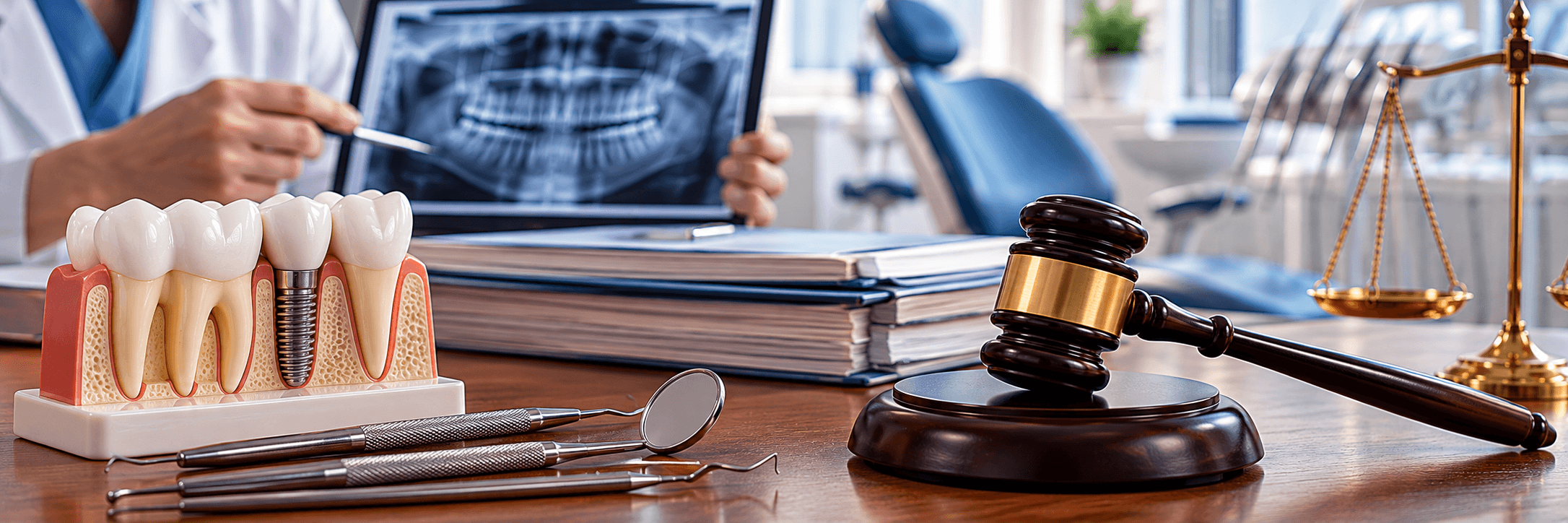
To prove dental negligence in California, you generally need to show that your dentist failed to provide the level of care expected of a reasonably competent dental professional and that this failure caused your injury. Dental records, X-rays, photographs, treatment bills, and expert opinions can help establish what happened and whether the treatment was negligent.
A successful dental malpractice claim generally requires proving four key elements:
- Duty of care: Your dentist had a professional responsibility to provide appropriate dental treatment.
- Breach of duty: Your dentist failed to meet the accepted standard of dental care.
- Causation: The dentist’s negligent actions or omissions caused your injury.
- Damages: You suffered actual harm, such as additional medical expenses, lost income, physical pain, or the need for corrective treatment.
Key Takeaways
- The duty to prove the claim sits with the person bringing it, not with the dentist to disprove it.
- The standard is not certainty. A California civil claim is proved on a preponderance of the evidence — evidence of greater weight, even minimally so, than what is offered against it.
- Documents are not self-proving. The California Courts state that exhibits do not come into evidence by themselves.
- The professional judgment at the centre of the claim can only come from an expert, because it is not a matter of common knowledge.
- What your records establish is what happened. What they cannot establish on their own is whether it should have.
Who Has to Prove It, and How Convincingly
Two things are commonly assumed and both are wrong.
The first is that the dentist has to justify what happened. They do not. A California court glossary defines the burden of proof as “the duty to establish a claim or allegation by admissible evidence,” and notes that this “is usually the duty of the plaintiff in a civil case.” The person bringing the claim carries it throughout.
The second is that the standard is near-certainty. It is not, and this cuts the other way. The same glossary defines a preponderance of evidence as “evidence which is (even minimally) of greater weight or more convincing than the evidence which is offered in opposition to it,” and states that this “is the standard by which a plaintiff must prove his/her case in a civil suit.”
That is a materially lower threshold than the criminal standard most people have in mind, which the same source describes as requiring a tribunal to be “entirely convinced” and calls “the highest burden of proof any party has in any proceeding.” A civil claim does not require certainty. It requires the scales to tip.
Collecting Is Not Proving
This is the part the collection lists leave out.
The glossary defines evidence as “testimony, records, documents, material objects, or other things presented at a trial to prove the existence or nonexistence of a fact.” The operative words are presented at a trial. Material in a folder is not yet evidence of anything.
The Courts’ guidance on preparing for trial makes the mechanics explicit. Rules of evidence “say what evidence a judge (or jury) can consider,” and “exhibits do not come into evidence by themselves.” Unless the other side agrees to their admission, documents arrive through people: “witnesses are key to having documents, videos, pictures, physical evidence” before the court at all.
The practical consequence is that a dental record proves nothing until someone who can speak to it puts it before the court, and that the question of who that person is has to be answered early rather than at the end.
The Part Only an Expert Can Supply
A dental negligence claim turns on a professional judgment: whether the care delivered met the standard expected of a practitioner of that kind. That judgment is not something a court can make by looking at the records, and it is not something a patient can supply by describing what happened.
The glossary describes expert testimony as evidence “given in relation to some scientific, technical or professional matter by experts, i.e., persons qualified to speak authoritatively by reason of their special training, skill or familiarity with the subject.” That is the mechanism by which a professional standard enters a case at all.
It is also why the sequence matters. The records have to exist before anyone can assess them, and the assessment has to happen before anyone can say what the claim is. Our page on California dental malpractice claims sets out what has to be established and the deadlines within which it has to be done.
What the Records Do, and What They Do Not
Treatment records are the foundation, and it is worth being precise about what they carry.
What they establish: what was done, when, by whom, in what order, and what was recorded at the time about the patient’s condition and the plan. They are contemporaneous, which is their strength — they were created before anyone had a reason to characterise events.
What they do not establish: whether what was done met the standard. A complete and accurate record of competent treatment and a complete and accurate record of substandard treatment can look similar to a non-specialist. The record supplies the facts; the expert supplies the measure.
What is easy to lose: the material that is not the dentist’s file. The account of how things changed afterwards, and documentation from anyone who treated the problem subsequently, accumulates over time and cannot be reconstructed later.
Why the Threshold Changes the Picture
Because the standard is a preponderance rather than certainty, a claim does not fail because a question is arguable. It fails where the evidence on the point does not outweigh what is offered against it.
That distinction does real work. It means a defensible alternative explanation does not end a claim — it has to be weighed against the claimant’s evidence, and the weighing is what the expert evidence is for on both sides. It also means the quality of the record matters more than its volume, since what counts is what tips the scales rather than how much was filed.
Talk to a California Dental Malpractice Lawyer
The useful first step is not assembling more material. It is having what already exists assessed by someone who can say what it shows, and whether it carries the weight the standard requires.
Vaksman Khalfin, PC takes dental malpractice matters from across California, with Alan D. Khalfin heading that work from the San Mateo office. Reviewing what you have costs nothing — a consultation can be set up for that purpose. Wider reading is in the California personal injury guides.
Reviewed by Alan D. Khalfin, Partner and Managing Attorney, Vaksman Khalfin, PC (admitted in California). Last reviewed: 10/15/2026
Frequently Asked Questions
By establishing, through admissible evidence, that the care fell below the standard expected of a practitioner of that kind and that this caused the harm — to a preponderance of the evidence. The treatment records supply the facts and expert testimony supplies the professional measure, because the standard of care is not a matter of common knowledge.
The person bringing the claim. A California court glossary defines the burden as the duty to establish a claim by admissible evidence and notes that this is usually the plaintiff's duty in a civil case. The dentist does not have to disprove anything.
A preponderance of the evidence, described as evidence of greater weight — even minimally — than what is offered in opposition. That is considerably lower than the criminal standard, which requires a tribunal to be entirely convinced.
No. Records establish what was done; they do not establish whether it should have been. They also do not become evidence automatically — the Courts state that exhibits do not come into evidence by themselves.
Because the central question is a professional judgment. Expert testimony is the mechanism by which a professional standard is put before a court, given by someone qualified to speak authoritatively on the subject.
It is useful evidence about the current condition and what is needed to address it. It is not, by itself, a determination that the earlier care fell below the standard, which is a different question requiring a different kind of opinion.
That is ordinary rather than fatal. Because the standard is a preponderance, a disputed point is weighed rather than treated as unprovable, and contemporaneous records carry weight precisely because they were made before the dispute existed.
Consultations at Vaksman Khalfin, PC are free. Injury claims are handled on a contingency-fee basis: there is no upfront cost, and attorney's fees are owed only if we recover compensation for you. How case costs are handled is set out in the written agreement.
