
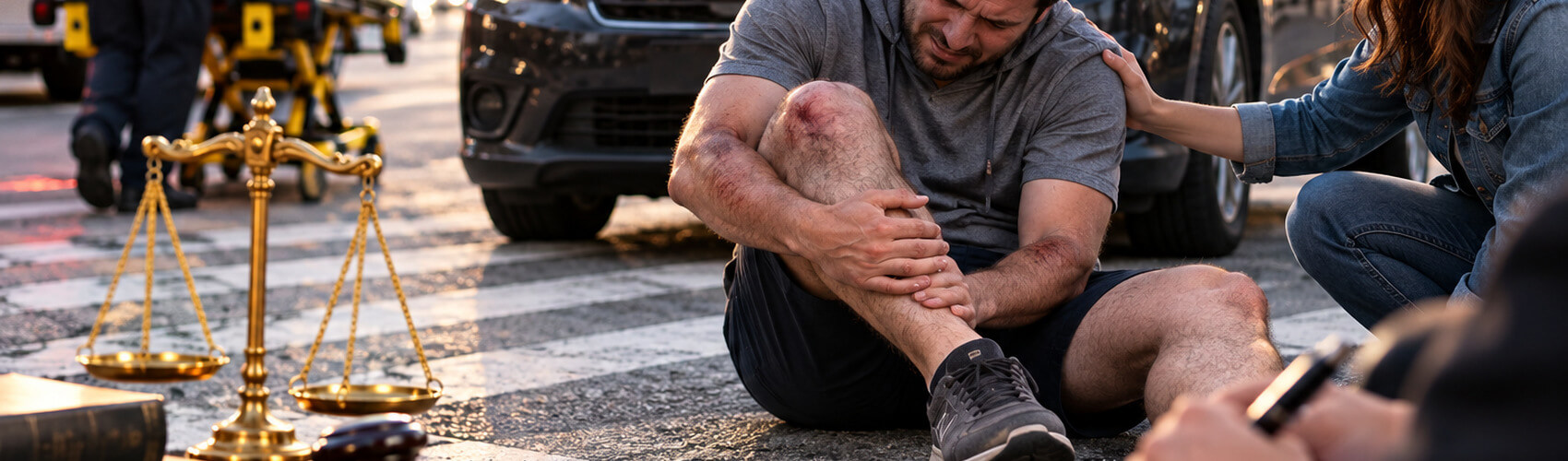
In the three days after a person is struck by a car, three separate clocks are running, and they move at completely different speeds. Confusing them is what causes people to rush the decisions that can wait and miss the ones that cannot.
The medical clock runs in hours and belongs entirely to clinicians. The evidence clock runs in days and is the one almost nobody is thinking about. The legal clock runs in months, and the most useful thing to know about it is that nothing on it is due in the first 72 hours.
Key Takeaways
- Medical questions in this window belong to the people treating you. The California Department of Insurance’s own instruction is to call 911 if there are injuries.
- The evidence that disappears fastest disappears inside this window, and most of it is not in your possession.
- An insurer is permitted up to 15 days to make contact. One that reaches you within 72 hours is moving considerably faster than the rule requires.
- The state’s consumer guidance is explicit about not signing statements regarding fault and not signing anything in exchange for an offer.
- Nothing legal is actually due in the first three days, and knowing that is what makes it possible to decline the things that are being rushed.
The Medical Clock Is Not This Page’s to Describe
A great deal of what is published on this subject consists of injury catalogues and lists of warning signs to watch for. That is medical content, and a law firm is not the right source for it. What happens in a body after a collision, which symptoms matter, and when to go back to a hospital are questions for clinicians, and a page like this one should not be standing between a person and that advice.
The one thing worth repeating here is what the state itself says. The California Department of Insurance’s guidance on what to do after a collision is direct: “Call 911 if there are injuries. Call the police.”
Everything below concerns the other two clocks — what is happening around the injury rather than to it.
The Evidence Clock
The first 72 hours is when the physical record of a collision is at its most complete and starts being dismantled, usually by ordinary processes that nobody intends as destruction.
Footage is overwritten on cycles measured in days. Vehicles are repaired. Roadways are swept, resurfaced and repainted. People who stopped at the scene go back to their lives and become difficult to find. None of this is anyone acting in bad faith; it is simply what happens when a few days pass.
Almost none of it is in the injured person’s possession, and that is the structural problem. Our page on California pedestrian accident claims sets out how liability evidence is assembled and why the scene answers questions that accounts cannot.
What can usually be done from a hospital bed, or by someone acting for you, is narrow but worth doing: establishing whether photographs were taken at the scene and by whom, noting what businesses or homes overlook the location, and writing down the names of anyone who stopped. These are not tasks that require decisions. They require someone to do them before the window closes.
What the Other Side Is Doing in the Same Window
This is the part of the first 72 hours that surprises people, and it is worth understanding before the call comes rather than during it.
The California Department of Insurance sets out what is required of insurers after a collision. A claim representative “should contact you within a reasonable period of time,” and insurers “can take up to 15 days to contact you.” An insurer must then accept or deny a claim “immediately but in no event later than 40 days after receiving proof of claim,” and once a settlement is reached must pay “immediately, but in no event later than 30 days.”
Read those together and something becomes clear. Contact within the first two or three days is not the system working at its normal speed. It is substantially faster than the fifteen days permitted, and it happens when a claim is expected to be straightforward to close. The speed is a choice, and it is being made before anyone knows what the injury turns out to involve.
The same Department of Insurance guidance is specific about what not to do. “Do not sign statements regarding fault or promise to pay for the other parties damages. If the other party offers to pay your deductible, don’t sign anything.” And on accounts of the collision: “Do not argue with other drivers and passengers. Save your story for the police and your insurance company” — your own insurer, not the other side’s.
An offer made in the first days is being made before the medical picture exists. Accepting it closes the claim, including the parts of it that have not happened yet.
What Is Not Urgent
Almost everything people believe is urgent in the first 72 hours is not.
No legal deadline falls in this window. The ordinary limit for a personal injury lawsuit in California is two years from the date of injury, and even the much shorter deadline that applies where a public agency may be responsible is measured in months rather than days. Our pedestrian accident page sets out the deadlines that do apply.
The DMV traffic accident report, where one is required, is due within ten days rather than immediately. There is no obligation to give the other driver’s insurer a recorded statement at all, and certainly not on their schedule. There is no figure to work out, and no number anyone can responsibly put on a claim at this stage, because the information that would support one does not exist yet. And there is no need to decide about representation in the first three days.
Knowing what is not urgent is practically useful, because the pressure in this window comes almost entirely from the direction of things that can wait.
What the Window Actually Looks Like
At the scene. Emergency services, and the account that goes into the collision report — frequently given by whoever is upright rather than by the person who was struck. The Department of Insurance advises collecting names, addresses, telephone numbers and driver’s licence details from drivers involved, along with licence plates, and photographing the scene where that is possible.
The first day. Medical assessment, and the beginning of a record that other people are writing. Notifying your own insurer, which the Department of Insurance advises doing immediately — a different thing from speaking to the other driver’s insurer.
Days two and three. The other side’s adjuster frequently makes contact. Footage begins to be overwritten. The vehicle may go in for repair. This is the point at which the evidence clock and the insurer’s clock are both running and neither is visible from a hospital.
Talk to a California Pedestrian Accident Lawyer
The things that are hardest to recover later are the ones that disappear in the first few days, and most of them are not in the injured person’s hands. Vaksman Khalfin, PC handles pedestrian claims throughout California from our San Mateo office, and the firm’s personal injury practice is led by Alan D. Khalfin.
You can schedule a free consultation to discuss what happened. Further reading is available in our California personal injury guides.
Reviewed by Alan D. Khalfin, Partner and Managing Attorney, Vaksman Khalfin, PC (admitted in California). Last reviewed: 10/13/2026
Frequently Asked Questions
Get medical attention, which is the only genuinely urgent item — the California Department of Insurance advises calling 911 if there are injuries. Beyond that, the useful actions are preservation rather than decision: establish whether photographs were taken at the scene, note what overlooks the location, record who stopped, and notify your own insurer. Decisions about offers, statements and representation can all wait.
Clinicians answer that, not lawyers, and this page deliberately does not attempt it. Anything that worries you in the days after a collision is a reason to go back to a doctor rather than to read further online — no page can assess a person, and a search result is a poor substitute for being examined.
It is faster than required. The California Department of Insurance states that insurers can take up to 15 days to make contact. Contact within a day or two is a choice rather than an obligation, and it generally reflects an expectation that the claim will be straightforward to resolve.
There is no obligation to give the other party's insurer a statement on their timetable. The Department of Insurance's own guidance is to save your account for the police and your own insurance company, and not to sign statements regarding fault.
An offer made in the first days is made before the extent of the injury is known. Accepting closes the claim, including the parts that have not yet become apparent. The Department of Insurance advises not signing anything in exchange for an offer to cover a deductible, and the same caution applies more strongly where injuries are involved.
The DMV traffic accident report is due within ten days, not immediately, where it is required. Notifying your own insurer is a separate matter and the Department of Insurance advises doing that straight away.
No. It creates something an insurer may raise later, which is an argument rather than a finding, and the response to it is a clear record of what happened afterwards. Seeking assessment remains worthwhile whenever concern arises.
Consultations at Vaksman Khalfin, PC are free. Injury claims are handled on a contingency-fee basis: there is no upfront cost, and attorney's fees are owed only if we recover compensation for you. The written agreement sets out how case costs are handled.
