
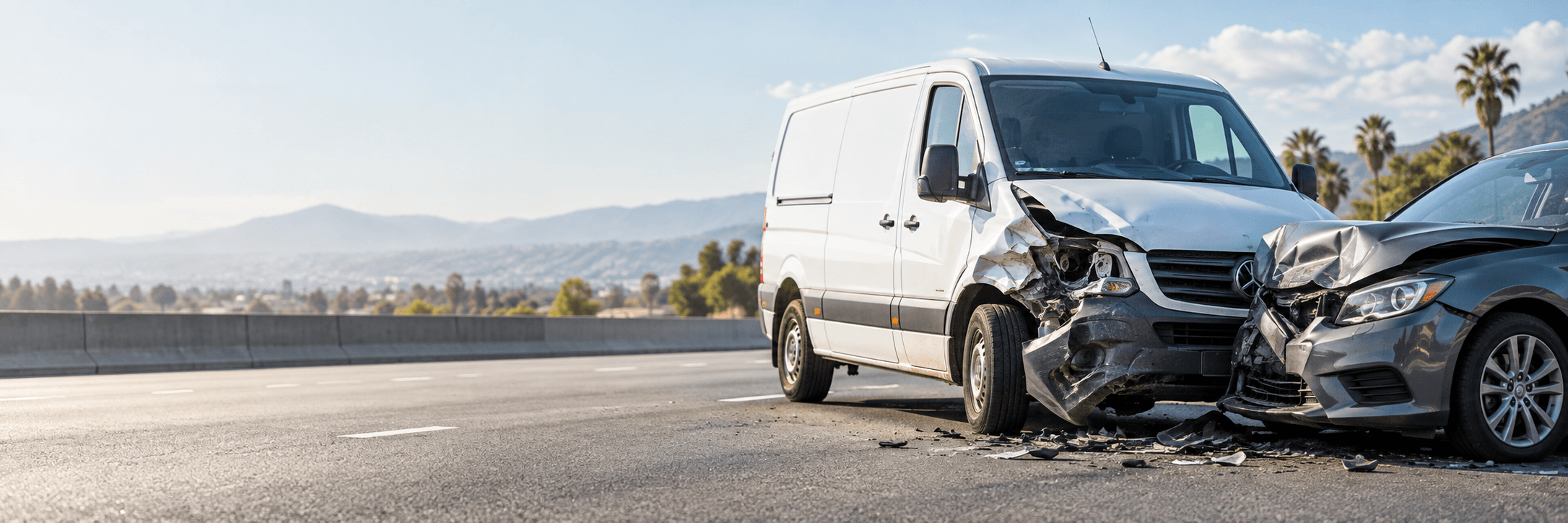
After a crash with a branded pickup, a utility van, or a fleet car, the question is often not only what the driver did, but whether the business behind the vehicle is responsible. California law offers several distinct routes to that business, and they work differently. One makes an employer responsible for an employee’s driving. Another makes a vehicle’s owner responsible for anyone it lets drive, but caps that liability. A third looks at the company’s own decisions. Government vehicles and rented or leased vehicles follow their own rules.
Which route applies affects who pays and how much coverage may be available. This guide explains each one.
In California, a business may be responsible for a crash involving one of its vehicles if the driver was its employee or agent acting in the course of its business (Civil Code section 2338), if it owned the vehicle and gave the driver permission to use it (Vehicle Code section 17150, which caps liability based only on ownership), or if its own decisions, such as entrusting the vehicle to an unfit driver or neglecting maintenance, were careless. Public entities and rental or leasing companies follow separate rules.
Key Takeaways
- An employer can be responsible for an employee’s driving in the course of the business, with no statutory cap.
- An owner’s liability based only on giving permission to drive is capped at $15,000 for one person and $30,000 for more than one person in an accident.
- A company can also be responsible for its own carelessness, separate from the driver’s.
- Claims involving a government vehicle generally require a written claim within six months.
- Rental and leasing companies generally cannot be held liable only because they own the vehicle.
The Five Routes at a Glance
| Route | Legal basis | What has to be shown | Built-in limit |
|---|---|---|---|
| 1. Employer responsibility | Civ. Code § 2338 and case law | The driver was an employee or agent acting in the business | No statutory cap; limited in practice by insurance and assets |
| 2. Owner’s permissive use | Veh. Code §§ 17150–17153 | The owner gave express or implied permission to drive | $15,000 per person, $30,000 per accident, $5,000 property damage |
| 3. Company’s own negligence | General negligence principles | Carelessness in hiring, entrusting, training, maintaining, or scheduling | No statutory cap |
| 4. Government vehicle | Veh. Code § 17001; Gov. Code § 911.2 | A public employee driving within the scope of employment | Written claim generally within six months |
| 5. Rental or leasing company | 49 U.S.C. § 30106 | The company’s own negligence or criminal wrongdoing | Generally no liability based only on ownership |
Route 1: When the Driver Was Working for the Business
Civil Code section 2338 makes a principal responsible to third persons for the negligence of its agent in the transaction of the business of the agency. California courts apply the same principle to employers whose employees cause harm while acting within the scope of their jobs.
The questions that usually decide this route are factual:
- Employee or contractor? A contract that calls the driver an independent contractor is not the last word. The actual working relationship matters.
- Was the trip work? A delivery, a service call, or travel between job sites usually is.
- Commute or required driving? Courts generally treat an ordinary commute differently from driving the employer required, such as taking a work vehicle home for on-call duty.
- A personal detour? If the driver stepped away from work for a personal errand, how far and for how long can matter.
The answers usually come from the company’s own records, which is why lawyers request their preservation early. For what those records look like when the vehicle falls below the federal commercial motor vehicle thresholds, see commercial vehicle accidents.
Route 2: Ownership Alone, and Its Low Cap
Under Vehicle Code section 17150, a vehicle’s owner is liable for death or injury caused by the negligent operation of the vehicle by anyone driving with the owner’s express or implied permission. That makes ownership a route to the business even when the driver was not working.
This route has significant limits:
- The cap. Section 17151 limits liability based only on ownership to $15,000 for the death of or injury to one person, $30,000 for more than one person in one accident, and $5,000 for property damage. The cap does not apply when the owner’s liability arises through a principal-agent or employer-employee relationship, which is why Route 1 matters.
- No punitive damages for the driver’s conduct. Section 17151 also provides that the owner is not liable under this route for punitive damages based on the driver’s conduct, though an owner can still face punitive damages for its own wrongful conduct.
- The driver comes first. Under section 17152, the driver must be named as a defendant if they can be served, and a judgment is collected first from the driver’s property.
- Reimbursement. Under section 17153, an owner that pays under this route can recover the amount from the driver.
Route 3: The Company’s Own Decisions
Apart from what the driver did, a business can be responsible for its own carelessness. Examples include:
- Entrusting a vehicle to someone it knew or should have known was unfit to drive it
- Ignoring a driver’s history of violations or crashes
- Failing to train a driver for the vehicle they were assigned
- Neglecting brakes, tires, lights, or other maintenance
- Setting schedules or policies that pushed drivers to speed or use their phones
These claims matter most when the business disputes that the driver was working at the time. When a company’s own conduct rises to malice, oppression, or fraud, Civil Code section 3294 allows punitive damages if proven by clear and convincing evidence, subject to the additional requirements that section sets for employers.
Route 4: Government Vehicles
City, county, transit, school district, and state vehicles are business vehicles too, but they follow different rules. Under Vehicle Code section 17001, a public entity is liable for death or injury caused by an employee’s negligent or wrongful operation of a vehicle within the scope of employment.
The practical difference is timing. Before any lawsuit, a written claim relating to injury generally must be presented to the public entity within six months under Government Code section 911.2, far sooner than the two years that applies to most private claims. Identifying which agency operated the vehicle can itself take time.
Route 5: Rental and Leased Vehicles
Many business vehicles are rented or leased. Under 49 U.S.C. section 30106(a), a company in the business of renting or leasing vehicles generally cannot be held liable under state law only because it owns the vehicle a renter or lessee was driving. That protection does not apply if the rental or leasing company was itself negligent or engaged in criminal wrongdoing, such as renting out a vehicle it knew had defective brakes. Under section 30106(b), state financial responsibility and insurance requirements still apply to these companies.
The business that rented or leased the vehicle and put its employee behind the wheel can still be responsible under Routes 1 and 3.
Insurance Behind a Company Vehicle
The route that applies often determines which policies respond. Depending on the facts, coverage may come from a commercial auto policy, an umbrella or excess policy, or, when an employee drove their own car for work, the employee’s personal policy and possibly the employer’s coverage for vehicles it does not own. Large trucks in interstate commerce must carry federal minimum coverage; see what a truck accident lawyer does. When the available coverage is thin or disputed, your own uninsured and underinsured motorist coverage may also matter.
Shared Fault and Multiple Defendants
Under California’s pure comparative fault rule, a share of fault assigned to the injured person reduces the recovery by that share but does not bar the claim. When both the driver and the business are found at fault, Civil Code section 1431.2 generally limits each defendant’s liability for non-economic damages to its own share of fault. That is one reason the route asserted against each defendant matters.
Deadlines
- Private businesses and drivers. An injury lawsuit generally must be filed within two years (Code of Civil Procedure section 335.1).
- Government vehicles. A written claim generally must be presented within six months (Government Code section 911.2).
- Your own policy. Uninsured and underinsured motorist claims are governed by the policy and their own rules, so check them early.
Talk With Vaksman Khalfin About a Company Vehicle Crash
If a work truck, van, or fleet vehicle injured you, Vaksman Khalfin, PC can help identify which route applies and who may be responsible. The first conversation is free. Injury matters are handled on contingency under a written agreement that states the fee percentage and explains case costs separately. Call (650) 250-0705, visit our San Mateo office page, or see our California truck accident page.
This page provides general information about California law and is not legal advice. Reading it or contacting the firm does not create an attorney-client relationship. Every case is different, and prior results do not guarantee a similar outcome.
Reviewed by Alan D. Khalfin, Partner and Managing Attorney, Vaksman Khalfin, PC (admitted in California). Last reviewed: 10/20/2026
Frequently Asked Questions
Generally, yes, if the employee was acting within the scope of the job. Civil Code section 2338 makes a principal responsible for an agent's negligence in the transaction of the business, and courts apply that principle to employers.
The company may still be liable as the vehicle's owner if it gave permission to drive, but that liability is capped at $15,000 for one person and $30,000 for more than one person in an accident. It may also be liable for its own carelessness, such as entrusting the vehicle to an unfit driver.
No. Vehicle Code section 17151 limits liability that is based only on ownership. It does not apply when the owner's liability arises through an employer-employee or principal-agent relationship.
Generally not just because it owns the vehicle. Under 49 U.S.C. section 30106, a rental or leasing company is not liable based only on ownership unless it was itself negligent or engaged in criminal wrongdoing. The business that rented the vehicle may still be responsible.
A public entity can be liable for its employee's driving under Vehicle Code section 17001, but a written claim generally must be presented within six months under Government Code section 911.2.
Generally two years for a lawsuit against a private business or driver, and six months for a written claim against a public entity. Uninsured motorist claims follow the policy's own rules.
