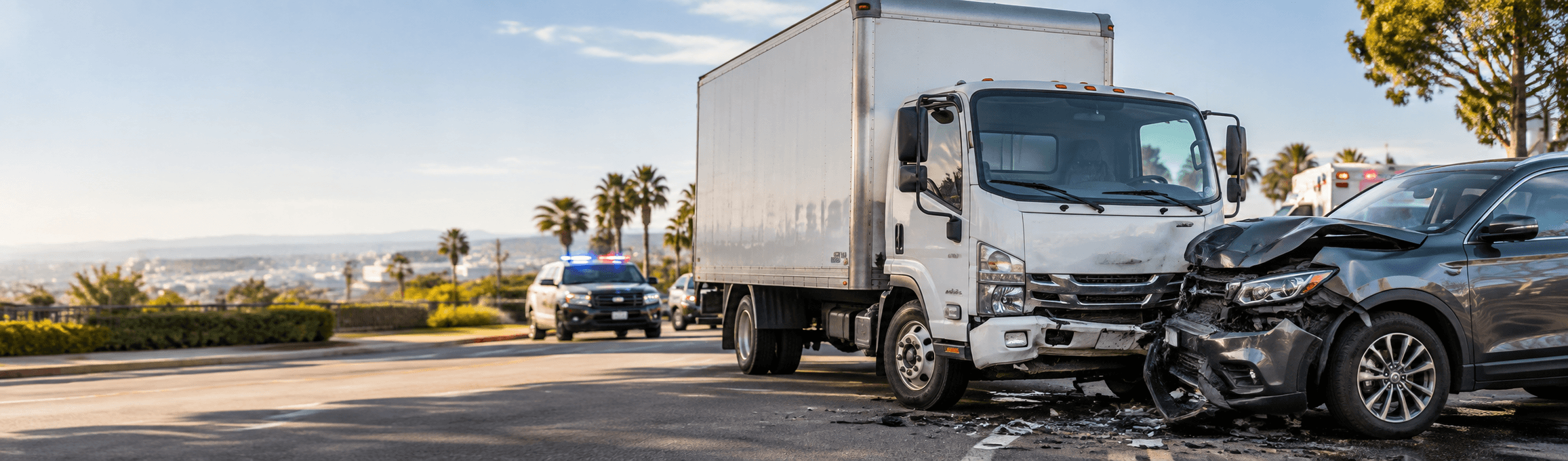
Two delivery vans can look identical from the sidewalk and sit on opposite sides of a federal line that decides what evidence will exist in your case. Above it, a mandated paper trail follows the vehicle whether anyone asks for it or not. Below it, almost none of that exists, and the case is built from a company’s ordinary business records instead. There is a second problem specific to delivery work, and it catches people even more often: the name painted on the side of the van is frequently not the company you would be making a claim against.
Key Takeaways
- Federal motor carrier rules turn principally on a gross vehicle weight rating of 10,001 pounds or more, for vehicles used in interstate commerce.
- You can find out which side of that line a specific vehicle is on: federal labeling rules require the rating to appear on a certification label at the driver’s door, readable without moving anything but the door itself.
- Delivery networks commonly operate through contracted delivery companies, franchisees, and independent drivers, so the branded vehicle and the employer may be different entities.
- Identifying the operating entity early matters, because a preservation demand sent to the wrong company preserves nothing.
- Whether any particular party is legally responsible is a question of evidence rather than assumption.
Where the Line Sits, and How to Check It at the Scene
The federal motor carrier safety regulations define a commercial motor vehicle, for vehicles used in interstate commerce to transport passengers or property, as one with a gross vehicle weight rating or gross combination weight rating of 10,001 pounds or more; or designed or used to carry more than 8 passengers including the driver for compensation; or more than 15 passengers including the driver not for compensation; or carrying hazardous materials in placardable quantity.
For delivery work, the weight criterion is the one that matters, and delivery fleets sit on both sides of it. A heavy box truck is comfortably above. A cargo van or a step van may be just above or just below depending on the model and how it is rated. You cannot tell by looking.
But you can look it up, and it is on the vehicle. Federal rules require manufacturers to put the gross vehicle weight rating on a certification label, and to place that label on the hinge pillar, door-latch post, or door edge near the driver’s seat — readable without moving any part of the vehicle except an outer door. In practical terms: the sticker inside the driver’s door frame.
If you are safely able to do so after a collision, photograph that label along with everything else. It is a small thing that resolves a threshold question which otherwise takes weeks to answer. For vehicles above the line, our page on California truck accident claims covers the federal framework that then applies.
The Name on the Van Is Not Necessarily the Defendant
This is the feature that makes delivery cases different from other commercial vehicle cases, and it is worth understanding before the first phone call with an insurer.
Modern delivery is layered. A national brand may contract with regional delivery companies that employ the drivers. Vehicles may be leased from a separate entity, or owned by the contractor while carrying the national brand’s livery. Some routes are run by franchisees. Some are run by individuals working through an app. The person who handed you a package and the logo on the vehicle they arrived in can belong to three different organizations.
None of that means a claim is hopeless — it means identification is the first real task rather than a formality. The consequences are practical:
- Preservation demands have to reach the right entity. A letter to a national brand does not necessarily preserve records held by a contractor, and contractor records are often the ones that matter.
- The insurance may sit in more than one place — the operating company’s commercial auto policy, coverage carried at the network level, a lessor’s policy, an umbrella above any of them.
- Deadlines do not wait for the identification work to be finished.
What helps most is what you capture in the first minutes: the full vehicle including any business name, the license plate, any USDOT or CA number displayed on the cab, unit or fleet numbers, the driver’s name and who they say they work for, and any paperwork or handheld device visible with a company name on it.
Which Side of the Line Changes What Evidence Exists
Above the threshold, a regulated carrier generates records because regulation requires it: driver qualification files, hours-of-service records, electronic logging device data, systematic maintenance records, and a USDOT number that makes a safety record publicly searchable. Much of it is retained on a schedule whether or not anyone has asked.
Below the threshold, most of that apparatus does not attach. What exists instead are ordinary business records: routing and dispatch data, delivery scheduling and scanning app data, telematics if the operator installed any, vehicle maintenance invoices, timekeeping and payroll, and communications between a supervisor and a driver. These can be more informative than the regulated records — scanning and routing data in particular can show the sequence and pace of a shift in considerable detail — but very little of it is retained on a mandated schedule, and none of it is public.
That combination is why the identification problem and the evidence problem compound each other in delivery cases. The records that matter most are held by an entity you may not have identified yet, under no obligation to keep them, and a preservation demand is only as good as the address on it.
Who May Be Responsible
Several parties can be in the picture: the driver; the company that employed or engaged the driver; a contracting network above that company; the owner or lessor of the vehicle, where different from the operator; a maintenance provider; and, in defect cases, a manufacturer. An employer may be responsible for an employee’s conduct in the course of employment, and separately for its own conduct in hiring, training, supervising, entrusting a vehicle, or maintaining it.
Where a business responds that the driver was an independent contractor, that is the beginning of the question rather than the end of it. Classification is examined on the facts of the relationship rather than settled by the label applied to it, and claims about a business’s own conduct are separate questions in any event.
California allocates responsibility by percentage rather than using it as a bar, so being assigned some share does not end a claim — our page on pure comparative fault explains how that works.
If You Were Walking or Cycling
Delivery vehicles spend their working day exactly where people walk and ride: loading zones, driveways, double-parked in traffic lanes, reversing in residential streets. Sight lines from a box van or step van are substantially more restricted than from a passenger car, particularly to the right rear. Our pages on pedestrian accidents and bicycle accidents cover those claims, and everything above about identifying the operating entity applies to them in the same way.
When the Available Coverage Is Thin
Delivery operations range from national networks to a single contractor with a handful of vans, and the insurance ranges accordingly. Where what is available turns out to be limited relative to the injuries, uninsured and underinsured motorist coverage on the injured person’s own side can become central — including for people who were not driving at all. Our guide on uninsured motorist coverage in California covers how that can apply.
What to Do After a Delivery Vehicle Collision
- Call 911 and get an independent record created.
- Photograph the vehicle in full: business name, plate, any USDOT or CA number, unit or fleet numbers, and — if you can do so safely — the certification label inside the driver’s door frame.
- Ask the driver who they work for, and note the answer.
- Collect witness details, including from any business whose premises the vehicle was serving.
- Seek medical evaluation promptly and keep treatment continuous.
- Preserve anything with a timestamp: a delivery notification, a receipt, your phone’s location history.
Our guide on what to do after a car accident covers the general scene-level steps.
Deadlines
California sets a deadline for filing a personal injury lawsuit, and a materially shorter claim-presentation requirement applies where a public entity may be responsible — relevant here, because postal, municipal and utility fleets make deliveries too. Policy-based claims carry their own notice requirements. Because which applies depends on who may be responsible — and in a delivery case that can take time to establish — confirming the deadlines early is worth more than estimating them later.
Talk to a California Delivery Truck Accident Lawyer
Vaksman Khalfin, PC represents injured people throughout California. If you were hurt in a collision with a delivery vehicle, we offer a free consultation to review which companies may be involved, what records should be preserved and from whom, and what deadlines apply. Call (650) 250-0705, schedule a free consultation, or read more about our California personal injury practice.
Reviewed by Alan D. Khalfin, Partner and Managing Attorney, Vaksman Khalfin, PC (admitted in California). Last reviewed: 10/01/2026
Frequently Asked Questions
Usually yes, on two fronts. Which records exist depends on whether the vehicle falls above or below the federal motor carrier thresholds, principally a gross vehicle weight rating of 10,001 pounds. And the company whose name is on the vehicle may not be the company that employed the driver, so identifying the right entity becomes part of the work.
Federal labeling rules require the gross vehicle weight rating to appear on a certification label placed at the driver's door — on the hinge pillar, door-latch post, or door edge — readable without moving any part of the vehicle except an outer door. A photograph of that sticker answers the question directly.
Whether a particular company can be named depends on the actual relationships between the driver, the operating company, and any contracting network above it. That is a factual question, and it is one of the first things worth investigating rather than assuming in either direction.
For vehicles above the federal thresholds, the regulated records: driver qualification files, hours-of-service data, electronic logging device data. Below them, the operator's own business records — routing and dispatch, delivery scanning and scheduling data, telematics, maintenance invoices, timekeeping. Little of the second category is retained on a mandated schedule, so early preservation matters.
Not by itself. Classification is examined on the facts of the relationship rather than settled by the label, and claims about a business's own conduct in hiring, supervising, entrusting or maintaining are separate questions regardless.
Not every claim requires one. Where more than one company may be involved, where the vehicle's regulatory status is unclear, where records need preserving quickly, or where injuries are significant, an attorney can identify the parties, direct preservation demands to the right entities, and explain which policies may respond.