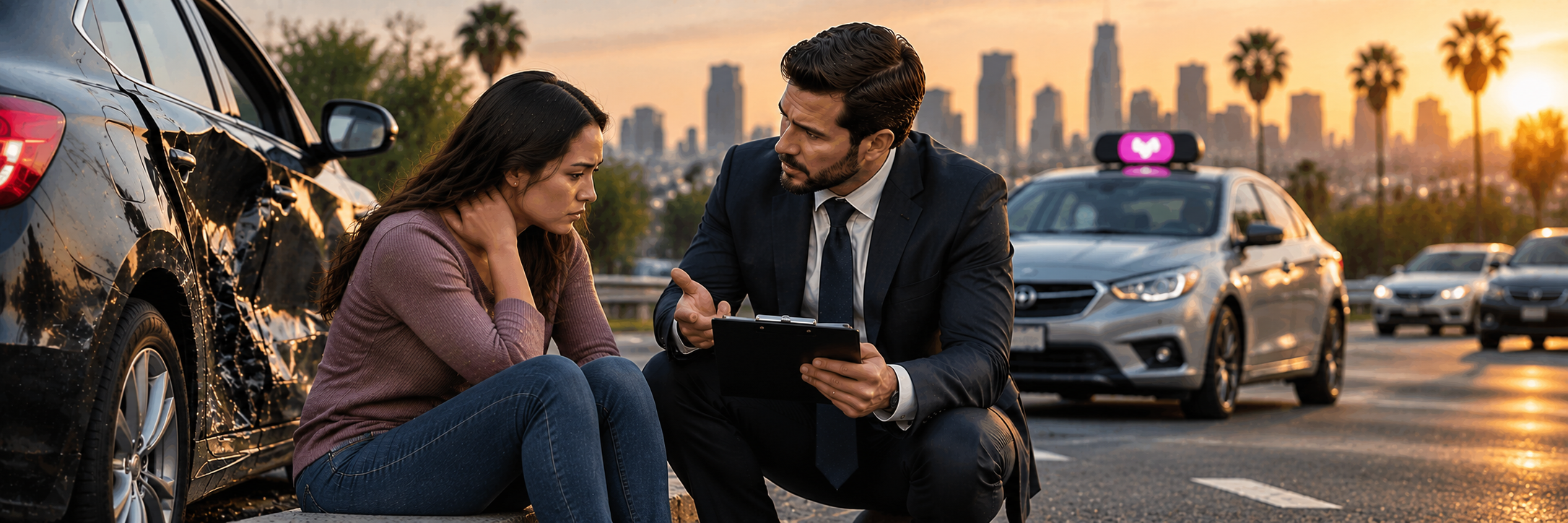
A Lyft accident attorney handles one thing an ordinary car accident lawyer usually does not have to: proving which insurance policy was live at the moment of the crash. In California, the answer depends on what the Lyft driver’s app was doing — off, on and waiting for a ride request, or actively matched with a passenger. The steps below are ordered the way they actually matter after a rideshare collision: protect your health, preserve the app evidence before it becomes hard to retrieve, keep an independent record of the crash, and get legal advice before the coverage questions and filing deadlines narrow what is available to you.
Key Takeaways
- The Lyft driver’s app status at the moment of impact is what determines whether a personal auto policy, a contingent rideshare policy, or Lyft’s larger commercial coverage is the one that responds.
- Evidence that lives inside the Lyft app — the ride receipt, the driver and vehicle details, the trip route — is the evidence most often lost, because it is easy to assume it will always be there.
- Passengers, Lyft drivers, other motorists, pedestrians, and cyclists can all be affected by the same crash, and the coverage analysis is not identical for each of them.
- California applies a pure comparative fault approach, so being assigned part of the responsibility does not by itself end a claim.
- Deadlines differ depending on who may be responsible, and a claim involving a public entity follows a much shorter path than a claim against a private party.
Why a Lyft Claim Is Not an Ordinary Car Accident Claim
Most collision claims start with a simple question: whose policy covers this? A rideshare collision starts with a narrower one — what was the app doing?
Lyft publishes its own description of how its coverage is structured, and it turns on three phases of a driver’s shift. When the app is off, Lyft states that it does not maintain a policy that applies, and the driver’s personal auto insurance is the starting point. When the app is on and the driver is waiting for a ride request, Lyft maintains contingent third-party liability coverage at lower limits. Once the driver is matched and en route to a pickup, and through the ride itself, Lyft’s larger commercial third-party liability coverage applies in most markets, along with certain first-party coverages. The specific limits that attach to each phase are set out on our California Uber and Lyft accident attorney page and in Lyft’s published insurance coverage information.
That structure is why a few seconds of app history can change which insurer is even at the table. It is also why the waiting-for-a-request phase tends to generate the most disagreement: it sits between a personal policy and a commercial one, and the parties involved may read the same trip data differently.
Who you were in the collision matters as well. A passenger, the Lyft driver, the driver of another vehicle, and a pedestrian or cyclist may each be looking at a different combination of policies, including their own coverage. A lawyer can explain which of those apply to a specific situation.
The Steps to Take After a Lyft Injury
1. Get medical attention, and keep the record continuous
Seek evaluation promptly, even if symptoms seem manageable at the scene. Beyond the obvious health reasons, the medical record is what connects an injury to a specific event on a specific date. Gaps between the crash and the first visit, or long unexplained breaks in treatment afterward, are routinely raised by insurers as a reason to question that connection. Follow the treatment plan you are given, and keep discharge paperwork, imaging orders, referrals, and pharmacy records together in one place.
2. Preserve what the app shows — early
This is the step that is unique to rideshare claims, and the one most often missed. Within the Lyft app, a passenger typically has access to the ride receipt, the driver’s first name and photo, the vehicle make, model, and license plate, the pickup and drop-off points, and the route and timestamps. Capture screenshots of all of it. If a Lyft driver was involved and you were not the passenger, note the plate and any visible rideshare markings, because you will not have app-side access to any of it.
Ride history can become harder to retrieve over time, and app interfaces change. Screenshots taken in the first days after a crash are far more reliable than a request made months later.
3. Make sure an independent record of the crash exists
Call law enforcement and let a report be created. At the scene, if you are able to do so safely, photograph vehicle positions and damage, the roadway and any traffic controls, skid marks and debris, weather and lighting conditions, and any visible injuries. Collect names and contact details for every witness — including other passengers, who are witnesses too and are often the only people who can describe what was happening inside the vehicle.
Our guide on what to do after a car accident covers the scene-level reporting steps in more detail, and those steps apply to a rideshare collision the same way they apply to any other.
4. Report the crash through Lyft’s own channel — factually
Lyft maintains a reporting path for accidents and safety incidents, and using it creates a record on the company’s side. Keep the report to objective facts: date, time, location, what happened, who was present, and that injuries are being evaluated. This is not the place to characterize fault, estimate the severity of an injury before a physician has, or speculate about what another party was doing.
5. Be careful with recorded statements and early offers
An adjuster — for Lyft’s insurer, the driver’s insurer, or another motorist’s insurer — may ask for a recorded statement or present a resolution early, sometimes before the full extent of an injury is understood. You are generally not required to give a recorded statement to an insurer you have no contract with, and you can decline until you have spoken with a lawyer. If an early offer is on the table, it can be evaluated rather than accepted on the spot. Where your own insurer is the one handling the claim unreasonably, that is its own issue — see our guide on bad faith insurance claims in California.
6. Track your losses by category
Keep organized records across the categories that a claim can involve: medical expenses incurred and anticipated, lost income and any reduction in earning capacity, property damage, out-of-pocket costs such as transportation to appointments and assistive equipment, and the non-economic effects on daily life. A claim’s value is not set by a formula or a table, and it depends on facts specific to the person and the collision. A lawyer can explain which categories a particular claim may support.
7. Understand how shared fault and deadlines affect your options
California follows a pure comparative fault approach, which means someone found partly responsible is not barred from recovering — the recovery is reduced by that share instead. Our page on pure comparative fault in California explains how that allocation works in practice.
Deadlines are a separate and less forgiving issue. California sets a general deadline for filing a personal injury lawsuit, and a materially shorter claim-presentation requirement applies when a public entity may be responsible — for example, where a transit vehicle or a roadway condition is part of the picture. Uninsured and underinsured motorist claims are governed by the terms of the applicable policy, which commonly imposes its own notice requirements; our guide on uninsured motorist coverage in California covers that. Because the deadline that applies depends on who may be responsible, an attorney can confirm which one governs a specific claim.
8. Bring the right materials to the consultation
A first conversation with a Lyft accident attorney is more productive with these in hand:
- Screenshots of the ride receipt, trip details, and driver and vehicle information
- The police report number, or the agency and date if the report is not yet available
- Photographs and video from the scene
- Names and contact details for witnesses and other passengers
- Medical records, discharge instructions, and bills received so far
- Your own auto insurance declarations page, including any uninsured or underinsured motorist coverage
- Any correspondence already received from an insurer or from Lyft
What a Lyft Accident Attorney Does With All of This
The work that follows is mostly evidentiary and procedural: establishing the driver’s app status at the moment of impact and preserving the trip data that shows it, identifying every policy that may respond rather than the first one offered, calendaring the deadline that actually applies, assembling the medical and wage documentation that supports each category of loss, communicating with adjusters, and filing suit if a claim cannot be resolved on reasonable terms. Our guide on what a car accident lawyer does in a California claim sets out that sequence in more detail, including the situations in which representation may not be necessary.
Fees and Costs
Personal injury representation at our firm is offered on a contingency basis: there is no upfront attorney’s fee, and attorney’s fees are owed only if we recover compensation for you. Case costs — filing fees, records retrieval, deposition transcripts, expert fees — are a separate category from attorney’s fees, and how they are handled is set out in the written fee agreement before representation begins. Ask about both when you speak with any firm.
Serving San Mateo and the Bay Area
Vaksman Khalfin, PC maintains an office at 15 North Ellsworth Avenue, Suite 105, San Mateo, CA 94401, and can be reached at (650) 250-0705. We represent injured people across California; more on the office is available on our San Mateo lawyers page, and our full range of injury practice areas is on the California personal injury hub. To discuss a rideshare collision, you can schedule a free consultation.
Speak With a California Rideshare Injury Lawyer
If you were injured in a Lyft collision in San Mateo County or elsewhere in California, Vaksman Khalfin, PC can review the coverage picture and the deadlines that may apply. Call (650) 250-0705 or schedule a free consultation.
This page provides general information about California law and is not legal advice; reading it does not create an attorney-client relationship. Prior results do not guarantee a similar outcome.
Reviewed by Alan D. Khalfin, Partner and Managing Attorney, Vaksman Khalfin, PC (admitted in California). Last reviewed: 09/28/2026
Frequently Asked Questions
Passengers are generally not assigned fault for a collision between vehicles, but that does not make the claim automatic. Which policy responds still depends on the driver's app status, more than one insurer may be involved, and an early offer may arrive before the full extent of an injury is known. An attorney can review the situation and explain what a claim may involve.
Not necessarily in the way people expect. When another motorist is responsible, that motorist's liability coverage is typically the first policy examined, and uninsured or underinsured motorist coverage — yours, or coverage available through the rideshare policy — may become relevant if that coverage is absent or insufficient. Which applies depends on the facts and on the policies involved.
That phase is where coverage disputes concentrate. Lyft maintains contingent liability coverage at lower limits during it, and the driver's personal policy may also be implicated. Establishing the app status from trip data is usually the first step.
California sets a general deadline for personal injury lawsuits, and a much shorter claim-presentation requirement applies where a public entity may be responsible. Policy-based claims, such as uninsured motorist claims, carry their own notice requirements. Because the applicable deadline depends on who may be responsible, it is worth confirming early rather than assuming.
An offer can be evaluated before it is accepted. Accepting generally closes the claim, including for treatment or losses that emerge later, so it is reasonable to understand the full scope of an injury first and to have the offer reviewed.
Our initial consultation is free. If we take the case, attorney's fees are contingent on a recovery, and the treatment of case costs is set out in the written fee agreement.