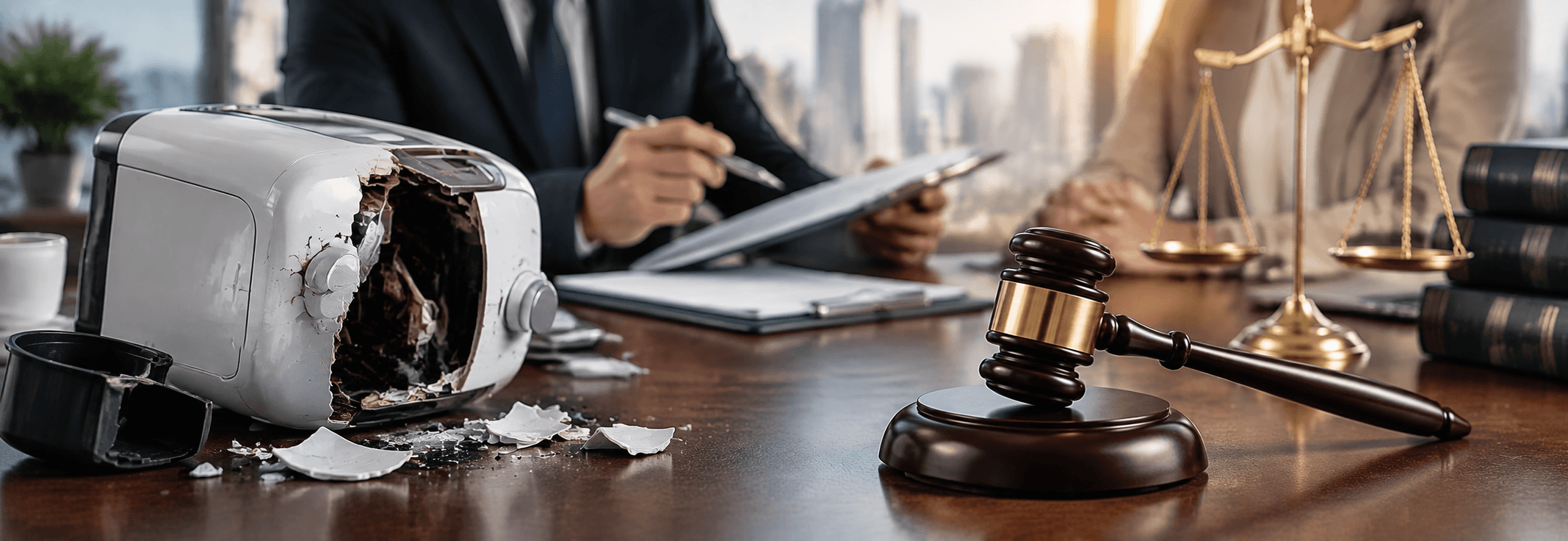
A product liability lawsuit is a civil case asking a court to hold a manufacturer, component maker, distributor, or retailer responsible for harm caused by a defective product. Two things set it apart from other injury suits. The evidence that decides it, meaning design files, testing records, and complaint histories, sits inside the defendant company and arrives only through discovery, usually under a protective order. And the case is normally decided on competing expert analysis of the same physical object, which often has to be examined, sometimes destructively, under an agreed protocol. Those two features are why product suits run longer than most injury cases.
This article walks through how a California product liability lawsuit actually proceeds. For the legal framework, including the three defect theories and the two tests California applies to design defects, see our California defective product lawyer page. For what the lawyer does before anything is filed, see our article on what a product liability lawyer does. To talk through a specific product, call our San Mateo office at 650-250-0705. The consultation is free.
Key Takeaways
- “Three types of product liability claims” refers to two different triads that get mixed up. One is the three legal theories; the other is the three defect types. They answer different questions.
- Most product matters begin as claims rather than lawsuits, but filing is more often necessary here than in other injury cases, because the decisive records are only obtainable through discovery.
- Defendants along the chain of distribution frequently sue each other, which adds parties and time without the injured person doing anything.
- The product itself usually has to be examined by both sides under an agreed protocol, and that examination can be destructive.
- Filing does not end negotiation. Most cases resolve before trial, often after the expert analysis is exchanged.
“Three Types” of What? The Two Triads
Search results for this topic use “the three types” to mean two entirely different things, which is why explanations seem to contradict each other. Both triads are real and they operate at different levels.
| The three legal theories | The three defect types | |
| What it answers | On what legal basis is the defendant responsible? | What is wrong with the product? |
| The three | Strict liability, negligence, breach of warranty | Manufacturing defect, design defect, failure to warn |
| Where they appear in California’s jury instructions | CACI No. 1200 (strict liability), No. 1220 (negligence), and Nos. 1230 to 1232 (express and implied warranties) | CACI No. 1201 (manufacturing), Nos. 1203 and 1204 (design, by two different tests), and No. 1205 (failure to warn) |
| How many apply at once | More than one can be pleaded together | More than one can be pleaded together |
A single case can combine them: a strict liability claim for a design defect, a negligence claim for failure to warn, and a warranty claim, all in one complaint. Claims are often pleaded in the alternative early, because what the evidence will ultimately support is not clear before discovery.
Why Product Cases Get Filed
Most injury matters begin with a claim to an insurer, and many resolve there. Product cases reach the filing stage more often, for reasons specific to this area:
- The decisive records are internal. Design and engineering files, testing and validation data, quality control records, complaint and adverse-event histories, and prior claims involving the same product are not public. A company has little reason to hand them over voluntarily, and formal discovery is the mechanism that compels it.
- The defendant may be out of reach informally. A foreign manufacturer may not respond to a demand letter at all, and establishing jurisdiction and effecting service can itself require a filed case.
- Multiple parties need to be brought in together. Where responsibility may sit anywhere along the chain of distribution, a lawsuit is the practical way to put everyone in one proceeding.
- The deadline. The limitations period runs whether or not an insurer is evaluating the file.
The Stages of a Product Liability Lawsuit
1. The complaint and the parties
A complaint is filed in the superior court identifying the plaintiff, each defendant, what happened, and the legal theories asserted. Because the injured person often cannot know at the outset which entity designed, made, or supplied a given component, the early pleading stage frequently involves adding parties as the supply chain becomes clear. Product cases are almost always unlimited civil matters, meaning full discovery tools are available, because the amount in dispute exceeds the limited civil threshold.
2. Responses, and the defendants suing each other
Each defendant answers, usually through counsel provided by its insurer. What surprises people is what happens next: defendants along the chain commonly file cross-complaints against one another, seeking indemnity or contribution. A retailer points at the distributor, the distributor at the manufacturer, the manufacturer at the component supplier. California’s jury instructions include separate series on comparative fault among tortfeasors and on implied contractual indemnity. None of this is driven by the injured person, and all of it adds parties, counsel, and calendar time.
3. Written discovery and the fight over the company’s documents
This is the longest and most contested phase. Document demands seek the design history, testing records, complaint data, and internal risk assessments. Manufacturers typically resist on trade secret and proprietary grounds, and the material is usually produced subject to a protective order restricting who may see it and how it may be used. Negotiating the scope of production and the terms of that order is substantive work, not a formality, and disputes over it are a common reason these cases extend.
4. Depositions
The injured person is deposed, and so are design engineers, quality personnel, and corporate witnesses designated to testify about company knowledge. Depositions of engineers are where the design rationale gets tested against the documents produced in the previous stage.
5. Examination of the product, sometimes destructively
Both sides normally want their experts to inspect the item. Where inspection requires cutting, disassembling, or testing it to failure, the examination changes or consumes the evidence, so it proceeds under a protocol agreed between the parties or set by the court: who attends, what is documented, what sequence is followed, and what is preserved. This is a stage with no real equivalent in an ordinary injury case, and it is the main reason the earlier instruction to keep the product unaltered matters so much.
6. Expert designation and challenges
Each side designates experts and exchanges their opinions. Expect engineering or failure analysis, human factors or warnings expertise where labeling is at issue, and medical causation experts. Each side then tests the other’s expert, including through motions attacking the reliability or foundation of the opinions. California’s jury instructions address expert testimony and how a jury should handle conflicting expert opinions, which reflects how central this phase is.
7. Summary judgment
Defendants often move for judgment before trial, arguing no defect has been shown, that causation is missing, or that a specific defendant is the wrong party. Where the design defect claim runs on the risk-benefit test, the burden structure matters here, because once the injured person establishes the basic elements it is the defendant that must justify the design.
8. Mediation and settlement
Courts manage civil cases actively and encourage resolution outside trial. The San Mateo County Superior Court describes alternative dispute resolution, including mediation, as a way of resolving legal problems without going to trial. In product cases the natural moment is after expert opinions are exchanged, when both sides can finally see the same technical picture. Many cases resolve there.
9. Trial
If the case does not resolve, a judge or jury decides whether the product was defective, whether the defect caused the harm, how fault is shared among the parties, and what damages are awarded. The civil standard is whether something is more likely true than not true, not the criminal standard of beyond a reasonable doubt. Comparatively few filed cases reach this point.
What Makes These Cases Take Longer
- Document discovery and protective order disputes, which can consume months on their own.
- The number of parties, multiplied by cross-complaints among them.
- Foreign defendants, where service and jurisdiction add steps before the case can even proceed.
- The expert phase, including scheduling a joint inspection and completing destructive testing.
- The medical picture, since a claim is difficult to value before treatment stabilizes.
- The court’s calendar.
There is no dependable average duration, and figures quoted online are drawn from cases with little in common. Resolving quickly is rarely an advantage if it means resolving before the company’s own records have been seen.
When the Same Product Has Injured Many People
Where a product has harmed people across multiple cases, those cases are sometimes handled together rather than separately, through procedures for coordinating related actions. That can change the pace and the forum, and it can mean shared discovery of the manufacturer’s records across cases. Whether any coordination applies to a particular product is a question for a lawyer to check at the time, because it depends on what has been filed elsewhere. It does not change whether an individual has a claim.
Deadlines
| Situation | General rule | Source |
| Injury claims against a private party | Two years from the date of injury | Code Civ. Proc., § 335.1 |
| Claims where a public entity may be responsible | A written claim generally must be presented to the entity before any lawsuit, on a much shorter timeline | California’s Government Claims Act |
| Warranty-based claims | Governed by their own limitations rules, which differ from the injury deadline | Worth confirming for the specific theory rather than assuming |
The practical deadline arrives earlier than the legal one. A product returned to the seller in the first week takes a theory with it, and no amount of remaining time restores it.
Product Lawsuits in San Mateo County
Our office at 15 North Ellsworth Avenue, Suite 105, San Mateo, CA 94401 works with injured people across the Peninsula. A product liability lawsuit arising here is generally filed in the Superior Court’s Civil Division at the Hall of Justice, 400 County Center, Redwood City, as an unlimited civil case.
Product claims on the Peninsula often surface inside another matter rather than on their own: a vehicle component or restraint system in a car or truck collision, or equipment involved in a fall on unsafe property. Where that is the case, the product theory and the underlying claim usually proceed in the same lawsuit, with the product defendants added once the component is identified.
More about the office is on our San Mateo page, and related explanations are collected in our California personal injury guides.
How Vaksman Khalfin Can Help
Vaksman Khalfin, PC can preserve the product and the documentation before anything is lost, identify and bring in everyone along the chain of distribution, pursue the design, testing, and complaint records through discovery and negotiate the protective order that governs them, work with engineering and safety experts through inspection and any destructive testing, respond to the defendants’ motions and to the cross-complaints they file against each other, and take the case to trial where a fair resolution is not offered.
The firm’s California personal injury practice is led by Alan D. Khalfin, admitted in California. Product matters are handled on a contingency-fee basis: there is no upfront attorney’s fee, and attorney’s fees are owed only if there is a recovery. Case costs, which in product litigation frequently include expert analysis and testing fees, are a separate category from attorney’s fees. How case costs are handled, including whether you may be responsible for them, is set out in the written fee agreement that is reviewed with you before anything is signed.
To talk about a product liability lawsuit in San Mateo County, call 650-250-0705 or schedule a free consultation. If you still have the product, do not alter it, and photograph it before you come.
Reviewed by Alan D. Khalfin, Partner and Managing Attorney, Vaksman Khalfin, PC (admitted in California). Last reviewed: 09/22/2026
Frequently Asked Questions
The phrase is used for two different triads. The three legal theories are strict liability, negligence, and breach of warranty, and they answer on what basis a defendant is responsible. The three defect types are a manufacturing defect, a design defect, and a failure to warn, and they answer what is wrong with the product. A single lawsuit can combine several of each.
Yes, where a defective product caused injury or damage. California recognizes strict liability claims, which focus on whether the product was defective and whether the defect caused harm rather than on whether the company was careless, and negligence and warranty theories may also apply. Whether a particular situation supports a claim depends on the product, the facts, and what evidence still exists.
There is no dependable average, and these run longer than most injury cases. The drivers are document discovery and disputes over protective orders, the number of parties and the cross-complaints they file against each other, service and jurisdiction where a defendant is foreign, the expert phase including joint inspection and any destructive testing, how long treatment takes to stabilize, and the court's calendar.
By establishing a defect and causation with evidence. A manufacturing defect claim usually requires the product itself, compared against its intended design. A design defect claim requires engineering analysis, and under the risk-benefit test the burden shifts to the defendant once the injured person proves the design was a substantial factor in causing harm. A failure-to-warn claim turns on labeling, manuals, and what the company knew or could have known.
Because responsibility may sit anywhere along the chain of distribution, and each party would prefer it sat with someone else. Defendants commonly file cross-complaints seeking indemnity or contribution from others in the chain. It happens without any action by the injured person, and it usually adds parties and time.
It may be altered. Where the experts need to cut, disassemble, or test the item to failure, that examination proceeds under a protocol agreed between the parties or set by the court, covering who attends, what is documented, and what is preserved. This is one reason the product must not be repaired or handled before a lawyer is involved.
Often not in the sense of a trial. You should expect to sit for a deposition and to attend a mediation or settlement conference. Most filed cases resolve before trial, frequently once the expert opinions have been exchanged.
It adds steps rather than ending the claim. Establishing jurisdiction and completing service on a foreign company takes time and may require a filed case. It is also a practical reason to identify the distributors and retailers in the chain, because a claim may be viable against a party inside California even where the manufacturer is difficult to reach.
Most injury claims against a private party must be filed within two years of the date of injury under Code of Civil Procedure section 335.1. Where a public entity may be responsible, a written claim generally must be presented before any lawsuit, on a much shorter timeline. Warranty-based claims follow their own limitations rules.