
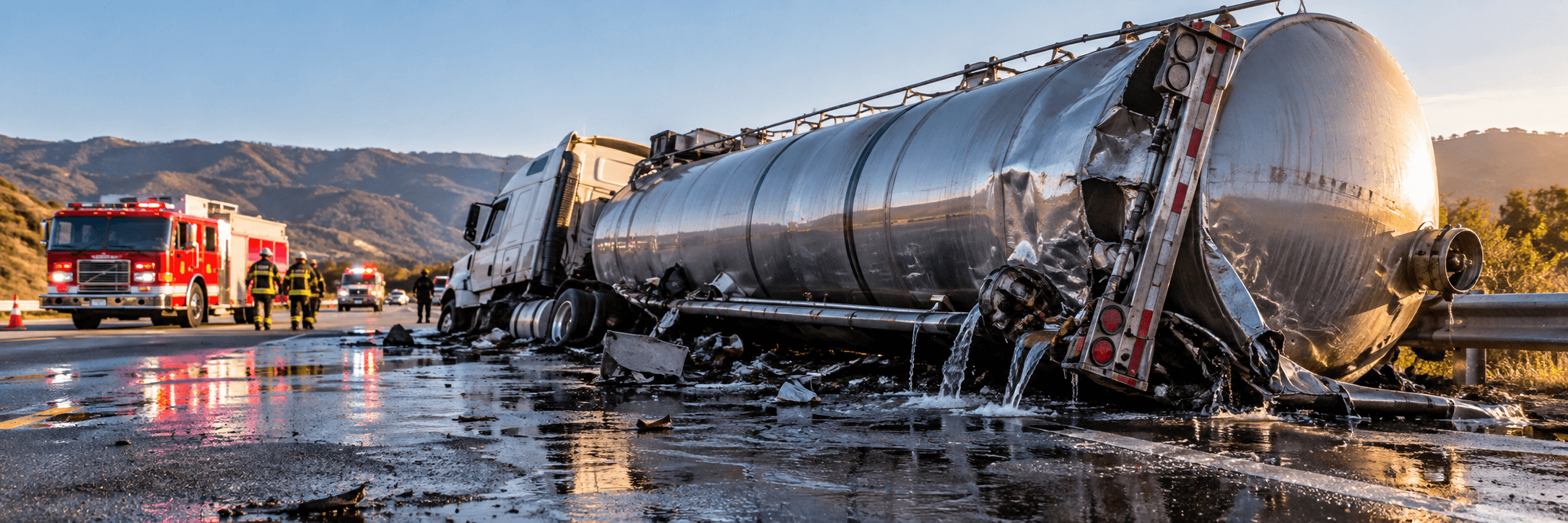
A tanker is not just a large truck with a round trailer. A moving liquid load changes how the vehicle brakes, turns, and recovers from a swerve. Driving one requires additional licensing. When the cargo is hazardous, the shipper, the carrier, and the driver each have legal duties, and a spill can trigger federal incident reporting. After a tanker crash, a lawyer looks at how the load behaved, whether the driver was qualified for it, who filled the tank, and what reports followed.
This guide covers what makes tanker crashes different and the records that matter in a California claim. For the other federal records trucking companies keep, see what a truck accident lawyer does.
Tanker crashes turn on how a liquid load moves, whether the driver held the required tank vehicle and hazardous materials endorsements, who loaded the tank, and what was released. Federal rules require a tank vehicle endorsement under 49 C.F.R. section 383.93, higher minimum insurance for hazardous cargo under section 387.9, and written reports of qualifying hazardous materials incidents within 30 days under section 171.16. In California, drivers of tank vehicles over 500 gallons carrying flammable liquid within the state are limited to 10 hours of driving.
Key Takeaways
- Liquid surges and shifts in a tank, which can push a tanker toward a rollover, especially when the tank is partly full.
- Tanker drivers need a tank vehicle endorsement, and a separate hazardous materials endorsement for hazardous cargo.
- Carriers hauling hazardous materials must carry higher federal minimum insurance, up to $5,000,000 for certain cargo.
- The shipper, the loading terminal, the carrier, and the tank owner may each have a role and their own records.
- Serious hazardous materials incidents require telephone notice within 12 hours and a written report within 30 days.
Why Tankers Handle Differently, and What a Tanker Truck Accident Lawyer Asks
Liquid surges forward when a tanker brakes and shifts sideways when it turns or changes lanes, which can push the truck toward a rollover. A partly filled tank can be harder to control than a full one, because the liquid has more room to move. Tankers also carry their weight high. Drivers are trained to brake earlier, slow down for curves and ramps, and avoid sudden steering.
After a tanker crash, the questions usually include:
- How full was the tank, and was it divided by baffles or compartments?
- How fast was the truck going into a curve, ramp, or lane change?
- Were the brakes in good condition and properly adjusted?
- Did the driver have training and experience with liquid loads?
Licensing a Tanker Truck Accident Lawyer Will Check
Under 49 C.F.R. section 383.93, a driver must hold a state-issued endorsement on their commercial driver’s license to operate a tank vehicle. Section 383.5 defines a tank vehicle as a commercial motor vehicle designed to carry liquid or gaseous materials in a tank or tanks with an individual rated capacity of more than 119 gallons and an aggregate rated capacity of 1,000 gallons or more. Hauling hazardous materials requires a separate hazardous materials endorsement, and each endorsement requires passing a knowledge test.
A missing or expired endorsement does not by itself prove the driver caused the crash, but it bears on whether the carrier should have put that driver in that truck. The driver qualification file and licensing history are among the first records requested.
California’s Shorter Limit for Flammable Liquid Tankers
Drivers who operate only within California follow state hours-of-service rules, which generally allow 12 hours of driving after 10 consecutive hours off duty. Under California Code of Regulations, title 13, section 1212.5, a driver of a tank vehicle with a capacity of more than 500 gallons carrying flammable liquid is limited to 10 hours. Fuel delivery trucks that never leave the state are often subject to the shorter limit. For the full set of limits, see how many hours a week a truck driver can drive.
Insurance Behind a Tanker
Federal minimum insurance depends on what the truck carries. Under 49 C.F.R. section 387.9, for vehicles with a gross vehicle weight rating of 10,001 pounds or more:
| Cargo | Federal minimum |
|---|---|
| Non-hazardous property, for-hire carriers in interstate or foreign commerce | $750,000 |
| Oil and hazardous materials or substances not listed in the $5,000,000 category | $1,000,000 |
| Certain hazardous substances transported in bulk in cargo tanks, portable tanks, or hopper-type vehicles, and certain other high-hazard materials | $5,000,000 |
These are minimums, and the categories turn on the exact commodity and how it was carried, which is why the shipping papers matter. The shipper, the loading terminal, and the tank owner may also have their own coverage.
The Parties Behind a Tanker Load
| Party | Typical role | Records worth examining |
|---|---|---|
| Shipper | Classifies, packages, and prepares shipping papers for the cargo | Shipping papers, cargo classification, loading instructions |
| Loading facility or terminal | Fills the tank | Fill levels, loading records, any overfill or partial fill |
| Motor carrier | Hires and supervises the driver, maintains the tractor and often the tank | Driver file, endorsements, training, maintenance, hours |
| Tank owner or lessor | Owns the tank if different from the carrier | Inspection and testing records, valve and baffle condition |
| Manufacturer | Built the tank, valves, or other components | Design and failure analysis |
Who is responsible depends on the facts. Under Civil Code section 1431.2, each defendant’s liability for non-economic damages is generally limited to its own share of fault, so leaving out a responsible party can reduce what is recovered. See parties often responsible in truck crashes.
When Hazardous Cargo Spills: Reports a Tanker Truck Accident Lawyer Requests
Federal hazardous materials rules create two kinds of reports:
- Telephone notice. Under 49 C.F.R. section 171.15, the person in physical possession of the hazardous material must notify the National Response Center by telephone as soon as practical, and no later than 12 hours after the incident, when, as a direct result of the hazardous material, someone is killed, someone is hospitalized, the public is evacuated for an hour or more, or a major transportation artery or facility is closed for an hour or more, among other situations.
- Written report. Under section 171.16, the person in physical possession must submit a written report on DOT Form F 5800.1 within 30 days of discovering a qualifying incident, including any unintentional release of a hazardous material. It also applies when a specification cargo tank of 1,000 gallons or more carrying hazardous material suffers structural damage, even without a release.
These reports apply during loading, unloading, and temporary storage as well as on the road. Together with fire department, hazmat team, and police records, they can show what was released, how much, and how the response unfolded.
Injuries Specific to Tanker Crashes
Beyond the impact injuries common to all truck crashes, tanker crashes can cause burns from fuel fires, chemical burns, and breathing injuries from fumes or smoke. Some effects of exposure appear later, so it helps to tell every medical provider about any exposure and to have the possible substance noted in the records. Evacuations and road closures can also cause losses for people who were not in the collision. For how serious injuries are documented, see truck accident injury claims. When a crash was fatal, see truck accident wrongful death.
What to Do After a Tanker Crash
- Follow the instructions of fire and hazmat responders, and stay away from any spill, vapor, or fire.
- From a safe distance, photograph the placards, the tank, the truck number, and the company name.
- Tell medical providers about any odor, fumes, or contact with a liquid.
- Keep the police report number and the names of the agencies that responded.
- Avoid giving a recorded statement to the carrier’s insurer before getting advice.
Deadlines
A California injury lawsuit generally must be filed within two years (Code of Civil Procedure section 335.1). If a public entity may share responsibility, a written claim generally must be presented within six months (Government Code section 911.2). Under California’s pure comparative fault rule, a share of fault assigned to the injured person reduces the recovery but does not bar it.
Talk With a Tanker Truck Accident Lawyer at Vaksman Khalfin
Vaksman Khalfin, PC can help identify who loaded, hauled, and owned the tank, and request the records created after a tanker crash. The first conversation is free. Injury matters are handled on contingency under a written agreement that states the fee percentage and explains separately how case costs, including expert, lab, and testing costs, are handled. Call (650) 250-0705, visit our San Mateo office page, or see our California truck accident page.
This page provides general information about California law and is not legal advice. Reading it or contacting the firm does not create an attorney-client relationship. Every case is different, and prior results do not guarantee a similar outcome.
Reviewed by Alan D. Khalfin, Partner and Managing Attorney, Vaksman Khalfin, PC (admitted in California). Last reviewed: 10/20/2026
Frequently Asked Questions
How the load behaved, how full the tank was, whether the driver held the required endorsements, who loaded the tank, and what hazardous materials reports were made.
Liquid surges and shifts during braking and turning, and tankers carry their weight high. A partly filled tank can be harder to control than a full one.
Yes. A tank vehicle endorsement is required under 49 C.F.R. section 383.93, and hauling hazardous materials requires a separate hazardous materials endorsement.
Under 49 C.F.R. section 387.9, the federal minimum is $1,000,000 or $5,000,000 depending on the commodity and how it is carried. These are minimums, and actual coverage may be higher.
A driver operating only within California with a tank vehicle of more than 500 gallons carrying flammable liquid is limited to 10 hours of driving, compared with 12 hours for most intrastate truck drivers.
Yes. Serious incidents require telephone notice to the National Response Center within 12 hours, and qualifying incidents, including unintentional releases, require a written report within 30 days.
Possibly. Depending on the facts, a shipper or loading terminal may share responsibility based on how the cargo was classified, documented, and loaded.
