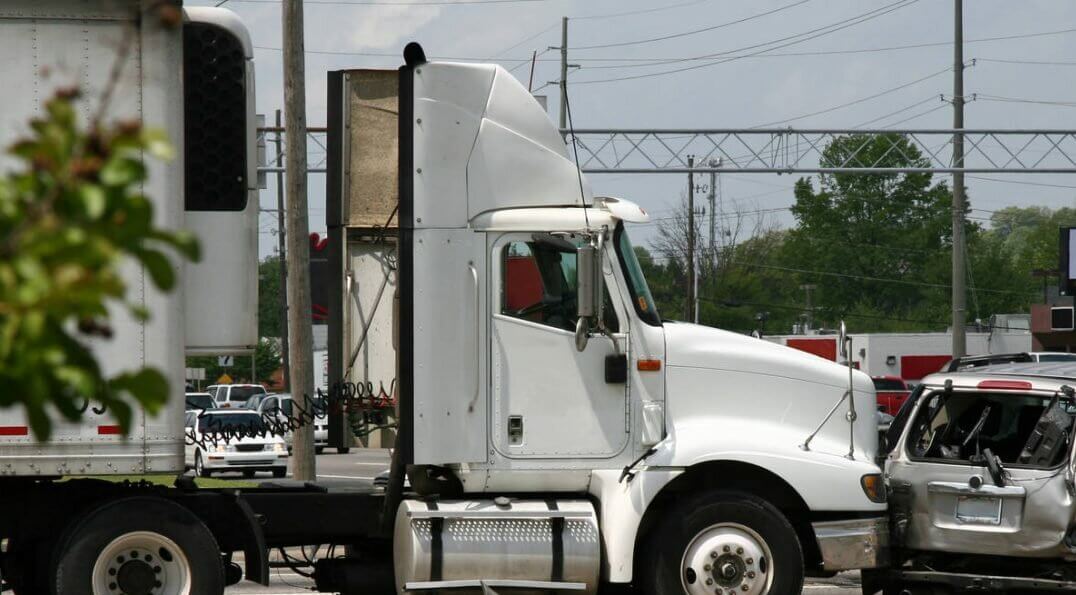
A collision with a tractor-trailer, delivery truck, or other commercial vehicle is rarely a dispute between two drivers. Behind the truck there is usually a motor carrier, often a separate trailer owner, a maintenance contractor, and a shipper who loaded the freight, each with its own insurer and its own lawyers. Working out who may be responsible is the part of a truck accident case that determines almost everything else about it.
This page explains how responsibility is assessed in a California truck accident, which federal safety rules tend to matter, what evidence decides these questions, and how quickly that evidence can disappear. Our California truck accident lawyers handle these claims from our San Mateo office. For a free consultation, call 650-250-0705.
Who Can Be Held Responsible for a Truck Accident?
In a California truck accident, responsibility may rest with more than one party. Depending on what the evidence shows, the parties who can be involved include the truck driver, the motor carrier that employed them, the owner of the tractor or trailer, a maintenance or repair contractor, the shipper or cargo loader, another motorist, a parts manufacturer, and sometimes a public agency responsible for the roadway. Which of these may be legally responsible turns on the facts of the crash, not on the size of the company.
Key Takeaways
- Truck accident claims commonly involve several potentially responsible companies rather than a single at-fault driver.
- A motor carrier may be responsible both for what its driver did and, separately, for its own hiring, training, scheduling, or maintenance decisions.
- Federal rules require motor carriers to keep drivers’ records of duty status and supporting documents for six months, so the records that often matter most have a short guaranteed life.
- Most California injury lawsuits must be filed within two years, and a claim involving a public agency runs on a much shorter timeline.
- Vaksman Khalfin, PC handles truck accident cases on a contingency-fee basis, with a free consultation. Call 650-250-0705.
The Parties Who May Be Responsible in a Truck Accident
None of the parties below is responsible by default. Each becomes relevant only if the evidence supports it, and in many cases several are involved at once.
The truck driver
Fatigue, speeding, distraction, impairment, unsafe lane changes, or following too closely can all support a claim against the driver personally. Driving-time records, onboard data, and phone records are often what establish or rule this out.
The motor carrier that employed the driver
A carrier can face responsibility on two separate tracks. The first is vicarious: an employer may be answerable for the negligence of an employee acting within the scope of employment. The second is direct, and concerns the carrier’s own conduct — how it screened and hired the driver, how it trained and supervised, whether its delivery schedules were realistic, and whether it kept an unsafe vehicle in service. The second track is often where the more significant evidence lives.
The owner of the tractor or trailer
Equipment in the trucking industry is frequently leased rather than owned outright, and the tractor, the trailer, and the operating authority can belong to three different companies. Ownership affects who was responsible for inspection and upkeep, and which insurance policies may apply.
Maintenance and repair contractors
Brake, tire, coupling, and lighting failures may trace back to work that was skipped, deferred, or done poorly. Service invoices, inspection reports, and parts records are the usual proof, and a repair company can be a defendant separate from the carrier.
Shippers, brokers, and cargo loaders
A load that is overweight, unbalanced, or inadequately secured can change how a truck brakes and corners, and can contribute to a rollover or jackknife. Where the loading was done by a shipper or a third-party loading company rather than the driver, responsibility may extend to them. Bills of lading, weight tickets, and loading records tend to tell that story.
Another motorist
Not every truck crash originates with the truck. A passenger vehicle that merges into a truck’s blind spot, brakes abruptly in front of a loaded trailer, or cuts across a wide right turn may bear some or all of the responsibility. This is why the same investigation that identifies commercial defendants can also clarify what the truck driver could and could not have avoided.
A parts or component manufacturer
Where a brake system, tire, coupling, or safety component may have failed rather than simply worn out, a defective product claim can run alongside the negligence claims. These require the component itself to be preserved, which is a practical reason not to let a wrecked vehicle be salvaged before it is examined.
A public agency responsible for the roadway
Where a dangerous roadway condition may have contributed — a poorly designed interchange, a missing barrier, an unrepaired defect — a state or local agency may be involved. These claims follow a different and much shorter process, described below.
What Tends to Establish Each Party’s Role
| Potentially responsible party | What may make them responsible | Evidence that usually bears on it |
|---|---|---|
| Truck driver | Negligent operation of the vehicle | Duty status records, engine and event data, phone records, dashcam footage |
| Motor carrier | Its driver’s conduct, plus its own hiring, training, scheduling, and maintenance decisions | Driver qualification file, dispatch records, safety policies, prior violations |
| Tractor or trailer owner | Inspection and upkeep duties tied to ownership | Lease agreements, title records, inspection reports |
| Maintenance contractor | Work not performed, deferred, or performed poorly | Service invoices, work orders, parts records |
| Shipper or cargo loader | Loading, weight distribution, or securement | Bills of lading, weight tickets, loading logs, scene photographs |
| Another motorist | Negligent driving that contributed to the collision | Witness accounts, video, reconstruction analysis |
| Component manufacturer | A component that failed rather than wore out | The physical part, recall history, engineering examination |
| Public agency | A dangerous condition of public property | Maintenance and complaint records, design documents, prior incident history |
Federal Safety Rules That Shape Liability
Interstate motor carriers and their drivers operate under the Federal Motor Carrier Safety Administration’s rules, and whether those rules were followed is frequently the center of a truck accident case. Several areas come up repeatedly:
- Hours of service. FMCSA limits how long a property-carrying driver may operate. In general terms, a driver may drive up to 11 hours within a 14-hour window that begins after 10 consecutive hours off duty, and a 30-minute break is required after 8 cumulative hours of driving. Weekly limits also apply. A schedule that could only be met by exceeding these limits is a recurring issue in fatigue cases.
- Driver qualification. Carriers must maintain a qualification file covering licensing, medical certification, employment history, and testing. Gaps in that file can bear on a negligent hiring or retention claim.
- Inspection, repair, and maintenance. Carriers must systematically inspect and maintain their vehicles and keep records of that work, which is what makes a maintenance history discoverable rather than a matter of the company’s word.
- Cargo securement. Federal rules govern how freight must be contained and secured, which is directly relevant when a load shifts or spills.
A violation of a safety rule does not by itself decide a case. What it can do is help establish that a party failed to use reasonable care, which is one of the elements an injured person generally must prove.
The Evidence Clock: Why Truck Cases Reward Moving Early
Under FMCSA rules, a motor carrier must retain drivers’ records of duty status and supporting documents for six months from the date of receipt, and must keep a back-up copy of electronic logging device records for the same period. After that window, a carrier that disposes of those records in the ordinary course of business may be entirely within its rights.
That has a practical consequence. The records most likely to show what happened — duty status logs, engine and event data, dispatch communications — have a guaranteed life measured in months, while the deadline to file a lawsuit is measured in years. Waiting until the filing deadline approaches can mean litigating without the evidence that would have settled the question.
A formal preservation letter, sent early, puts the carrier on notice not to destroy material relevant to the crash. Alongside that, the physical evidence matters: the vehicles themselves, the failed component, the scene before it is repaired or repaved.
When a Public Agency May Be Involved
Where a roadway condition may have contributed to a crash, a claim against the responsible state or local agency runs through California’s Government Claims Act rather than straight to court. A written claim generally must be presented to the entity before any lawsuit can be filed, on a timeline much shorter than the general two-year period for injury claims.
Because that window can close well before most people have finished medical treatment, identifying early whether a public agency may be involved is one of the more consequential first steps in a truck case.
Deadlines That May Apply
| Situation | General rule | Source |
|---|---|---|
| Most injury claims against private parties, including motor carriers | Two years from the date of injury | Code Civ. Proc., § 335.1 |
| Claims involving a public agency | A written claim generally must be presented to the entity first, on a much shorter timeline | California’s Government Claims Act |
| Carrier retention of duty status records and supporting documents | Six months from date of receipt | FMCSA recordkeeping rules |
How Shared Fault Works in California
California follows a pure comparative fault approach. An injured person found partly responsible is not barred from recovering; the recovery is reduced by that share of responsibility. In truck cases this cuts both ways, because a carrier facing several co-defendants often has an interest in shifting responsibility toward the other companies as much as toward the injured person.
Damages California Recognizes
There is no preset value for a truck accident claim, and no attorney can promise a figure. California recognizes economic and non-economic damages, and the categories that may be available include:
- Past and future medical expenses, including rehabilitation and long-term care needs
- Lost income and reduced future earning capacity
- Pain, suffering, and loss of enjoyment of life
- Property damage
- Loss of consortium, in claims brought by a spouse
Truck collisions can produce catastrophic outcomes, including traumatic brain injuries. Where a crash is fatal, certain surviving family members may be able to bring a wrongful death claim, which follows its own rules about who may sue.
Truck Accidents in San Mateo and on the Peninsula
Our office at 15 North Ellsworth Avenue, Suite 105, San Mateo, CA 94401 serves people injured across the Peninsula. Freight moves through this corridor on US-101 and I-280, with local delivery and construction traffic on El Camino Real and surrounding surface streets, and collisions involving commercial vehicles can occur anywhere along them.
Civil matters for this area are generally heard in the San Mateo County Superior Court. Where a city, the county, or a state agency may share responsibility for a roadway condition, the Government Claims Act timeline applies, which is one reason an early conversation can be useful even if no claim is ultimately filed.
More detail is available on our San Mateo office page, and related explanations are collected in our California personal injury guides.
How Our California Truck Accident Lawyers Can Help
Identifying every party who may be responsible is investigative work, and it competes against a clock. Vaksman Khalfin, PC can send preservation demands before records are lawfully disposed of, obtain the driver qualification file and maintenance history, work with reconstruction and trucking-safety experts where a case calls for them, identify the layers of insurance that may apply, and handle the carriers’ insurers directly. If a fair resolution is not offered, we are prepared to litigate.
The firm’s personal injury practice is led by Alan D. Khalfin and Robert B. Vaksman. We handle truck accident cases on a contingency-fee basis: there is no upfront cost, and attorney’s fees are owed only if we recover compensation for you. To talk with a California truck accident lawyer, call 650-250-0705 or schedule a free consultation. Related claims are covered on our car accident, motorcycle accident, and pedestrian accident pages.
This page provides general information about California law and is not legal advice; reading it does not create an attorney-client relationship. Every case is different, and prior results do not guarantee a similar outcome.
Reviewed by Alan D. Khalfin, Partner and Managing Attorney, Vaksman Khalfin, PC (admitted in California). Last reviewed: 08/14/2026