
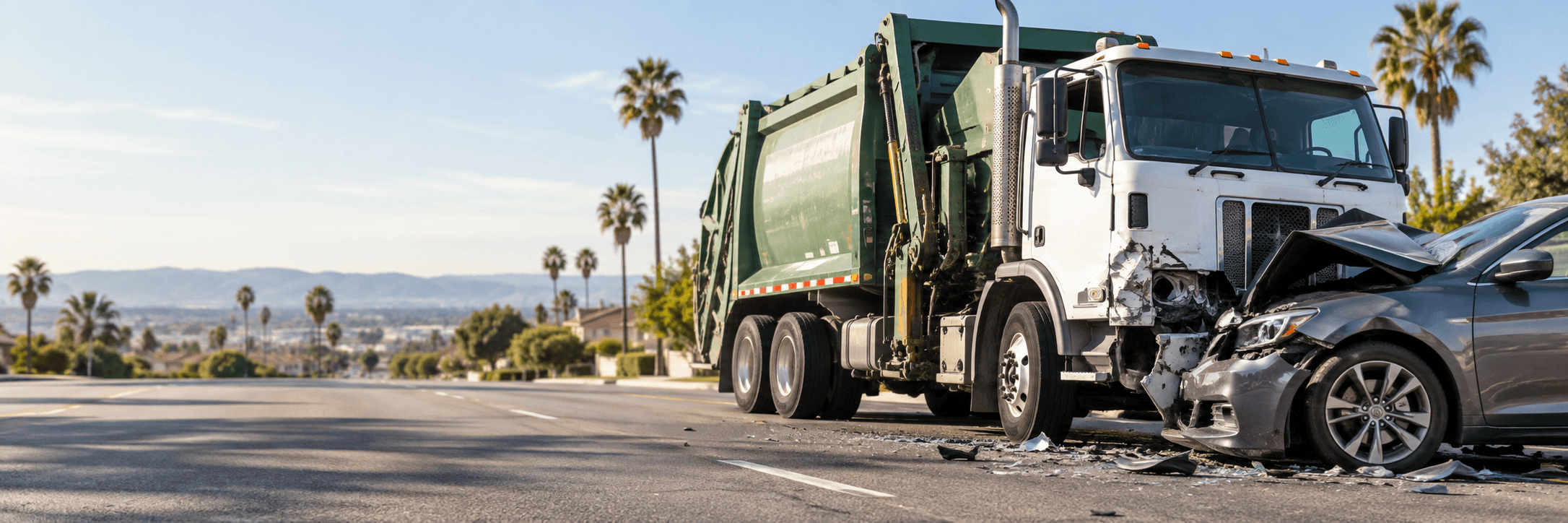
Refuse trucks move differently from other traffic. They stop every few yards, pull to the curb and back out, swing mechanical arms over the sidewalk, back into alleys, and make wide right turns, often early in the morning on residential streets shared with pedestrians, cyclists, and commuters. After a crash, a garbage truck accident lawyer first works out which of those movements caused it, because each one leaves different evidence and can point to different responsible parties.
This guide covers the common types of refuse truck crashes, the records modern collection trucks generate, and the operator question and deadlines that shape a California claim.
The first question in a California garbage truck crash is usually whether the truck was operated by a city, county, or district, or by a private hauler. Against a public operator, a written claim generally must be presented within six months under Government Code section 911.2 before any lawsuit. Against a private hauler, an injury lawsuit generally must be filed within two years under Code of Civil Procedure section 335.1. In either case, onboard video and route data can be overwritten, so early preservation requests matter.
Key Takeaways
- Backing, pulling away from the curb, wide right turns, sudden stops, automated arms, and falling debris each leave different evidence.
- Many collection trucks record video, GPS routes, telematics, and arm data, and video is often overwritten on a set schedule.
- Truck markings do not always show whether the operator is public or private, and the deadlines differ sharply.
- Most federal motor carrier rules do not apply to government-operated trucks, but post-accident drug and alcohol testing rules still apply to government drivers who hold a commercial license.
- Until the operator is confirmed, it is safest to treat the six-month government claim deadline as the one that applies.
Common Refuse Truck Crashes and What a Garbage Truck Accident Lawyer Looks For
| Crash type | Common failure | Evidence that usually matters |
|---|---|---|
| Truck backs into a car, pedestrian, or cyclist | Limited rear visibility, no spotter, a backup alarm or camera that was broken or not monitored | Rear and side camera footage, backup alarm condition, the route’s backing procedures |
| Truck pulls away from the curb or a stop | Mirrors not checked, or not checked again, after a pickup | Side camera footage, stop-and-go timing from route data |
| Wide right turn | A car or cyclist trapped between the truck and the curb | Turn path, mirror and camera coverage, scene measurements |
| Rear-end collision during collection | Sudden stops, warning lights not working, poor lane position | Whether warning lights worked, the truck’s position, witness accounts |
| Automated arm or bin strikes a person or vehicle | Arm operated without a clear area, or equipment malfunction | Arm control and sensor data, hydraulic and control system maintenance records |
| Debris or a container falls from the truck | Load not contained, hopper or lid not secured | Photos of the debris, loading procedures, inspection records |
Many crashes combine more than one of these. A truck that pulls away from a stop and turns right in one movement is a common example.
The Records Collection Trucks Generate
Many newer refuse trucks carry equipment that records what happens on a route:
- Multi-camera video systems
- GPS route tracking and stop-by-stop service logs
- Telematics showing speed and braking
- Data from automated arms and their sensors
Operators also keep driver training and safety files, pre-trip inspection reports, and maintenance records for brakes, hydraulics, cameras, and alarms. Video systems commonly record over older footage after a set period, so a lawyer will usually send a written preservation request as soon as possible, covering the truck involved and, where relevant, other trucks on nearby routes. Doorbell and security cameras along the route may also have captured the crash, and that footage is often overwritten quickly too.
Public or Private Operator: Why a Garbage Truck Accident Lawyer Asks First
In California, trash collection is handled in some places by a city, county, or district sanitation department and in others by a private hauler under a franchise agreement with the city. The markings on the truck do not always make clear which one it is, and the answer changes the rules and the deadline.
| Public operator | Private hauler | |
|---|---|---|
| Basis of responsibility | Vehicle Code section 17001 makes a public entity liable for an employee’s negligent driving within the scope of employment | The company is generally responsible for the drivers it employs while they are working |
| First deadline | Written claim to the agency, generally within six months (Gov. Code § 911.2) | Lawsuit generally within two years (Code Civ. Proc. § 335.1) |
| Insurance | The agency’s own coverage or self-insurance | The hauler’s policies, and the franchise agreement may require specific coverage |
Federal rules. Under 49 C.F.R. section 390.3(f)(2), most of the Federal Motor Carrier Safety Regulations do not apply to transportation performed by a state or any of its political subdivisions. For a city or county truck, the rules on hours of service and driver qualification files that govern long-haul trucks may not apply, and the operator’s own policies, California law, and general negligence principles usually fill the gap.
There is an important exception. Under 49 C.F.R. section 382.103(c), that government exemption does not apply to the federal drug and alcohol testing rules. A government employer whose driver must hold a commercial driver’s license is still subject to the post-accident testing requirements in section 382.303. After a qualifying crash, those records are worth requesting. For how those rules work, see what a truck accident lawyer does.
If a City or County Truck Was Involved
Claims against a public entity follow a set sequence under the Government Claims Act:
- The claim. A written claim relating to injury generally must be presented within six months (Gov. Code § 911.2).
- The agency’s response. The agency’s board generally has 45 days to act on the claim, and that period can be extended by written agreement (Gov. Code § 912.4). If the board does not act in time, the claim is deemed rejected.
- The lawsuit, after a written rejection. If the agency gives written notice of rejection under section 913, suit generally must be filed within six months of the date the notice was personally delivered or deposited in the mail (Gov. Code § 945.6(a)(1)).
- The lawsuit, without written notice. If no written notice is given in accordance with section 913, suit generally must be filed within two years from when the claim arose (Gov. Code § 945.6(a)(2)).
If the six-month claim deadline was missed, Government Code section 911.4 allows a written application for leave to present a late claim, generally within one year. It has its own requirements, and the agency can deny it. Because the operator is often unclear at first, a lawyer will usually treat the six-month claim deadline as the one that applies until the operator is confirmed. For other city, county, or fleet vehicles, see company vehicle accidents.
Pedestrians and Cyclists on Collection Day
Bins at the curb push pedestrians into the street, and cyclists share the lane with a truck that stops and starts without warning. A pedestrian struck by a backing truck or a cyclist caught in a right turn are among the most serious refuse truck cases. See our pages on pedestrian accidents and bicycle accidents.
Other Parties Who May Be Responsible
Beyond the driver and the operator, responsibility can extend to a staffing agency that supplied the driver, a contractor that maintained the brakes, hydraulics, or cameras, or the manufacturer of the truck body, arm, camera, or alarm when equipment failed; see auto defect claims. Under California’s pure comparative fault rule, a share of fault assigned to the injured person reduces the recovery but does not bar it, and Civil Code section 1431.2 generally limits each defendant’s liability for non-economic damages to its own share of fault. For how each party’s role is established, see six people or entities often found responsible in a truck accident.
What to Do After a Refuse Truck Collision
- Photograph the truck, including any company name, city seal, unit or truck number, and license plate.
- Note the exact location, the time, and which way the truck was moving.
- Get the police report number and witness contact information, and look for home or business cameras nearby.
- Get medical care promptly and keep follow-up appointments.
- Do not wait to learn whether the operator is public. Treat the six-month claim deadline as the one that applies until you know.
Talk With a Garbage Truck Accident Lawyer at Vaksman Khalfin
Vaksman Khalfin, PC can help identify who operated the truck, request video and route data, and track the deadline that applies. The first conversation is free and can take place by video or at our San Mateo office. Injury matters are handled on contingency under a written agreement that states the fee percentage and explains case costs separately. Call (650) 250-0705, visit our San Mateo office page, or see our California truck accident page.
This page provides general information about California law and is not legal advice. Reading it or contacting the firm does not create an attorney-client relationship. Every case is different, and prior results do not guarantee a similar outcome.
Reviewed by Alan D. Khalfin, Partner and Managing Attorney, Vaksman Khalfin, PC (admitted in California). Last reviewed: 10/20/2026
Frequently Asked Questions
Usually, works out whether the truck was operated by a public agency or a private hauler, because that decides the deadline, and sends written preservation requests for video, GPS, and maintenance records.
Common causes include backing without a clear view, pulling away from the curb, wide right turns, sudden stops, automated arm strikes, and debris or containers falling from the truck.
Many newer refuse trucks have multi-camera systems, GPS, and telematics. Footage is commonly recorded over after a set period, so it should be requested quickly.
A written claim generally must be presented to the agency within six months. After a written rejection, suit generally must be filed within six months of the notice. If no proper written notice is given, the period is generally two years from when the claim arose.
An injury lawsuit generally must be filed within two years, and the company is generally responsible for the drivers it employs while they are working.
For city or county trucks, most federal motor carrier rules do not apply. The federal post-accident drug and alcohol testing rules still apply to government drivers who must hold a commercial driver's license. For private haulers, it depends on the truck and the operation.
